
Orthodontic treatment has come a long way from bulky metal braces and painful adjustments. Today, many patients seeking straighter teeth want a solution that fits seamlessly into their lifestyle both aesthetically and practically. Invisalign has emerged as one of the most popular alternatives to traditional braces, promising discreet treatment, improved comfort and flexibility.
But is Invisalign really the best option for everyone?
In this in-depth guide, we’ll explore the Invisalign pros and cons, compare Invisalign vs braces, and help you decide if Invisalign is worth it for your dental needs, lifestyle and budget.
⊡ Introduction to Invisalign
Invisalign is an advanced orthodontic treatment that uses a series of clear, removable aligners to gradually straighten teeth. These aligners are custom-made using 3D imaging technology and are designed to move teeth into proper alignment over time.
Unlike traditional metal braces, Invisalign aligners are made from smooth, BPA-free plastic and are nearly invisible when worn. Patients typically switch to a new set of aligners every one to two weeks, with each set applying gentle pressure to guide teeth into the desired position.
Invisalign is commonly used to treat-
- Crooked or misaligned teeth
- Overcrowding
- Gaps between teeth
- Mild to moderate overbites, underbites, and crossbites
While Invisalign has revolutionised orthodontic care, understanding both its advantages and limitations is essential before committing to treatment.
⊡ Pros of Invisalign
Invisalign has become a preferred orthodontic solution for teens and adults seeking a modern, discreet way to straighten their teeth. Unlike traditional braces, Invisalign uses clear, removable aligners that gradually shift teeth into proper alignment. These aligners are custom-made, comfortable to wear and designed to fit seamlessly into daily life. When evaluating Invisalign pros and cons, many patients find that the advantages especially aesthetics, comfort and convenience make it a highly appealing alternative to metal braces.
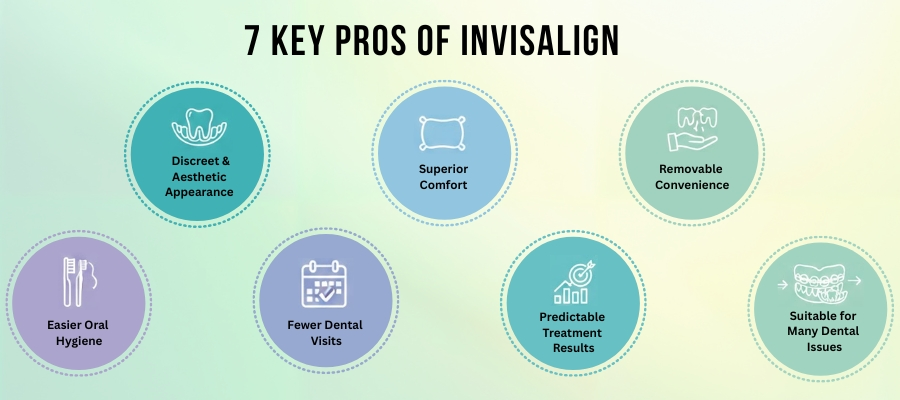
7 Key Pros of Invisalign
✓ Discreet Aesthetic Appearance</strong
Invisalign aligners are made from clear, transparent material, making them nearly invisible when worn. This allows patients to straighten their teeth without drawing attention to their treatment. It’s especially popular among professionals, teens and adults who value confidence in social and work settings.
✓ Superior Comfort
Unlike metal braces, Invisalign has no sharp brackets or wires. The smooth, custom-fitted aligners reduce irritation to gums, cheeks and lips. Most patients experience less pain and discomfort compared to traditional orthodontic methods.
✓ Removable Convenience
Invisalign aligners can be removed while eating, drinking, or attending special occasions. There are no food restrictions and patients can enjoy their favorite meals without worry. This flexibility is a major advantage when comparing Invisalign vs braces.
✓ Easier Oral Hygiene
Because aligners are removable, brushing and flossing remain simple and effective. There’s no need to clean around wires or brackets, reducing the risk of plaque buildup, cavities and gum disease during treatment.
✓ Fewer Dental Visits
Invisalign treatment usually requires fewer in-office appointments than traditional braces. Patients receive multiple aligner sets in advance and switch them at home, saving time and reducing disruption to busy schedules.
✓ Predictable Treatment Results
Advanced 3D imaging technology allows patients to see a digital preview of their smile transformation before treatment begins. This predictability helps patients understand timelines and expected outcomes, making Invisalign worth it for many.
✓ Suitable for Many Dental Issues
Invisalign can effectively treat a wide range of orthodontic problems, including mild to moderate crowding, spacing, overbites, underbites and crossbites. For many cases, it offers results comparable to braces without the visual drawbacks.
⊡ Cons of Invisalign
Although Invisalign is a modern and popular orthodontic solution, it may not be the ideal choice for everyone. Like any dental treatment, it comes with certain limitations related to cost, commitment and clinical suitability. Understanding these drawbacks is essential when evaluating Invisalign pros and cons and deciding whether this treatment aligns with your dental needs, lifestyle and budget.
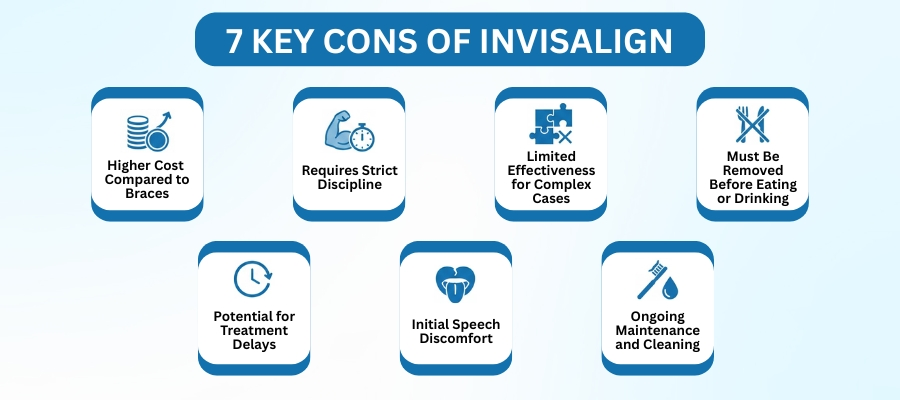
7 Key Cons of Invisalign
✓ Higher Cost Compared to Braces
Invisalign treatment is often more expensive than traditional metal braces. The use of advanced 3D imaging, digital treatment planning and custom-made aligners adds to the overall cost. While some insurance plans offer partial coverage, many patients still face higher out-of-pocket expenses.
✓ Requires Strict Discipline
For Invisalign to be effective, aligners must be worn for 20–22 hours every day. Frequently removing them or forgetting to wear them can slow progress and affect final results. This makes Invisalign less suitable for individuals who struggle with consistency or adherence to daily routines.
✓ Limited Effectiveness for Complex Cases
Invisalign works best for mild to moderate orthodontic issues. Severe bite problems, major jaw misalignment, or complex tooth rotations may not respond well to aligners alone. In such cases, traditional braces or surgical orthodontic treatments may be more effective.
✓ Must Be Removed Before Eating or Drinking
Aligners need to be taken out before meals and beverages (except water). This can be inconvenient, especially when eating out or attending social events. Frequent removal also increases the risk of losing or damaging the aligners.
✓ Potential for Treatment Delays
If aligners are not worn as prescribed, treatment timelines can extend beyond expectations. Lost or broken aligners may require replacements, adding time and sometimes additional cost to the overall treatment plan.
✓ Initial Speech Discomfort
Some patients experience a temporary lisp or speech difficulty when first wearing Invisalign. While this usually resolves as the mouth adjusts, it can be uncomfortable for professionals who rely heavily on clear speech, such as presenters or teachers.
✓ Ongoing Maintenance and Cleaning
Invisalign aligners require regular cleaning to prevent odor, staining and bacterial buildup. Poor maintenance can affect oral hygiene and the appearance of the aligners. This added responsibility may feel burdensome for some patients.
⊡ Invisalign vs Braces
Understanding the differences between Invisalign and traditional braces can help you make an informed decision.
Comparative Effectiveness
Both Invisalign and braces are effective orthodontic treatments when used appropriately. However, their effectiveness depends largely on the complexity of the case and patient compliance.
Invisalign effectiveness-
- Ideal for mild to moderate alignment issues
- Relies on patient wearing aligners consistently
- Uses advanced digital planning for precision
Braces effectiveness-
- Suitable for mild to severe orthodontic problems
- Fixed appliances ensure continuous treatment
- Often preferred for complex bite corrections
When comparing Invisalign vs braces, braces generally offer more control for orthodontists in complex cases, while Invisalign excels in convenience and aesthetics.
⊡ Overall Treatment Experience
The overall treatment experience differs significantly between Invisalign and braces.
Invisalign experience-
- Fewer in-office visits
- Less discomfort during adjustments
- No dietary restrictions
- More flexibility in daily life
Braces experience-
- Regular tightening appointments
- Dietary restrictions to avoid damaging brackets
- More visible appearance
- Possible discomfort from wires and brackets
For many adults, Invisalign offers a more lifestyle-friendly approach. However, younger patients or those needing intensive correction may benefit more from traditional braces.
⊡ Is Invisalign Worth It?
The question most patients ultimately ask is- Is Invisalign worth it?
The answer depends on several factors, including your dental needs, lifestyle, budget and commitment level.
Invisalign may be worth it if-
- You value discretion and aesthetics
- You have mild to moderate alignment issues
- You can commit to wearing aligners consistently
- You want greater comfort and convenience
- You prioritise easy oral hygiene
On the other hand, Invisalign may not be ideal if-
- You have severe orthodontic issues
- You struggle with compliance
- Cost is a major concern
- You prefer a fixed, maintenance-free option
Weighing the Invisalign pros and cons carefully with your orthodontist is essential to making the right decision.
⊡ Additional Factors to Consider Before Choosing Invisalign
Treatment Duration
Invisalign treatment time is comparable to braces for many cases, typically ranging from 12 to 24 months. Some mild cases may even be completed sooner.
However, inconsistent wear can extend treatment time, making patient discipline critical to success.
Lifestyle and Eating Habits
Because aligners must be removed before eating, frequent snacking or sugary drinks can become inconvenient. Patients must also brush before reinserting aligners to prevent staining and decay.
For individuals with structured routines, this is manageable but for others, it may feel restrictive.
Follow-Up and Monitoring
Invisalign often requires fewer in-office visits than braces, which is especially beneficial for international patients or those with busy schedules.
Some providers also offer virtual monitoring, further enhancing convenience.
⊡ Contact MediKaya Healthcare for INVISALIGN Support in India
If you are seeking verified information, private hospital options, treatment cost guidance or international patient support Invisalign in India, our medical coordination team is here to assist you with complete confidentiality and professional care.
MediKaya Healthcare provides end-to-end patient support including hospital selection, doctor consultations, medical visa assistance, treatment coordination and post-treatment follow-up.
📞 WhatsApp & Call: +91 9717998697
📧 Email: info@medikayahealthcare.com
🌐 Website: www.medikayahealthcare.com
Follow us on:
LinkedIn | Instagram | Facebook | Twitter
Our team will respond promptly with verified medical guidance and personalised assistance.