
A liver transplant is not just a medical procedure; it is a life‑saving journey that involves emotional resilience, physical endurance and careful logistical planning. For patients diagnosed with end‑stage liver disease or acute liver failure, transplantation often represents the only definitive treatment option. Families facing this diagnosis frequently confront two major challenges simultaneously, finding the highest quality medical care and managing the significant financial burden associated with liver transplantation.
Over the past decade, India has emerged as one of the most trusted global destinations for liver transplant surgery, offering advanced medical expertise at a fraction of the cost compared to Western countries. Internationally trained transplant surgeons, state‑of‑the‑art hospitals, advanced intensive care facilities and ethical organ transplant practices have positioned India as a preferred choice for patients from Africa, the Middle East, CIS countries and Southeast Asia.
For international patients, however, the challenge goes beyond understanding the cost of liver transplant in India. Navigating hospital selection, surgeon expertise, donor evaluation, legal requirements and post‑transplant care in a foreign country can be overwhelming. Medikaya Healthcare plays a vital role in simplifying this journey by acting as a trusted medical coordinator, ensuring transparency, safety and seamless treatment planning from the first consultation to long‑term recovery.
India’s success in liver transplantation is reflected in its outcomes. Leading transplant centers report survival rates comparable to the best hospitals in the United States and Europe. With expertise in complex procedures such as living‑donor liver transplant, deceased‑donor liver transplant and pediatric liver transplant, India continues to redefine global standards while keeping treatment accessible and affordable.
⊡ Liver Transplant Surgery
A liver transplant is a surgical procedure in which a diseased or failing liver is replaced with a healthy liver from a donor. The donor liver may come from a deceased donor or from a living donor, where a portion of the donor’s liver is transplanted into the recipient. The liver has a unique regenerative capacity, allowing both the donor’s and recipient’s livers to regrow to near‑normal size within weeks.
Liver transplantation is considered the gold‑standard treatment for end‑stage liver disease and certain acute liver conditions. Unlike other treatments that only manage symptoms, a successful liver transplant restores essential liver functions such as detoxification, metabolism, protein synthesis and bile production, significantly improving survival and quality of life.
The procedure requires meticulous planning, precise surgical expertise and lifelong medical follow‑up. Advances in immunosuppressive therapy, surgical techniques and intensive care management have dramatically improved transplant success rates over the years.
⊡ What Is the Medical Necessity for a Liver Transplant?
A liver transplant becomes medically necessary when the liver can no longer perform its vital functions and the damage is irreversible. At this stage, conservative medical treatment is no longer effective and transplantation offers the only chance for survival.
End‑Stage Liver Disease (ESLD)
End‑stage liver disease is the most common indication for liver transplantation. It occurs when chronic liver damage progresses to cirrhosis, leading to permanent scarring and loss of liver function. Patients with ESLD may experience complications such as jaundice, ascites, internal bleeding and hepatic encephalopathy.
Acute Liver Failure
Acute liver failure is a sudden and severe loss of liver function, often occurring in individuals without prior liver disease. Causes may include viral hepatitis, drug‑induced liver injury or toxin exposure. In such cases, emergency liver transplantation is often life‑saving.
Failure of Medical Management
When medications, lifestyle changes and interventional treatments fail to control liver disease progression or its complications, transplantation becomes medically necessary. Persistent symptoms despite optimal care signal irreversible liver damage.
Irreversible Liver Conditions
Conditions such as alcoholic liver disease, non‑alcoholic fatty liver disease (NASH), hepatitis B or C‑related cirrhosis, autoimmune hepatitis, biliary atresia and genetic metabolic disorders often lead to irreversible liver failure requiring transplantation.
Survival and Quality‑of‑Life Benefit
Medical necessity is also defined by the survival advantage offered by transplantation. Liver transplant recipients generally experience significantly longer survival, improved physical capacity and restored independence compared to patients receiving only supportive care.
⊡ Types of Liver Transplant
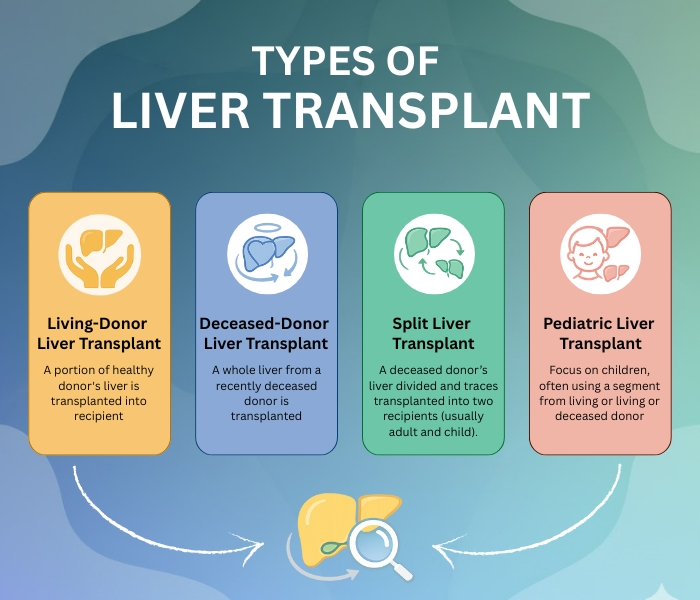
Liver transplantation is a life-saving surgical procedure performed when the liver can no longer function adequately due to chronic disease, acute liver failure, or genetic conditions. The type of liver transplant recommended depends on several factors, including the patient’s medical condition, age, urgency of treatment, availability of donors, and overall suitability for surgery. In India, liver transplantation programs have advanced significantly, offering multiple transplant options with high success rates. The major types of liver transplant include:
☑ Living-Donor Liver Transplant (LDLT)
In a living-donor liver transplant, a healthy person donates a portion of their liver to the recipient. This donor is most often a close blood relative or a legally approved family member, which helps ensure better tissue compatibility and reduces the risk of rejection. One of the biggest advantages of LDLT is that the transplant can be planned in advance, avoiding long waiting periods and reducing the risk of disease progression while waiting for an organ.
The liver has a unique ability to regenerate, allowing both the donor’s remaining liver and the transplanted portion in the recipient to grow back to near-normal size within a few months. Due to the limited availability of deceased-donor organs in India, LDLT is the most commonly performed type of liver transplant and has shown excellent long-term outcomes for both donors and recipients.
☑ Deceased-Donor Liver Transplant (DDLT)
A deceased-donor liver transplant involves transplanting a liver obtained from a brain-dead donor whose family has consented to organ donation. Organ allocation is carried out based on strict national transplant guidelines, taking into account factors such as medical urgency, blood group compatibility, severity of liver disease (often measured by MELD score), and waiting time on the transplant list.
DDLT is a vital option for patients who do not have a suitable living donor or are too critically ill to wait for a planned transplant. Although waiting times can vary depending on organ availability and region, this type of transplant plays a crucial role in saving lives and promoting ethical organ donation practices in India.
☑ Split Liver Transplant
A split liver transplant is a specialized procedure in which a single deceased-donor liver is divided into two separate portions and transplanted into two different recipients. Typically, one portion is transplanted into an adult, while the smaller segment is used for a pediatric patient. This technique helps maximize the use of available donor organs and increases the number of transplants that can be performed.
Split liver transplantation requires advanced surgical expertise and careful donor and recipient selection. When performed at experienced transplant centers, it offers outcomes comparable to whole-liver transplants and is particularly beneficial in addressing organ shortages.
☑ Pediatric Liver Transplant
Pediatric liver transplantation is performed for infants and children suffering from congenital, metabolic, or acquired liver diseases such as biliary atresia, acute liver failure, or genetic liver disorders. These procedures require specialized surgical skills, child-specific anesthesia, and long-term multidisciplinary care.
India has several well-established transplant centers with dedicated pediatric liver transplant programs, offering high success rates and improved quality of life for affected children. Early diagnosis, timely referral, and expert post-transplant care are key factors in achieving favorable outcomes in pediatric liver transplantation.
⊡ Liver Transplant Cost in India
The liver transplant cost in India is one of the primary reasons international patients choose the country for treatment. Compared to Western nations, India offers the same level of medical expertise at significantly reduced costs.
Average Cost of Liver Transplant in India
The cost of liver transplant in India typically ranges between USD 30,000 to USD 45,000, depending on multiple factors. In contrast, the same procedure can cost USD 300,000 to USD 500,000 in the United States or Europe.
Factors Affecting Liver Transplant Cost in India
- Type of transplant (living donor or deceased donor)
- Hospital infrastructure and location
- Surgeon’s expertise and experience
- Pre‑transplant evaluation and investigations
- Donor evaluation and surgery costs (in living donor cases)
- ICU stay duration and post‑operative care
- Cost of immunosuppressive medications
- Management of complications, if any
Despite variations, India remains one of the most cost‑effective destinations for liver transplant surgery without compromising on safety or outcomes.
⊡ Risks of Liver Transplant Surgery
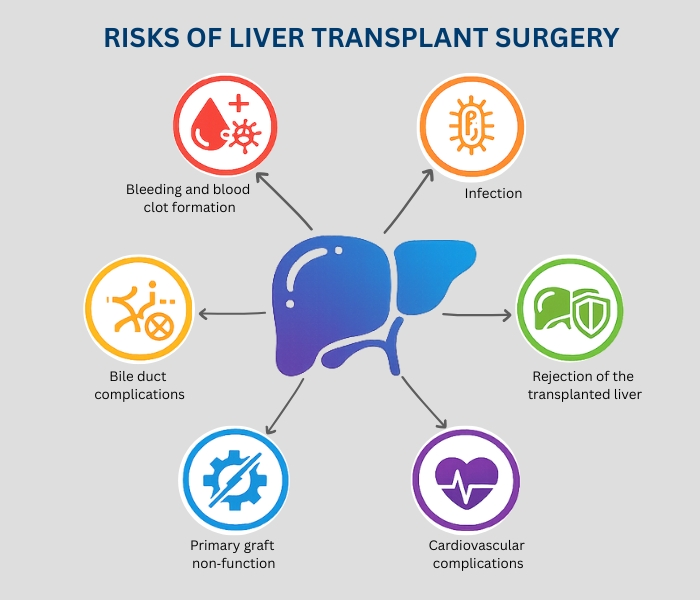
Like any major surgery, liver transplantation carries certain risks, including:
- Bleeding and blood clot formation
- Infection
- Bile duct complications
- Rejection of the transplanted liver
- Primary graft non‑function
- Cardiovascular complications
Long‑term immunosuppressive therapy may lead to-
- Increased infection risk
- High blood pressure and diabetes
- Kidney dysfunction
- Increased cancer risk
Despite these risks, liver transplantation offers a significantly higher survival rate compared to non‑transplant management in advanced liver disease.
⊡ Liver Transplant Procedure- An Overview
Liver transplant surgery is performed under general anaesthesia and may last 8 to 12 hours. A multidisciplinary team of transplant surgeons, anaesthetists and critical care specialists closely monitor the patient throughout the procedure.
Steps of the Surgery
- Removal of the diseased liver
- Implantation of the donor liver or liver segment
- Connection of blood vessels
- Bile duct reconstruction
After surgery, the transplant team monitors patients in a dedicated ICU to detect complications early.
⊡ Eligibility for Liver Transplant
Eligibility is determined through a comprehensive evaluation process. Key criteria include:
- Diagnosis of irreversible liver disease
- Adequate cardiac and pulmonary function
- Absence of active infection or uncontrolled cancer
- Commitment to lifelong follow‑up and medication adherence
- Abstinence from alcohol and substance abuse
Careful selection ensures optimal outcomes and long‑term graft survival.
⊡ Why Choose Medikaya Healthcare for Liver Transplant?
Medikaya Healthcare partners with India’s leading liver transplant hospitals and surgeons to deliver world‑class care at affordable costs. Our network includes Centers of Excellence equipped with advanced operation theatres, transplant ICUs and modern diagnostic facilities.
We provide end‑to‑end support including medical evaluation, hospital selection, cost transparency, visa assistance, travel arrangements, accommodation and post‑transplant follow‑up. With Medikaya Healthcare, international patients receive ethical guidance, personalised care and seamless coordination throughout their liver transplant journey in India.
With Medikaya Healthcare, your liver transplant journey in India is safe, transparent and fully supported from start to recovery!
Facilities & Services
Medikaya Healthcare provides comprehensive, end-to-end support for international patients traveling to India for kidney transplant surgery. We understand that crossing borders for a life-saving procedure can be overwhelming, which is why our services are designed to ensure medical safety, logistical ease and complete peace of mind.
- Free medical case review and kidney transplant eligibility assessment
- Assistance in selecting the most suitable kidney transplant hospital and transplant surgeon in India
- Detailed and transparent kidney transplant treatment plan with cost estimates
- Medical visa invitation letter and documentation support for patients and donors
- Airport pickup, drop and coordinated local transportation
- Hotel or serviced apartment arrangements close to transplant hospitals
- Dedicated international patient coordinator throughout the treatment journey
- Scheduling of pre-transplant evaluations, donor tests and surgical appointments
- Coordination during hospital admission, surgery and post-transplant ICU care
- Language interpretation and cultural support for non-English-speaking patients
- Assistance with post-transplant medications and discharge planning
- Follow-up care coordination and teleconsultation support after returning home
- Support for accompanying family members or caregivers
Through Medikaya Healthcare, international kidney transplant patients receive personalised care, ethical guidance and seamless coordination, allowing them to focus entirely on recovery while we manage every aspect of their medical journey in India.
⊡ Contact Medikaya Healthcare for LIVER TRANSPLANT SUREGERY in India
If you are seeking verified information, private hospital options, treatment cost guidance or international patient support for Liver transplant surgery in India, our medical coordination team is here to assist you with complete confidentiality and professional care.
MedikayaHealthcare provides end-to-end patient support including hospital selection, doctor consultations, medical visa assistance, treatment coordination and post-treatment follow-up.
📞 WhatsApp & Call: +91 9717998697
📧 Email: info@medikayahealthcare.com
🌐 Website: www.medikayahealthcare.com
Follow us on:
LinkedIn | Instagram | Facebook | Twitter
Our team will respond promptly with verified medical guidance and personalised assistance.