
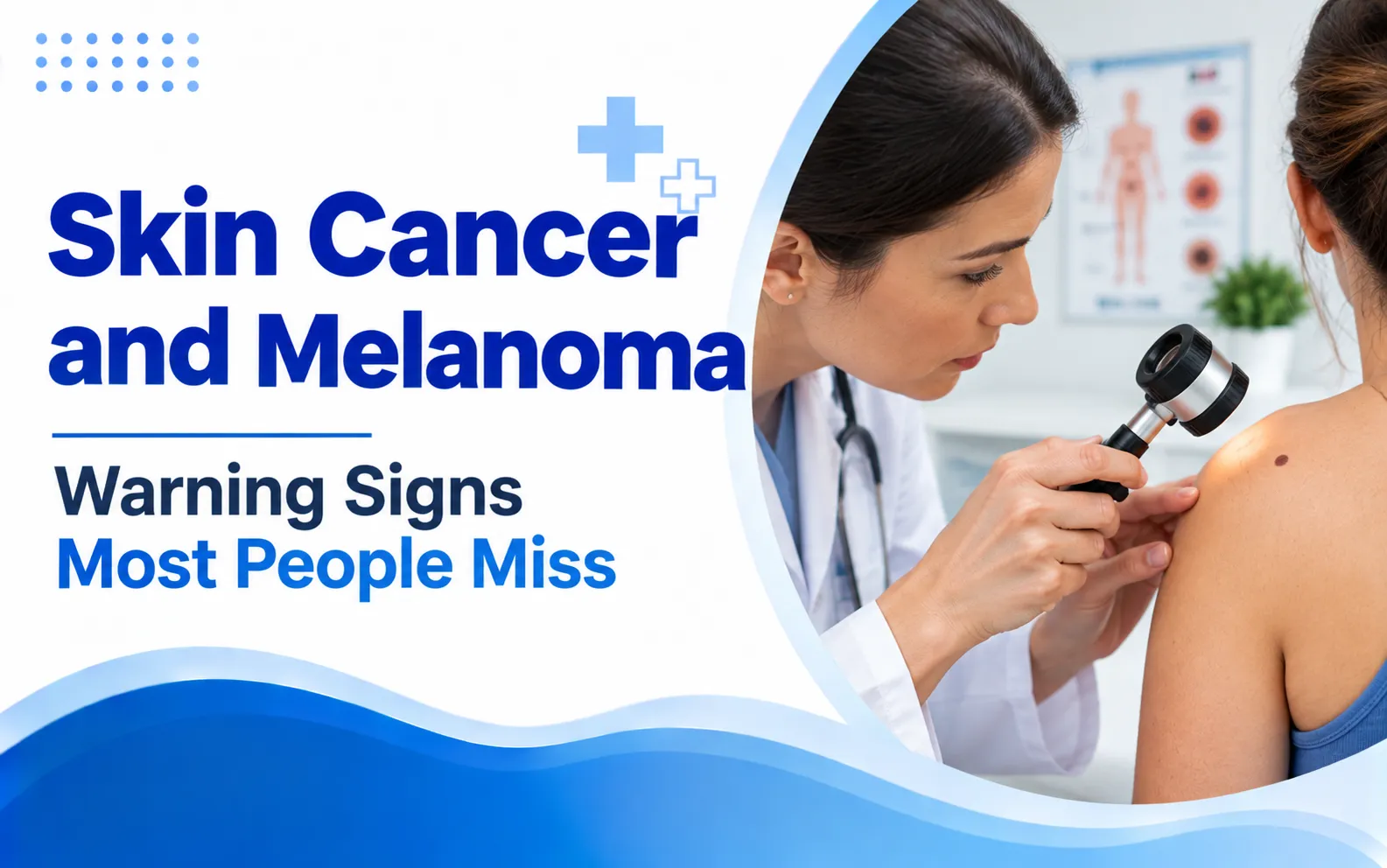
Skin cancer, including melanoma, is highly treatable when caught early, but early skin cancer warning signs are often mistaken for an ordinary mole or age spot, delaying the evaluation that would catch it at its most treatable stage. This guide covers the specific warning signs worth learning, distinguishes melanoma from the other, more common but generally less dangerous types of skin cancer, and explains why recognizing these signs early is the single biggest factor in a good outcome.
Understanding the Different Types of Skin Cancer
Basal cell carcinoma is the most common form of skin cancer, typically appearing as a pearly or waxy bump, often on sun-exposed areas, and while it rarely spreads to other parts of the body, it can grow locally and cause significant tissue damage if left untreated for a long period. Squamous cell carcinoma often appears as a firm, red nodule or a flat lesion with a scaly, crusted surface and carries a somewhat higher risk of spreading than basal cell carcinoma, though still generally lower than melanoma.
Melanoma, while less common than the other two types, is responsible for the significant majority of skin cancer deaths precisely because of its greater tendency to spread to other organs if not caught early which is exactly why melanoma-specific warning signs deserve particular attention even though it’s a less frequently diagnosed type overall.
The ABCDE Rule for Checking Moles
Dermatologists use the ABCDE framework to flag concerning moles: Asymmetry (one half doesn’t match the other), Border irregularity (uneven, notched, or blurred edges), Color variation (multiple shades of brown, black, red, or blue within one mole), Diameter greater than 6mm (roughly a pencil eraser), and Evolving (any change in size, shape, color, or symptoms like itching or bleeding over time, which is often considered the single most important feature of this framework).
Any single feature alone doesn’t confirm cancer, but a mole showing several of these features — or one that’s actively changing — is worth a dermatologist’s evaluation rather than continued watching, since the ‘evolving’ criterion specifically captures the pattern of change that a static photo or one-time exam alone would miss.
Signs That Are Easy to Miss
Melanoma doesn’t always start as a new mole — sometimes it develops within an existing one that has been present for years, which is exactly why ‘it’s always been there’ isn’t reassurance on its own if it’s recently started changing in any noticeable way. Less commonly recognized warning signs include a dark streak under a fingernail (which can indicate a specific, less common melanoma subtype), a sore that doesn’t heal, or a new pigmented area on the sole of the foot or palm — locations people rarely check and that are sometimes overlooked even during a general skin self-exam.
Fair skin, significant sun exposure history, and family history of melanoma all increase baseline risk, but melanoma can occur in anyone, including people with darker skin, often in less sun-exposed areas like the palms, soles, or under nails — a pattern that’s led to later diagnosis in some populations specifically because it doesn’t fit the commonly assumed ‘sun-exposed skin’ risk profile.
Performing a Thorough Skin Self-Examination
A comprehensive self-examination includes checking areas people commonly overlook — between toes, the soles of feet, the scalp (using a mirror or asking a partner for help), behind ears, and under nails — not just the more visible, sun-exposed areas that naturally draw attention first. Taking photos of any moles of concern and comparing them every few months provides a more objective way to track subtle changes than relying on memory alone.
For patients with many moles, a history of significant sun exposure, or a family history of melanoma, an annual full-body skin check by a dermatologist using dermoscopy — a specialized magnified examination tool — adds a level of scrutiny and expertise beyond what self-examination alone can provide.
Why Early Detection Changes Everything
When melanoma is caught while still confined to the skin’s surface layer, surgical removal alone often achieves excellent long-term outcomes, with cure rates considered very high for this earliest stage. Once it has spread deeper into the skin or to lymph nodes, treatment becomes considerably more complex, potentially involving a sentinel lymph node biopsy (checking the first lymph node the cancer would likely spread to) alongside immunotherapy or targeted therapy in addition to surgery.
This dramatic difference in treatment complexity and outcome between early and later-stage diagnosis is the single strongest argument for taking any changing mole seriously and seeking evaluation promptly, rather than adopting a ‘wait and see’ approach for a lesion that’s actively evolving.
Getting a Thorough Evaluation Without Delay
MediKaya connects international patients with dermatology and oncology specialists for skin cancer evaluation, including dermoscopy and biopsy where indicated, without the wait times common in many home healthcare systems for a specialist skin cancer evaluation — a genuinely important consideration given how much outcome depends on catching the disease at its earliest, most treatable stage.
For patients with a confirmed melanoma diagnosis, MediKaya’s oncology partners provide staging evaluation and a complete treatment plan, whether that involves surgical excision alone for early-stage disease or a more comprehensive multi-modality approach for more advanced presentations.
Reducing Risk Going Forward
While past sun exposure can’t be undone, ongoing sun protection — broad-spectrum sunscreen, protective clothing, and avoiding peak UV hours — meaningfully reduces the risk of new skin cancers developing, particularly important for patients who’ve already had one skin cancer diagnosis, since this history increases the likelihood of developing additional lesions over time.
Regular self-examination combined with periodic professional skin checks, rather than either approach alone, provides the most reliable ongoing monitoring strategy for patients at elevated risk, allowing new or changing lesions to be caught and evaluated promptly rather than accumulating unnoticed between infrequent check-ups.
Frequently Asked Questions
Does every irregular mole mean skin cancer?
No — many moles are naturally irregular without being cancerous. The ABCDE features are meant to flag when a professional evaluation is worthwhile, not to self-diagnose cancer.
Can melanoma occur on skin that’s rarely exposed to the sun?
Yes — while sun-exposed areas are more common sites, melanoma can occur on the soles of feet, palms, under nails, or even inside the mouth, particularly in people with darker skin tones.
How is melanoma diagnosed?
Typically through dermoscopy (a specialized magnified skin examination) followed by a biopsy of any suspicious lesion to confirm diagnosis and determine depth, which guides treatment planning.
What does early-stage melanoma treatment usually involve?
Surgical excision with a margin of healthy tissue is often sufficient for early-stage melanoma; a sentinel lymph node biopsy may also be recommended depending on the lesion’s characteristics.
What’s the difference between basal cell carcinoma, squamous cell carcinoma, and melanoma?
Basal cell and squamous cell carcinoma are more common and rarely spread to other organs; melanoma is less common but carries a significantly higher risk of spreading if not caught early.
How often should someone with many moles get a professional skin check?
An annual full-body skin examination by a dermatologist using dermoscopy is generally recommended for patients with many moles, significant sun exposure history, or a family history of melanoma.
КРАТКО НА РУССКОМ
Меланома часто маскируется под обычную родинку, поэтому важно знать признаки ABCDE: асимметрия, неровные края, изменение цвета, диаметр более 6 мм и любые изменения родинки со временем — последний признак считается наиболее важным. Меланома может появляться и на редко подвергающихся солнцу участках — ладонях, стопах, под ногтями. Базальноклеточный и плоскоклеточный рак кожи встречаются чаще, но реже распространяются на другие органы, в отличие от меланомы. Раннее обнаружение значительно упрощает лечение и повышает шансы на полное выздоровление. MediKaya Healthcare организует дерматологическое и онкологическое обследование, включая дерматоскопию и биопsию, для пациентов из СНГ без длительного ожидания.
Noticed a changing mole or unusual skin spot? Get a free dermatology evaluation before it becomes urgent.