
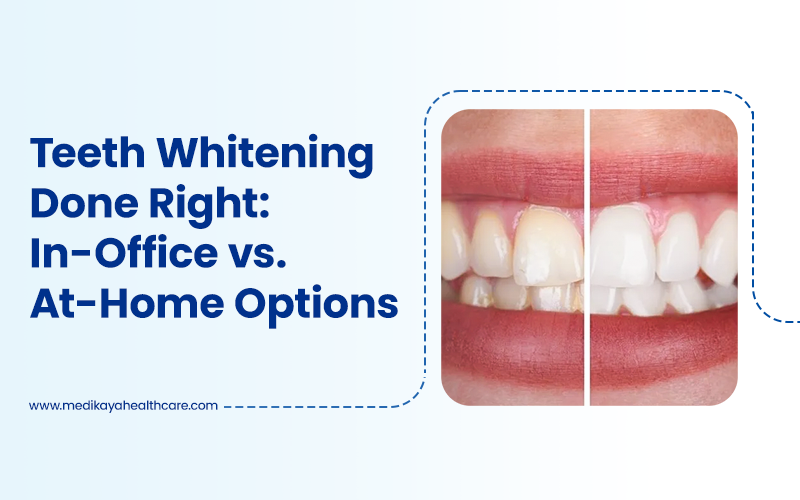
Teeth whitening is one of the cosmetic dental treatments but not every way works for every person. Here is how the choices compare what they can and cannot fix and why seeing a dentist should be first.
Teeth can become darker. Develop stains as time passes because of food, drinks, tobacco, aging, and certain medicines. I have seen how whitening products use peroxide-based agents to lighten the color of teeth. Whitening products are widely available. Not all whitening products are the same, and the right whitening product depends on the cause of the discoloration and the health of your teeth and gums.
Ask your dentist which approach the dentist recommends for you and why because your comfort matters. The best option is the one that fits your teeth, your sensitivity, and your expectations.
Teeth Whitening Options: In-office vs. at-home
| In-office whitening | Dentist-supplied at-home kit | Over-the-counter products | |
|---|---|---|---|
| What it is | Whitening done in the dental chair, with the gums protected | Custom-fitted trays and a whitening gel you use at home as directed | Strips, gels, pens, and whitening toothpastes |
| Strength | Generally the strongest, applied by a professional | Usually moderate, used over a period | Generally the mildest |
| Supervision | Full professional supervision | Initial supervision, then self-applied | Self-directed |
| Best for | Wanting a faster change under supervision | Gradual, controlled whitening that suits your schedule | Mild surface staining and maintenance |
| Watch for | Tooth sensitivity and gum irritation | Overuse or a poorly fitting tray | Uneven results; misuse |
Ask your dentist which approach they recommend for you and why. The best option is the one that fits your teeth, your sensitivity, and your expectations.
What whitening can and cannot do
- The product can lighten stains from food, drinks, and tobacco. Can also lighten the general yellowing that comes with age.
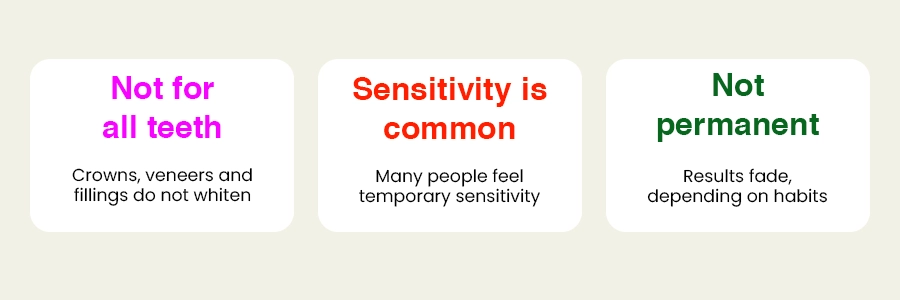
- It might not work well on stains caused by certain medicines or from an injury or from issues that happen inside the tooth. Other choices, like veneers could be talked about.
- It cannot change the color of crowns, veneers, bridges or fillings. This can lead to results if the natural teeth are lightened.
- It cannot treat decay or gum disease. Decay and gum disease should be treated first.
Side effects and who should be cautious
Tooth sensitivity and mild gum irritation are the common side effects, and they usually settle after treatment. If you already have teeth, receding gums, worn enamel cracked or decayed teeth, or if you are pregnant or breastfeeding, let your dentist know because whitening may need to be postponed or adapted, and whitening can be adjusted if necessary.
What to expect at a whitening visit
- Dental examination
The dentist checks for decay, gum problems, and old restorations and may recommend a clean first, since removing surface stains can make a difference by itself.
- Shade and plan
The current shade is recorded, and the approach is chosen, with realistic expectations discussed.
- Treatment
In the office, the gums are protected, and the whitening agent is applied. For at-home kits, you are shown how to use the trays safely.
- Aftercare
You may be advised to avoid strongly colored foods and drinks and tobacco for a period and to use a sensitivity toothpaste if needed.
- Maintenance
Good brushing, regular cleaning, and limiting staining habits help the result last. Top-ups may be suggested.
Questions for your dentist
Bring these to your appointment.
- Is my tooth discoloration suited to whitening?
- Do any of my teeth have crowns, veneers, or fillings that will not change color?
- Which method do you recommend for me, and why?
- How can I reduce sensitivity?
- How long might the result last, and how do I maintain it?
Frequently asked questions
Q: Does whitening damage enamel?
When whitening is used as directed by a professional, whitening is usually safe. Overusing whitening or using it incorrectly can cause sensitivity and irritation. So follow your dentist’s advice about whitening.
Q: How long does whitening last?
It changes for each person. Depends on habits, like smoking, drinking tea, coffee, or red wine. Some people might need maintenance.
Q: Is whitening toothpaste enough?
Whitening toothpastes mainly take away surface stains. They do not make the natural color of teeth much lighter than bleaching does.
Q: Can I whiten if I have braces or aligners?
Talk to your dentist. Orthodontist first because timing is important and the right approach can be different.
Q: Can I discuss options before travelling for dental work?
Yes. Our partner dental specialists can look at your goals during a consultation. There is no obligation. Our partner dental specialists can look at your goals during a consultation. There is no obligation.
Conclusion
Whitening can be a safe way to brighten your smile as long as your teeth and gums are in good condition and you know what to expect. Begin with a visit to the dentist, pick a whitening method that works well and take care of your teeth after the treatment.