
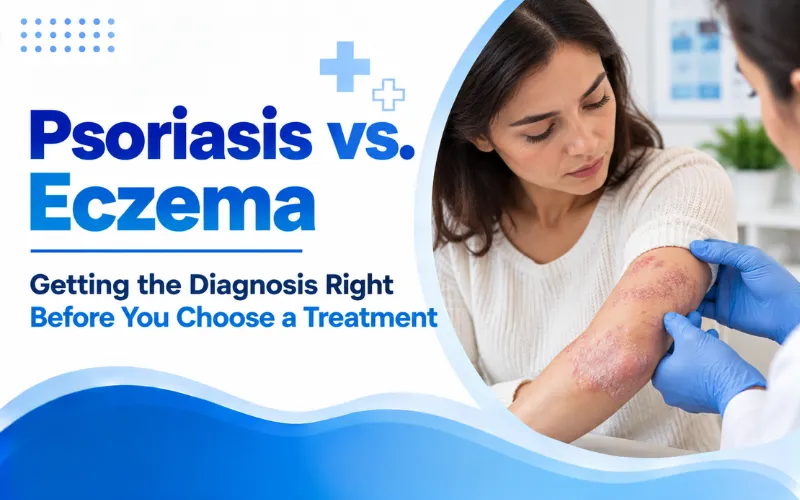
Psoriasis and eczema are highly racial and often itchy skin conditions that many patients are emotionally and medically unhappy to have misdiagnosed. Understanding the psoriasis vs. eczema differences is critical, because patients with either condition usually have insufficient information about the difference between both conditions, which leads to a lack of appropriate care and treatment. In some cases, misdiagnosis leads patients to be treated with methods unrelated to their condition and then leaves patients with an illusory sense of relief while the cause of their condition remains untreated.
Differences Between Psoriasis and Eczema
Psoriasis is a condition that leads to the buildup of keratin, a skin cell, and produces scaly and thickened skin. These plaques are built up in defined borders and are usually found in the knee and elbow regions, as well as the lumbosacral area. These plaques are also found in the scalp region. Eczema (also known as dermatitis) produces irritated and inflamed skin that also leads to the buildup of skin cells. Skin conditions that are associated with eczema are conditions that affect the respiratory system and are also associated with allergies. Eczema is also found in the elbow and knee regions.
Plaques are generally thick and itchy, and eczema generally produces inflamed and weepy skin. Eczema is also generally irritated and itchy and can be flared up by a number of environmental factors.
Psoriasis and eczema are generally confused with one another because both plaque types generally itch. However, plaques related to psoriasis are generally thicker and more defined than eczema plaques.
How to Tell Psoriasis from Eczema: Patterns of Occurrence
If you’re trying to work out how to tell psoriasis from eczema, age of onset and location are two of the clearest clues. Eczema frequently starts in childhood, and improvements frequently occur in adulthood, though it can persist and be lifelong. Eczema is more commonly seen in children with allergies, asthma and hay fever (the atopic triad) and may persist in these children. Psoriasis is not as common in children and may also appear in adults.
Psoriasis may also be more long-lasting and require treatment to help manage the condition. Like other conditions, the appearance of the lesions, the location of the lesions and the age of the patient help dermatologists make a diagnosis.
Eczema vs. Psoriasis Symptoms: Different Causes of Flare-ups
Comparing eczema vs. psoriasis symptoms often comes down to what triggers a flare. While eczema is frequently caused by allergens and irritants (i.e., dry/low humidity, synthetic cloth, harsh soaps and cleansers) and may be worsened by food allergens, psoriasis may be caused by streptococcal infections, skin injury (Koebner phenomenon) and certain medications. Like eczema, psoriasis may also be worsened by infections.
Because psoriasis is an autoimmune condition, it may not always be prudent to target allergens and irritants in order to improve conditions, as it may be directed at the wrong disease mechanism.
The Importance of an Accurate Diagnosis
In both psoriasis and eczema, the underlying defects in the skin’s barrier and inflammation result in skin cells being shed and replacing themselves too quickly. The difference is that in eczema, there is an ongoing inflammatory process, which can be affected by the environment. Effective atopic dermatitis treatment focuses on reducing inflammation, moisturising the skin to enhance the skin barrier, and avoiding contact with allergens and irritants. For psoriasis, treatment focuses on reducing skin cell growth and shedding. This can be done by using topical or oral medications to control the inflammatory process and/or by using phototherapy.
MediKaya’s dermatology partners assess patients and get a biopsy to confirm a diagnosis. This is often critical for international patients to stop the speculative and inappropriate treatment that occurs from patients and/or families assuming they know the diagnosis.
Recognising Related Conditions
The presence of psoriasis increases the risk of developing metabolic syndrome and other cardiovascular conditions. Psoriatic arthritis (joint inflammation and swelling) is also more common in patients with psoriasis. In addition to affecting the skin, eczema is related to the presence of asthma and/or allergic rhinitis (inflammation of the nose). Therefore, patients with eczema should be evaluated to rule out asthma and/or allergic rhinitis.
Because conditions in the same spectrum as psoriasis and eczema can affect the joints and cardiovascular system, skin conditions should not be evaluated in isolation.
Long-Term Condition Management and Psoriasis Treatment in India
Because most reported cases of the conditions of interest have been unable to identify a definitive cure, long-term management concentrates on improving control and symptoms rather than on curative measures. It is recognised that for conditions that are chronic or relapsing in nature, a patient may require management for an extended period. During this time, a management plan may need to be altered to reflect changes in the condition of the patient.
Patients seeking psoriasis treatment in India benefit from this same long-term, dermatologist-guided approach – it is essential that a dermatologist explains the long-term nature of the condition in order to set up realistic goals of control. Such an explanation helps patients accept that conditions may require long-term management and that certain levels of symptoms may persist. More importantly, such information helps patients accept that certain levels of control may require change in treatment.
International Dermatology Evaluation
There are several conditions that may present with similar symptoms and require an in-depth evaluation to determine the root cause. Such evaluations may include taking a detailed account of when the symptoms first started and a description of the symptoms, as well as an examination of affected areas of the body and possibly associated joints. A skin biopsy may also be necessary in some cases.
Because conditions may be similar, and treatment for each varies, it is essential that conditions be diagnosed appropriately and in a timely manner. This is especially true for conditions that are chronic in nature and may require prolonged management.
Our partners in dermatology are clear-thinking doctors. First, they identify the problem. Only then do they determine the most appropriate treatment. That’s why so many patients from around the world come to us for help.
Frequently Asked Questions
Q. Can a person have both psoriasis and eczema?
Most of the time a person will have either psoriasis or eczema. However, some people can have both. Both conditions can be confused with one another. A correct clinical evaluation is always necessary.
Q. Can psoriasis become other conditions?
There are several medical conditions that can occur with psoriasis. These can include arthritis, cardiovascular conditions, and other medical conditions.
Q. Can eczema go away?
Eczema can go away. It can be persistent and chronic. Eczema is known to improve or resolve during adolescence and adulthood. Persistent eczema during adulthood is more common in patients with a history of allergic and/or asthmatic conditions.
Q. How do you confirm the diagnosis of eczema when there is uncertainty?
There are distinctions in the appearance of the lesions of atopic dermatitis and psoriasis. Psoriasis lesions are typically found on the knees, elbows, and scalp. In cases where there is doubt, a skin biopsy will help provide the diagnosis.
Q. What is the Koebner phenomenon?
This phenomenon is when psoriasis is caused by an injury to the skin (for example, injured skin due to a break or sunburn), and new lesions of psoriasis form at that site.
Q. Is eczema related to asthma and allergies?
Yes, they are related. Eczema is also referred to as the ‘itchy triad’ and is related to asthma and allergic rhinitis. Patients who suffer from eczema are at risk of suffering from these conditions as well. Thus, it is recommended that patients undergo screening for these conditions.
Unsure whether it’s psoriasis or eczema? Get a free dermatology evaluation to start the right treatment.