
The liver is the only organ in the body that can regrow itself. As a result, the liver is the only organ that can provide an option for transplant that the kidney or the heart simply does not have. Know when a transplant actually becomes necessary and how a living donor liver transplant works.
No other transplantable organ does this, and it’s the single biggest reason living donor liver transplant is even an option.
For international patients considering liver transplant in India, the topic comes up less often than for kidney transplant, but it works on different biology. That biology is what makes a living donor option possible, and it also changes how a living donor transplant is planned.
Why the liver is different
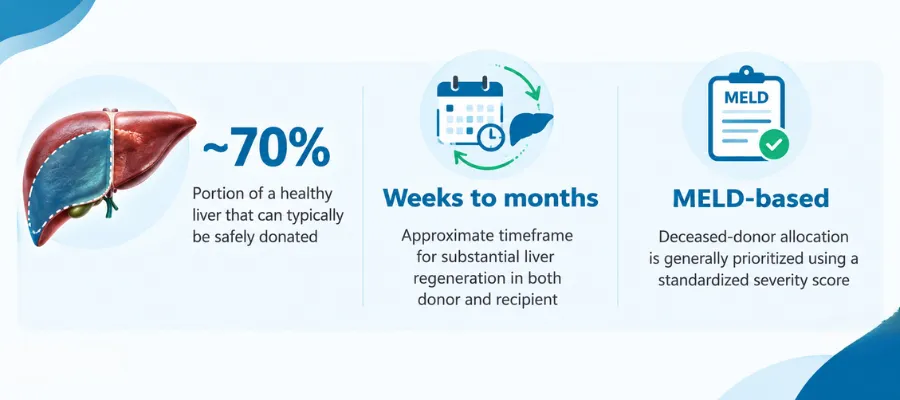
A healthy liver is able to regenerate a good portion of its volume within weeks to a few months after a portion of it is surgically removed. Both the remaining liver of the donor and the transplanted liver of the recipient will grow toward a fuller functional size. This unique regenerative capacity of the liver makes it so a living donor is able to give up a good portion of their liver and return to normal liver function in the vast majority of cases.
When liver transplant is actually considered
Liver transplant is generally evaluated when the liver has reached a point of failure or carries a specific cancer risk that other treatments can no longer adequately address:
- Decompensated cirrhosis: Advanced scarring where the liver can no longer perform its core functions adequately, often marked by complications like fluid buildup (ascites), confusion from toxin buildup (hepatic encephalopathy), or internal bleeding from enlarged veins
- Acute liver failure: A sudden, severe loss of liver function, sometimes from drug toxicity, infection, or other causes, which can progress rapidly and require urgent evaluation
- Certain liver cancers: Primary liver cancer that meets specific size and number criteria (commonly referenced against the “Milan criteria,” a single tumor up to about 5 cm, or up to three tumors each no larger than about 3 cm, with no spread beyond the liver) may be treated with transplant rather than other cancer treatments alone
- Certain genetic and metabolic liver diseases where the underlying condition has caused irreversible liver damage
The underlying cause matters significantly for both eligibility and approach; this is assessed individually by a hepatology or transplant specialist, not from a general checklist.
Living donor vs. deceased donor: the real difference for the liver specifically
| Factor | Living donor liver transplant | Deceased donor liver transplant |
|---|---|---|
| What’s transplanted | A portion of a healthy donor’s liver (commonly the larger lobe for an adult recipient) | The whole liver, or sometimes split between two recipients |
| Donor recovery | The donor’s remaining liver regenerates toward a fuller functional size over weeks to months | Not Applicable |
| Timeline predictability | Can be scheduled once a compatible, willing donor completes evaluation — generally the more predictable pathway for international patients | Depends on waitlist dynamics and organ availability, which are harder to predict and typically prioritize domestic patients |
| Legal requirements in India | Requires documented proof of donor-recipient relationship under India’s transplant legislation | Allocated through the national/regional waitlist system under the same legislation |
What the evaluation and surgery process looks like
A note on this topic
A liver transplant conversation often follows a long period of illness and can bring real uncertainty for the whole family, including whoever is weighing whether to be evaluated as a donor. That’s a significant decision deserving time, honest information, and freedom from pressure, whichever way it’s made.
Questions worth asking during evaluation
- What specifically about my liver condition makes transplant the recommended path, rather than continued medical management?
- Am I, or is my potential donor, a realistic candidate for living-donor transplant specifically?
- What does the donor’s expected recovery and long-term outlook look like?
- What is a realistic timeline from evaluation to surgery for both pathways?
- What does long-term life look like after transplant medication, monitoring, and activity restrictions?
Frequently asked questions
Q: Is it safe to donate part of your liver?
Living liver donation is a major surgery with real risks, which is exactly why thorough, independent donor evaluation exists to confirm a potential donor is healthy enough and fully informed before proceeding. The liver’s regenerative capacity is what makes this option possible at all, but it doesn’t eliminate surgical risk.
Q: How long does it take for the donor’s liver to fully regenerate?
Substantial regeneration typically occurs within the first few weeks to months after donation, though the exact timeline and degree of regrowth vary by individual.
Q: Does the recipient’s new liver portion grow to full size too?
Yes, the transplanted liver portion generally grows toward a fuller functional size in the recipient as well, supporting normal liver function over time.
Q: Can liver transplant treat liver cancer?
For liver cancers that meet specific size and number criteria and haven’t spread beyond the liver, transplant can be an appropriate and effective treatment. This is assessed individually against established criteria by the treating oncology and transplant team.
Q: Can I get a consultation to understand if transplant is the right path?
Yes, our partner transplant and hepatology specialists offer a free, no-obligation consultation to review your specific medical reports and discuss realistic options.
Q: How much does a living donor liver transplant cost in India?
The cost depends on the hospital, the recipient’s condition, the length of ICU and hospital stay, the donor’s evaluation and surgery, and whether complications arise. Because these factors differ for every case, a reliable figure comes from reviewing your medical reports. You can read a general breakdown on our liver transplant cost in India page.
Conclusion
The liver’s capacity to regenerate is one of the more remarkable facts in transplant medicine, and it’s the reason living-donor liver transplant exists as a genuine, plannable option rather than depending entirely on deceased-donor availability. Understanding when transplant actually becomes necessary and how the living-donor pathway specifically works because of this biology is the clearest starting point for a family navigating this decision.