
Treating strokes is one of the most time-constrained fields of practice in all of medicine, as opportunities to provide treatment lessen as time goes by. Checking for stroke using the FAST method for stokes only takes a few seconds to perform and could change the outcome for a stroke survivor.
Blood flow to part of the brain can be blocked (ischemic stroke, the most common type) or by bleeding (hemorrhagic stroke). Without blood supply, brain cells begin to be damaged and ultimately die. Stroke is treated as a race against time because irreversible damage can occur within minutes. There are a limited number of treatment options that can significantly limit the damage, and they work within certain time windows. These time windows are measured in hours, not days.
Because of this, in medicine, a stroke is very unique. In many situations the most critical decision is made by the doctor. But for stroke, the most critical decision is made by whoever is with the person at the time of the stroke. Do they call for help immediately, or do they take a chance to see if the stroke symptoms pass?
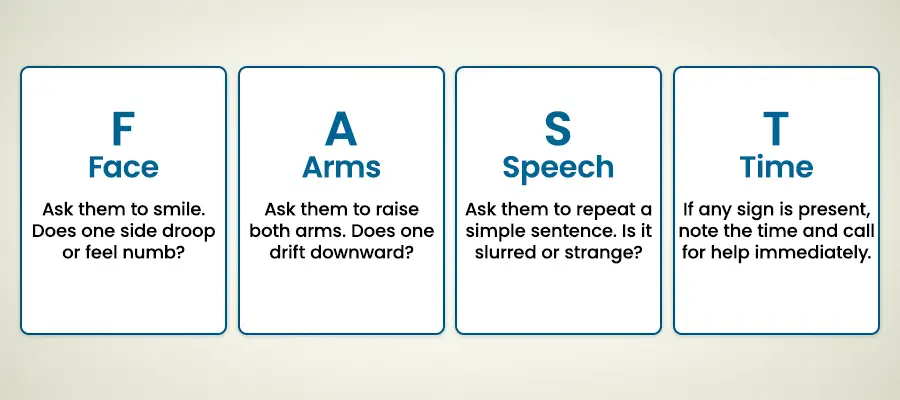
The FAST method: Recognizing Stroke Warning Signs
FAST is designed to be easy to remember and simple enough to be performed by anyone: no medical training is needed to perform it.
Why “time is brain” is not an exaggeration
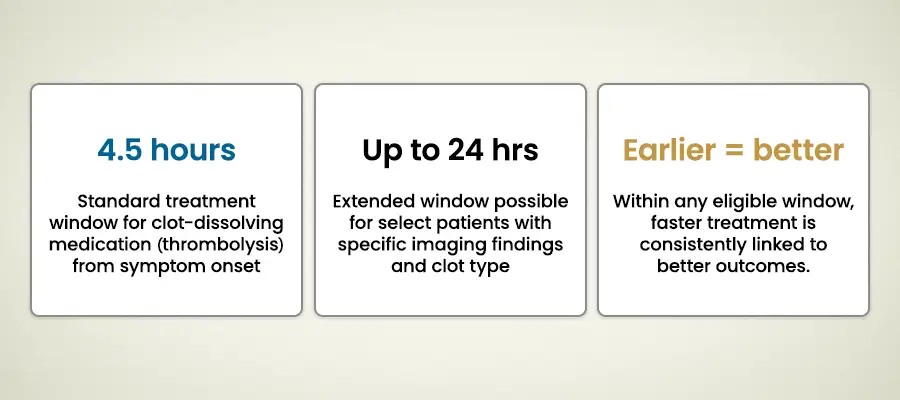
The standard window for administration of intravenous clot-dissolving medication is 4.5 hours from the time symptoms started. It is not from the time the patient is found or when he/she is brought to the hospital. Some patients who qualify for treatment using specialized brain imaging may be eligible for treatment beyond 4.5 hours, and clot-removing thrombectomy may be done up to 24 hours from the time the stroke occurred. It is not a reason to observe and wait. All the guidelines are clear and unequivocal that within the window where the patient is qualified for treatment, treatment should be given as early as possible. Informing the medical team exactly when the symptoms started is important and helpful.
What actually happens after you call for help
1. Call emergency services, and note the time.
Stroke is suspected; state the time as best as possible. Calling for suspected stroke changes emergency service response priority.
2. Rapid assessment and imaging
The patient is usually quickly assessed and sent for a brain scan (usually CT, other times MRI), the kind of imaging capability available at specialized neurology and stroke centers, to help determine the type of stroke and treatment.
3. Treatment Decision
Taking into account the person’s health and other factors, the team decides on the type of treatment and if a clot-dissolving drug, clot-removing treatment such as mechanical thrombectomy, or other means is more suitable.
4. Monitoring and Early Rehabilitation
Following treatment, a variety of rehabilitation therapies are begun and continued during the hospital stay.
Ischemic vs. hemorrhagic: why “type” matters for treatment
| Stroke type | What’s happening? | Why imaging matters so much |
|---|---|---|
| Ischemic (most common) | A clot blocks blood flow to part of the brain. | Treated with clot-dissolving medication and/or clot removal, within time-sensitive windows |
| Hemorrhagic | A blood vessel bleeds into or around the brain. | Clot-dissolving medication would make bleeding worse, so imaging must confirm the type before any treatment decision is made. |
This is why a brain scan happens quickly after the patient arrives. Clinically, the two conditions require opposite treatment approaches and it can’t always be determined based on the symptoms.
Reducing your own risk
- Blood pressure: One of the most significant modifiable stroke risk factors.
- Atrial fibrillation and other irregular heart rhythms, which can raise clot risk.
- Diabetes and cholesterol levels.
- Smoking: Quitting meaningfully reduces stroke risk over time.
- A prior stroke or “mini-stroke” (TIA) This raises the importance of follow-up, not a reason to be less vigilant afterward.
Neurologists specializing in stroke prevention can help assess which of these risk factors apply most to an individual’s situation and how to manage them.
This is a sensitive topic
If you’re reading this after witnessing or experiencing a stroke, that can understandably be frightening to revisit. This article covers general information; your own or your loved one’s care team, who has the actual scans and history, is the right source for what happens next.
Frequently asked questions
Q: What happens if the symptoms go away before help arrives?
The presence of symptoms is an indication for urgent medical evaluation. Symptoms that resolve on their own are often concerning for a transient ischemic attack (TIA). Individuals with TIAs are at significantly increased risk for a stroke in the near future and should be rapidly evaluated and not dismissed.
Q: Can young and otherwise healthy people have a stroke?
Yes, this is often the case with kids, teens, and young adults, but it is less common than in the older population. There are several factors that increase the stroke risk at any age (i.e. heart conditions, blood clotting disorders, and other health conditions), and this is the reason for the importance of the FAST recognition regardless of the person’s age.
Q: Should I have the person driven to the hospital by me, or should I call for help?
It is often preferred that you call for help, as emergency medical personnel can start an assessment and treatment during transport, and they can alert the receiving hospital to prepare their stroke team.
Q: What is the long term prognosis after a stroke?
The prognosis for each individual stroke is very different based on factors like where the stroke occurred, what the stroke affected, size of the stroke, how quickly the person was treated, and other health conditions the person may have. Many people regain a lot of function, especially with quick treatment and rehabilitation.
Q: Can I have a consultation to discuss stroke risk factors and/or ongoing neurological symptoms?
Yes, our partner neurology team offers a free, no-obligation consultation to discuss your stroke risk factors and/or any ongoing neurological symptoms.
Conclusion
FAST is necessary because the most important person to change the outcome of a stroke is usually not a doctor. That person is the one who notices symptoms and acts on it in under 30 seconds and sends for help with just a phone call. Remembering these simple steps of a stroke can truly change and maybe even save someone’s life. Whether it be yourself or a loved one, it’s worth sharing and teaching this information.