

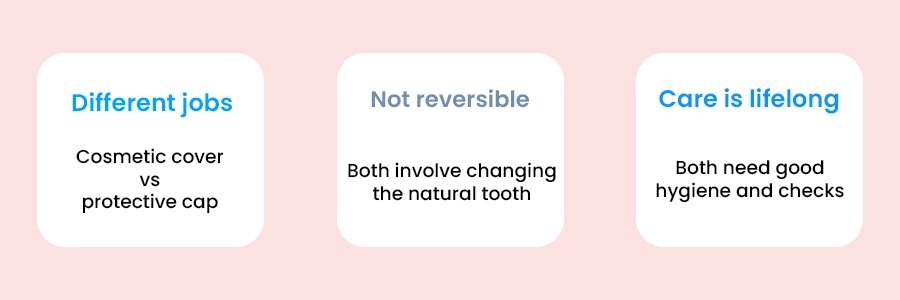
Veneers and crowns are often mentioned together. They do different jobs. One is mainly cosmetic. Covers the front of a tooth. The other protects a damaged tooth all the way round. Here is how to tell which is which.
Both veneers and crowns are “restorations.” These are custom-made coverings that are bonded or cemented onto your teeth. The main difference between them is how much of the tooth they cover. The reason they are used. When deciding between veneers and crowns, it’s best to start with the health of the tooth, not with the appearance you want.
The key differences between veneers and crowns
| Veneer | Crown | |
|---|---|---|
| What it covers | The front surface of a tooth | The whole tooth, like a cap |
| Main purpose | Improving color, shape, or minor gaps and chips | Protecting and rebuilding a weakened, broken, or heavily filled tooth |
| Tooth preparation | A thin layer of enamel is usually removed. | More of the tooth is shaped to make room for the cap. |
| Suitable when | The tooth is otherwise healthy and strong. | The tooth is cracked, decayed, root-treated, or heavily restored. |
| Reversibility | Generally not reversible | Not reversible |
When each is usually considered
- Veneers: stained teeth that do not respond to whitening, minor chips, small gaps, or slightly misshapen teeth in a healthy mouth.
- Crowns: a large filling that is failing, a cracked tooth, a tooth after root canal treatment, or a worn tooth that needs strengthening.
- Neither: teeth with active decay or gum disease. These must be treated first. Sometimes whitening, bonding, or orthodontics is a gentler first option.
Risks and limits
I notice that both can chip, loosen, or wear, and both may need replacing over time. The natural tooth underneath can still decay at the edges; good brushing, flossing, and regular checks remain essential. Teeth grinding can harm restorations. A night guard might be recommended to protect them. Sensitivity after tooth preparation is normal. Often goes away on its own. If the sensitivity continues, you should let your dentist know.
What the process looks like
- Examination and planning
Check-up, X-rays, and a discussion of your goals and alternatives. A preview or mock-up may be offered.
- Preparation
The tooth is shaped, and an impression or digital scan is taken. A temporary may be fitted.
- Making the restoration
Made in a dental laboratory, which may take some days.
- Fitting
The restoration is checked for fit, bite, and color, then bonded or cemented.
- Aftercare
Cleaning, avoiding biting hard objects, and regular reviews.
Questions for your dentist
Bring these to your consultation.
- Is my tooth strong enough for a veneer, or does it need a crown?
- Is there a less invasive option I should try first?
- How much of my natural tooth will be removed?
- How long can I expect it to last, and what would replacement involve?
- What does the guarantee cover?
Frequently asked questions
Q: Which lasts longer, a veneer or a crown?
The result depends on the material, the tooth, your habits, and your care. Ask your dentist what to expect for your tooth in your case.
Q: Do veneers damage teeth?
They usually involve removing some enamel, and enamel cannot grow. When done well, healthy teeth can work well, but it is a commitment.
Q: Can I whiten veneers or crowns?
No. They do not change color; with whitening, whiten natural teeth first if you plan to.
Q: Do these treatments hurt?
Treatment is done using an anesthetic. It is normal to feel some sensitivity after the procedure.
Q: Can I get an opinion first?
Yes. Our partner dental specialists will review your goals during a no-obligation consultation so you can see which steps are best, for you.
Conclusion
Veneers and crowns can both be excellent when matched to the tooth. Veneers and crowns work best when the tooth is healthy. Start with the health of your teeth and gums, which is the least invasive, and be wary of anything that is rushed.