
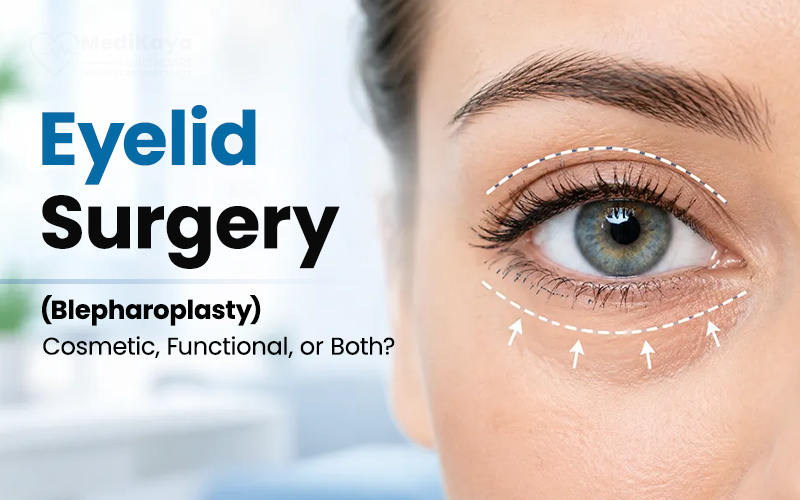
Eyelid issues can be both a cosmetic concern and an impediment to sight. Droopy eyelids are an example of a cosmetic concern that can impact appearance. Blepharoplasty can impact functional issues as well but is a surgery that requires careful consideration.
Blepharoplasty removes or repositions excess eyelid skin, fat, or muscle. The surgery improves or alters the eyelids’ appearance. The surgery can be performed on the lower and/or upper eyelids. Over time the skin on the eyelids thins and loses its elasticity. The fat that is under the eyelids can protrude and give the eyes an aged or tired appearance. It can also obstruct the field of vision. For some people, the excess skin of the upper eyelids can obstruct their vision and affect their everyday tasks. For other people it is purely a cosmetic concern.
Blepharoplasty (Eyelid Surgery): Cosmetic or functional?
| Cosmetic | Functional | |
|---|---|---|
| Reason | Appearance: puffiness, bags, extra skin, a tired look | Vision: upper-lid skin that hangs into the line of sight |
| Assessment | Surgeon’s examination and discussion of goals | Often includes an eye examination and visual-field testing |
| Insurance | Usually not covered | May be covered in some systems when medically justified; check with your insurer |
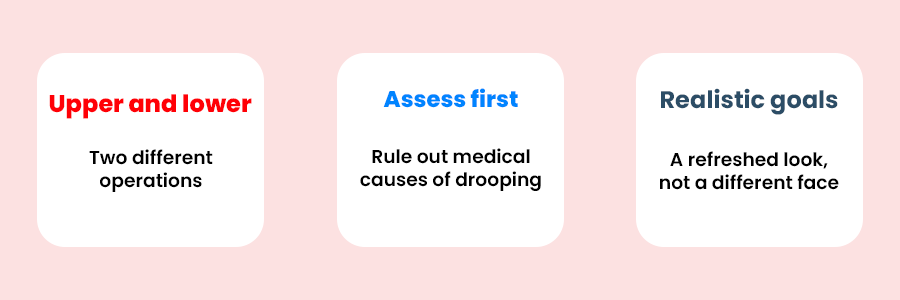
Not everyone has both conditions. It’s important to determine whether droopy lids are caused by muscle or nerve issues (ptosis). This condition is different from loose eyelid skin and requires different types of treatment.
What the surgery involves
- Consultation
Your goals, your medical history (particularly with regard to dry eyes, thyroid disease, blood pressure, and medications), and an examination of your lids and eyes.
- Planning
Which lids to remove or reposition, and where the incisions will be, typically along natural creases.
- Surgery
It is often done under local anesthesia with sedation but can also be done with general anesthesia. Upper-lid surgery takes less time than combined procedures.
- Early recovery
Swelling, bruising, tightness, and dry or watery eyes are common at first. You will be advised on cold compresses, lubricating drops, sleeping position, and avoiding strain.
- Follow-up
You may experience some swelling, bruising, tightness, and dry or watery eyes and need to be instructed on the use of cold compresses, lubricating drops, and sleeping positions. You also may be advised to refrain from any lifting or bending for an extended period of time.
Risks to understand
- Dry, itchy, or watery eyes
- Asymmetry, a lid that sits too high or too low, or a lack of eyelid symmetry
- Bruising, internal bleeding, and infection
- Permanent scarring and inability to fully close eyes
- Visual complications and loss
Risks are higher for anyone with allergies, preexisting dry eye, or eczema and certain older autoimmune disorders and inflammatory conditions (very rarely complicating lymph nodes and the surrounding soft tissue).
A note on this topic
Wanting to improve your looks is a personal decision, but it’s worth considering what it is you want to change. If you think your appearance is affecting your mental wellbeing, talking to a doctor or counsellor before the surgery is worth considering.
Questions for your surgeon
Bring these to your consultation.
- How often do you perform eyelid surgery, and what are your qualifications?
- Is my issue mostly cosmetic or functional, and is something else possibly causing this?
- What procedure would you recommend, and what will/won’t change with this?
- What are the possible complications, and how are they dealt with?
- What is the recovery like, and who do I contact if something is wrong?
Frequently asked questions
Q: How long do the results last?
Your results are long-lasting but not permanent as aging continues. Discuss your results with your surgeon.
Q: Will I be able to close my eyes after surgery?
Some tightness is normal after surgery; however, if the eyes still cannot close, that needs to be reported to your surgeon.
Q: Can I wear contact lenses after surgery?
Not right away. Your surgeon will tell you when it is alright to get back to normal activities.
Q: Is it safe if I have dry eyes?
Dry eyes can be worsened by the surgery, so tell your surgeon beforehand. They may suggest an eye assessment first.
Q: Can I get an opinion first?
Yes. Our partner plastic surgery specialists can review your goals through a free, no-obligation consultation.
Conclusion
The right surgeon and eyelid surgery can clear your line of sight and refresh the look of your tired eyes. Make sure to ask the right questions and don’t let them rush you.