
Each year, thousands of Central Asian patients come to find medical services of world standards at affordable prices in other countries. One of these, Kazakhstan to India medical tourism has shot up by leaps and bounds, and with substantial reasons. India has a mix of internationally-recognized hospitals, English-speaking specialist physicians, and treatment rates at 60-80% that of similar care in Europe or the Gulf without any clinical outcome being compromised.
Be it cardiac surgery, cancer care, fertility services or organ transplants, this guide has it all a Kazakhstani patient considering India for medical treatment as a place to receive medical care should know including how to go about selecting the appropriate hospital, and how to go about the entire process of getting a medical visa to India.
Why Kazakhstani Patients Choose India for Medical Treatment
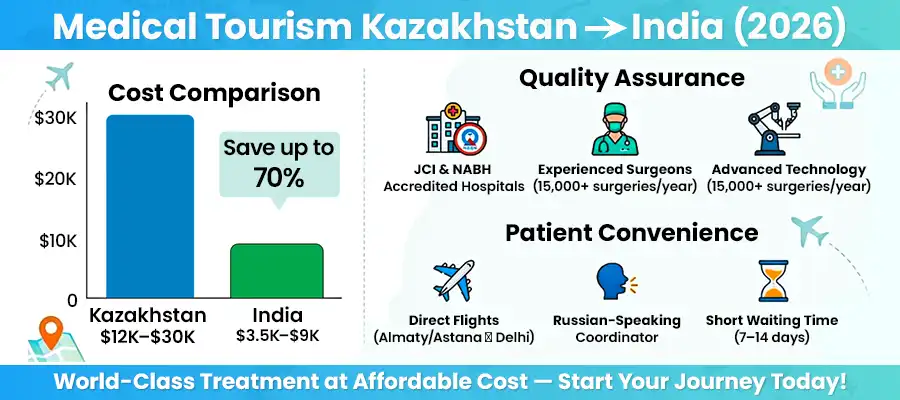
India has become one of the most popular for international medical tourism patients – and Central Asian patients (especially Kazakhstan) are noticing it. The nation has been considered as one of the top three medical tourism countries in the world with a healthcare system which comprises more than 40+ JCI accredited hospitals and thousands of internationally trained specialists.
|
70%
cost saving vs Europe
|
40+
JCI-accredited hospitals
|
5 hrs
Avg flight Almaty → Delhi
|
95%
Patient satisfaction
|
Other than cost, the geographical proximity of India to Kazakhstan is a significant strength. Almaty and Nur-Sultan (Astana) are in less than six hours away by direct and one-stop flights to the cities of Delhi, Mumbai, and Chennai; this is much more approachable than such destinations as Germany, Thailand, or Turkey.
Cost Comparison: Medical Treatment in India vs Kazakhstan
Cost is the most influential factor that is propelling Kazakhstani medical tourism to India. The healthcare of Kazakhstan, though being enhanced, has a shortage in terms of capacity to deal with complex procedures. The cost of local hospitals in Almaty or Nur-Sultan is very high and when it comes to specialised treatment, the price can be very close to European rates without the expertise.
| Treatment | Kazakhstan (USD) | India (USD) | Savings |
|---|---|---|---|
| Cardiac Bypass (CABG) | $18,000–$25,000 | $5,000–$7,500 | ~70% |
| Knee Replacement | $12,000–$18,000 | $4,000–$6,500 | ~65% |
| IVF (per cycle) | $4,000–$6,000 | $1,800–$3,000 | ~55% |
| Cancer Chemo (6 cycles) | $20,000–$40,000 | $6,000–$12,000 | ~70% |
| Liver Transplant | Rarely available | $28,000–$40,000 | vs $150k+ West |
| Dental Implant / tooth | $1,200–$2,000 | $400–$700 | ~65% |
Note: Costs include surgery, hospital stay (5–7 nights), anaesthesia, and basic post-op care. International travel and accommodation are additional
Top Medical Treatments Sought by Kazakhstani Patients in India
The following specialties account for the majority of inbound medical tourism from Kazakhstan:
- Cardiology & Cardiac Surgery- Bypass, valve replacement, angioplasty at Fortis, Apollo
- Orthopedics- Knee replacement, fracture repair, spinal surgery, arthroscopy, Shoulder replacement, Hip replacement.
- Oncology – Surgical Oncology, Immunotherapy, radiation Therapy, Chemotherapy
- Fertility (IVF/ART)- High success-rate IVF cycles with donor options
- Organ Transplants- Kidney, liver, bone marrow; India has one of Asia’s largest transplant programmes
- Neurosurgery- Brain tumour removal, deep brain stimulation, minimally invasive spine surgery
Best Hospitals in India for Kazakhstani Patients
When choosing a hospital for medical treatment in India as a Kazakhstani patient, prioritise JCI or NABH accreditation these are internationally recognised quality benchmarks. Below are the most recommended hospital networks:
Asia’s largest private hospital group, Apollo has dedicated International Patient Services desks with Russian-speaking coordinators — a critical advantage for Kazakhstani patients. They offer end-to-end facilitation including airport pickup, accommodation booking, and visa letter support.
Fortis Gurgaon is particularly renowned for its cardiac and orthopaedic departments. The hospital maintains an active Russia/CIS patient coordination team and has treated patients from Kazakhstan, Uzbekistan, and Kyrgyzstan for over a decade.
Medanta – The Medicity (Gurgaon)
Founded by renowned cardiac surgeon Dr. Naresh Trehan, Medanta specialises in complex multi-organ cases. It is a preferred destination for advanced oncology and cardiovascular cases from Central Asia.
Step-by-Step: How to Plan Your Medical Trip from Kazakhstan to India
1. Get a Second Opinion Online
Share medical records with 2–3 Indian hospitals through their international patient portals. Most respond within 48 hours with a treatment plan and cost estimate.
2. Apply for an Indian Medical Visa (e-MV)
Apply at indianvisaonline.gov.in. Kazakhstani nationals are eligible for the e-Medical Visa. You will need a letter from the Indian hospital confirming your treatment appointment.
3. Engage a Medical Facilitator (Optional but Recommended)
A registered medical tourism facilitator for India can coordinate between your local doctor, the Indian hospital, visa, travel, and accommodation — removing logistical stress.
4. Book Travel & Accommodation
Most hospitals offer tie-ups with nearby hotels for patient families. Delhi’s Indira Gandhi Airport has direct connections to Almaty (Air Astana) and Nur-Sultan.
5. Arrive, Treat & Follow Up Remotely
Indian hospitals provide complete discharge summaries and telemedicine follow-up with your treating doctor after you return home ensuring continuity of care.
Language, Culture & Practical Considerations
One of the main concerns for Kazakhstani patients travelling to India is related to the language barrier. Nevertheless, Russian-speaking patient coordinators work in most of the tier-1 Indian hospitals in Delhi, Gurgaon, Mumbai, or Chennai. Multilingual assistance is also provided in international patient lounges of airports like IGI Delhi.
Cultural compatibility is strong – both India and Kazakhstan had the culture of family-centred healthcare, and the hospitals in India are usually ready to host the family members of patients, sometimes even giving them a special room close to the patient ward. Most major cities, as well as hospital canteens, have many sources of halal food.
Frequently Asked Questions
Q. Do Kazakhstani citizens need a visa to travel to India for medical treatment?
Yes. The citizens of Kazakhstan will need to apply to the Indian Medical Visa (e-MV). The e-Medical Visa may be applied online at indianvisaonline.gov.in and is normally processed in 7296 business hours. You will also require a letter of your scheduled appointment in the Indian hospital you are selected in and some medically supporting medical documentations.
Q. Which city in India is best for Kazakhstani medical patients?
The most popular hub is Delhi (and the neighbouring Gurgaon), as it has a direct flight link with Almaty and Nur-Sultan, a high level of concentration of JCI-accredited hospitals, and developed infrastructure to serve international patients. Chennai is favored in terms of cardiac and bone marrow transplants whereas Mumbai is preferred in terms of oncology at Tata Memorial Hospital.
Q. How much should I budget for a medical trip to India from Kazakhstan?
Budget relies on the process. Approximately: a treatment (prices differ, see table above) + flights back home ($300-$600) + hotel ($30-$80 a night) + food and transportation in the country ($20-$40 a day). Even taking into account the cost of traveling, most patients will save 60-75% of what they would have spent on similar treatment in the private sector in Kazakhstan or other countries.
Q. Are Indian hospital standards safe and internationally recognised?
According to the Joint Commission International (JCI) which is the same gold standard under which hospitals are judged in the US and Europe, India has more than 40 hospitals that are accredited. There are also hundreds of others that are certified by the National Accreditation Board for Hospitals (NABH). Such major hospitals as Apollo, Fortis, Medanta and Max Healthcare are always in Asian hospital ratings.
Q. Can I bring a family member with me on a medical visa?
Yes. The e-Medical Visa provides India with the opportunity to bring up to two assistants (family members or caregivers) with the patient. Every attendant needs to submit an application of e-Medical Attendant Visa, which goes hand in hand with a visa application of the patient.
Q. Is post-treatment follow-up possible after returning to Kazakhstan?
Absolutely. Telemedicine follow-up consultations with the treating physician are provided by all the major Indian hospitals through video call. They also offer elaborate discharge summaries and medications protocols using English and sometimes in Russian, which can be handed over to your local physician in Kazakhstan to continue taking care.
Conclusion
Kazakhstan medical tourism to India provides a good mix of global clinical knowledge, internationally recognized clinics, huge savings and good logistics systems to the patients of the CIS region. India remains the destination of choice of complex and elective medical procedures to Kazakhstani patients thanks to its simplified medical visa policy, direct flight connections, and the availability of patient support in the Russian language in the major hospitals.
The initial step is not as difficult as you imagine it to be – you can begin by mailing your medical reports to an Indian hospital international patient team, and they will then provide you with a free consultation.