
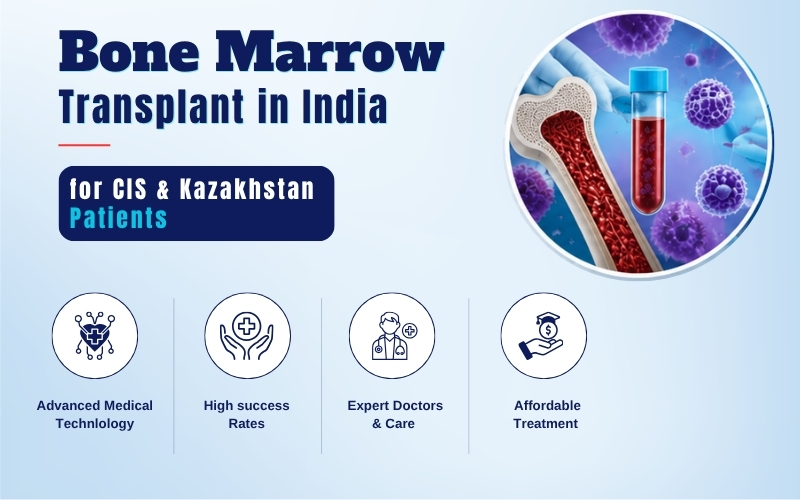
Bone marrow transplant India for Kazakhstan patients is increasingly gaining relevance for the families who want to avail their treatment at an economic cost, which saves their lives.
Bone marrow transplant (also known as haematopoietic stem cell transplant) is the main treatment which is curative for a number of life-threatening blood disorders: acute leukaemia, lymphoma, multiple myeloma, aplastic anaemia, thalassaemia major, and sickle cell disease. There is no alternative remedy to treatment for many of these diseases.
The incidence of thalassaemia major and aplastic anaemia is especially high in Central Asia, and the only way to a normal life is by bone marrow transplant. However, in Kazakhstan and throughout most of the CIS region, access to high quality bone marrow transplant services is still very limited. It is offered at the $80,000 to $120,000 in Germany and other European centres, but very few families in the CIS can afford it.
The quality of bone marrow transplant in India is comparable to that of Europe, with a 70 – 80 percent success rate in leukaemia and an 80 – 90 percent cure rate in thalassaemia at a cost of $18,000 to $28,000. The price of a bone marrow transplant India is also very low compared to Western countries, which makes it easily accessible to international patients as well. This guide has all the details that Kazakhstan and CIS patients need to know.
Bone Marrow Transplant Cost in India for CIS Patients — 2026 Full Breakdown
| Procedure | 🇮🇳 India | 🇰🇿 Kazakhstan | 🇹🇷 Turkey | 🇩🇪 Germany |
|---|---|---|---|---|
| Allogeneic BMT (Matched Sibling) | $18,000–$22,000 | Limited / not available | $35,000–$45,000 | $80,000–$100,000 |
| Haploidentical BMT (Half-Matched) | $22,000–$28,000 | Not available | $40,000–$55,000 | $90,000–$120,000 |
| Autologous BMT (Stem Cell Rescue) | $12,000–$18,000 | Limited / not available | $25,000–$35,000 | $60,000–$80,000 |
| Paediatric BMT (Thalassaemia / Leukaemia) | $18,000–$24,000 | Not available | $35,000–$45,000 | $80,000–$100,000 |
Costs include: All pre-transplant work-up and HLA typing, conditioning chemotherapy/radiotherapy, the transplant itself, clean room (HEPA-filtered isolation room), all medications during the transplant period, daily monitoring and routine management of complications, such as infections and graft-versus-host disease (GVHD). Long-term post-transplant medications are not included in the cost, and they are much more affordable in India than in Europe.
A child with thalassaemia major requiring bone marrow transplant in Germany would cost a family $80,000 to $100,000. The same procedure in India costs $18,000 to $24,000 — a saving of over $60,000. The medical outcome (cure rate: 80–90%) is equivalent. MediKaya Healthcare has coordinated multiple thalassaemia BMT cases for CIS families.
Thalassaemia Cure: Bone Marrow Transplant in India for Central Asian Patients
Bone marrow transplant India for Kazakhstan patients has become a life-changing option, especially for families dealing with genetic blood disorders like thalassaemia major.
Thalassaemia major is a genetic blood disease which needs blood transfusion every 3-4 weeks to stay alive (unless cured by bone marrow transplant). Thalassaemia has the highest prevalence in the world in Central Asia, specifically Kazakhstan, Uzbekistan, Tajikistan and Kyrgyzstan. However, the availability of bone marrow transplant as a ‘cure’ is not common in these countries.
India is now offering CIS families the best options for BMT for thalassaemia, with world-class medical facilities and affordable prices. The bone marrow transplant India cost is much less than in Western countries, allowing more patients to receive the treatment. A matched sibling bone marrow transplant is a complete, permanent cure; the cure rate is 80 to 90 percent in children younger than 10 years. The child will no longer need transfusions or iron chelation therapy and will be able to live a completely normal life.
The important criterion is that the sibling donor needs to be an identical twin — either brother or sister — with a human leukocyte antigen type match. About 25-30 per cent of thalassaemia patients have a matching sibling. If no one else, a haploidentical (half-matched) donor transplant (parent) is becoming available and successful.
Types of Bone Marrow Transplant India for Kazakhstan Patients
Allogeneic BMT — Matched Sibling Donor
The gold standard. The bone marrow or peripheral blood stem cells are harvested from a fully Human Leukocyte Antigen (HLA) matched sibling, who is compatible by blood test. The success rate of bone marrow transplantation India is high, and the medical procedures are also advanced and thus it’s a preferred option for international patients. The success rate for leukaemia in remission is between 65 and 80 per cent, and for thalassaemia and aplastic anaemia, it is between 80 and 90 per cent. The bone marrow transplant India cost is very reasonable ranging from $18,000 to $22,000, which makes India a prime destination for life-saving treatment.
Haploidentical BMT — Half-Matched Family Donor
If there is no fully matched sibling, a parent, child or half-matched sibling may be used as a donor. In a haploidentical (haplo) transplant, the techniques employed to prevent graft rejection and graft-versus-host disease are advanced, called post-transplant cyclophosphamide. This innovative step has revolutionised the stem cell transplant in India, and almost any patient can find a match. The cost of the bone marrow transplant in India for this procedure generally is in the range of Rs22,000 to Rs28,000, making it accessible for international patients.
Autologous BMT — Patient’s Own Stem Cells
It is mainly used for multiple myeloma, Hodgkin’s and non-Hodgkin’s lymphoma, following chemotherapy. High-dose chemotherapy is followed by the collection, freezing and re-infusion of the patient’s own stem cells. No rejection of grafts or GVHD. Cost: $12,000 to $18,000. Faster recovery: around 3-4 weeks in the hospital.
Conditions Treated with Bone Marrow Transplant in India — CIS Patient Indications
- Acute Myeloid Leukaemia (AML) — Allogeneic BMT recommended after first remission for high-risk cases
- Acute Lymphoblastic Leukaemia (ALL) — Paediatric ALL is one of the most common indications for CIS children
- Chronic Myeloid Leukaemia (CML) — BMT is considered when TKI therapy fails
- Hodgkin’s and Non-Hodgkin’s Lymphoma — Autologous BMT after chemotherapy relapse
- Multiple Myeloma — Autologous BMT as standard of care after induction chemotherapy
- Aplastic Anaemia — Allogeneic BMT curative with matched sibling; 80–90% success rate
- Thalassaemia Major — Allogeneic or haploidentical BMT curative; particularly relevant for Central Asian patients
- Sickle Cell Disease — BMT is increasingly offered as a curative treatment in India
Top BMT Hospitals in India for Kazakhstan Patients — MediKaya Partners
- BLK-Max Super Speciality Hospital, Delhi — Primary MediKaya partner for BMT. High-volume adult and paediatric BMT centre. Dedicated CIS patient coordinator. HEPA-filtered clean rooms for isolation during transplant.
- Fortis Memorial Research Institute, Gurugram — One of India’s largest BMT programmes with hundreds of transplants annually. Strong in haploidentical transplant and paediatric thalassaemia BMT.
- Medanta The Medicity, Gurugram — Strong adult haematology and BMT programme. Particularly strong for myeloma autologous BMT and CML cases.
- Max Super Speciality Hospital, Saket — Growing BMT programme with internationally trained haematology team. Good for both allogeneic and autologous transplant.
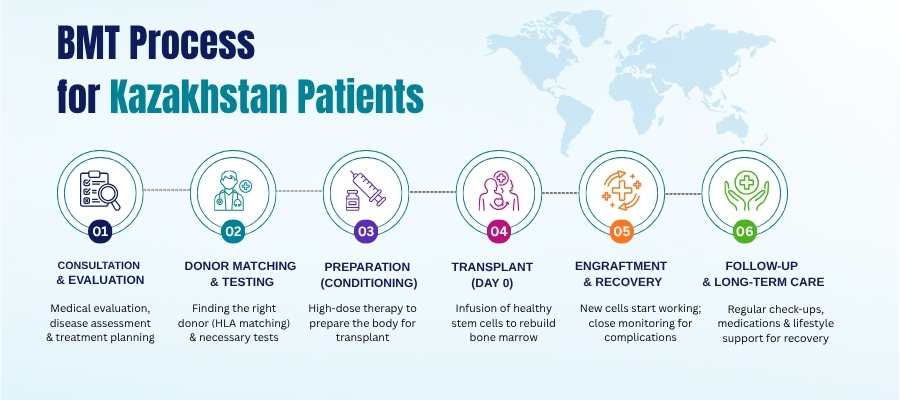
BMT Process for Kazakhstan Patients — What to Expect
- HLA typing — blood samples are sent to the patient and potential donors (siblings, parents) for HLA typing. HLA typing may be performed in India or a certified laboratory in Kazakhstan, which sends samples to India.
- Pre-transplant evaluation — The patient has a cardiac echo, pulmonary function tests, evaluation of kidney and liver function, bone marrow biopsy, and screening for infection. This process in India is 7 to 10 days.
- Donor collection – Bone marrow or peripheral blood stem cells are collected and taken from the donor (after G-CSF injections for 4-5 days for peripheral blood collection). A same-day procedure performed under light sedation.
- The conditioning period — This is where the patient undergoes a period of high-dose chemotherapy (sometimes radiotherapy) for 5 to 7 days prior to the transplant. This is because it kills the patient’s own bone marrow, providing room for the donor’s bone marrow.
- The day of transplant – On this day, the donor stem cells are given to the patient via an intravenous drip (intravenous infusion), just as in a blood transfusion. The cells travel to the bone marrow and start to grow in the marrow.
- Engraftment — The new marrow starts making cells in 14-21 days. This is the most critical stage—the patient is completely isolated in a HEPA-filtered clean room. Blood counts are taken every day.
- Discharge — 28-40 days after transplant. These are kept in India for close observation for an additional 2-4 weeks prior to their clearance to fly.
- Immunosuppression/anti-infection drugs are given for 6-12 months, followed by long-term therapy. The follow-up is done remotely by cooperation between the India Hospital and the doctor in Kazakhstan.
Frequently Asked Questions — Bone Marrow Transplant India for CIS Patients
Q: How much does bone marrow transplant cost in India vs Germany?
A: The price of an allogeneic bone marrow transplant in India is in the range of USD 18k to USD 22k. The same procedure in Germany costs $80,000 to $100,000 — a difference of $60,000 to $80,000. The success rates are comparable to those achieved in Europe (70-80% for leukaemia and 80-90% for thalassaemia) in India. The only feasible and high-quality choice available to CIS families is India.
Q: Can thalassaemia be cured with bone marrow transplant in India?
A: Yes. In India, the top centres have an 80 to 90 percent cure rate in children between the ages of 10 and under for matched sibling bone marrow transplant, which is used to treat thalassaemia major. Bone marrow transplant India is known for attaining such high success rates with advanced treatment modalities. Once a transplant is a success, the child does not need to have blood transfusions anymore and can enjoy a normal life thereafter. India has emerged as the world’s top choice for thalassaemia BMT for CIS patients.
Q: What is haploidentical transplant and when is it used?
A: Half-matched family donor (haploidentical, or ‘haplo’) transplant is performed by someone who is 50% HLA matched, typically a parent or sibling. It is used in the absence of a matched sibling. Modern haplo transplant with PTCy has a success rate of 60–70% when given for leukaemia and is becoming more and more common as an alternative to a fully matched transplant. Cost in India: $22,000 to $28,000.
Q: How long does a Kazakhstan family need to stay in India for bone marrow transplant india for kazakhstan patients?
A: The patient typically stays in India for 10 to 14 weeks — 4 to 6 weeks in hospital during the transplant and engraftment phase, and 4 to 8 weeks of close outpatient monitoring before being cleared to fly. The donor (if a living donor) is typically in India for 2 to 3 weeks for evaluation and collection.
Q: Can a sibling from Kazakhstan be a bone marrow donor in India?
A: Yes. A sibling is the ideal donor for allogeneic BMT. They undergo HLA typing first — this can be done in India after arrival. If HLA-matched, the sibling donates via peripheral blood stem cell collection (injections for 4 to 5 days, then a 4-hour collection procedure) or bone marrow harvest under general anaesthesia. The process is safe and well-tolerated.
Трансплантация костного мозга в Индии для пациентов из Казахстана и стран СНГ — 2026
Трансплантация костного мозга (ТКМ) в Индии стоит $18,000–$28,000 — на 65–75% дешевле, чем в Германии ($80,000–$120,000), при эквивалентных показателях выживаемости: 70–80% при лейкемии, 80–90% при талассемии и апластической анемии.
Центральная Азия — Казахстан, Узбекистан, Таджикистан, Кыргызстан — имеет один из самых высоких в мире уровней распространённости талассемии большой. Трансплантация костного мозга является единственным методом полного излечения. В Индии гаплоидентичная трансплантация от частично совместимых родителей-доноров также доступна, что расширяет возможности для пациентов без полностью совместимого брата или сестры.
Ведущие центры ТКМ — партнёры MediKaya Healthcare: BLK-Max Дели, Fortis Memorial Гургаон, Medanta Гургаон. Бесплатная консультация и ответ за 48 часов.