
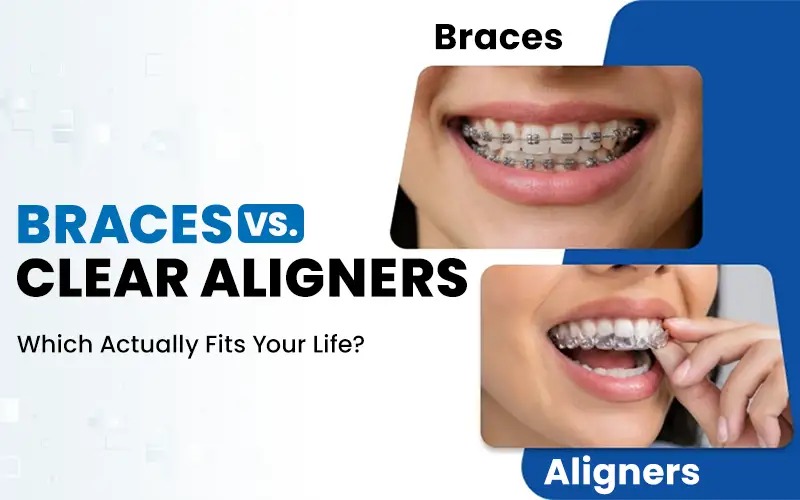
Both can fix teeth properly. The real answer to “which’s better” depends less on the tool and more on how complicated your bite is and how good you are at taking care of it every day. Here is a comparison of braces vs. Invisalign, without any marketing talk.
“Braces or Invisalign?” is one of the common questions in dentistry, and it’s usually framed as a style preference. Metal brackets, versus clear trays. The useful framing is different. One option is. Does not change when you do or do not follow it daily. The other option is removable and changes completely when you do or do not follow it daily. That difference matters more than looks for people who choose between them.
What each option actually involves
Traditional braces: Braces use brackets that are stuck to the teeth. These brackets are linked by a wire. The wire is adjusted every week to slowly move the teeth into the right spot. The braces stay attached to the teeth for the time you’re getting treatment. They don’t come off until the treatment is finished.
Clear Aligners: Also known by brand names such as Invisalign, Clear Aligners are a set of custom trays that can be removed. Certified Invisalign providers plan a series of trays, and each clear aligner is worn for one to two weeks before moving on to the next, in the series slowly moving teeth into better positions.
| Feature | Traditional braces | Clear aligners |
|---|---|---|
| Visibility | Visible metal or ceramic brackets and wire | Clear trays, much less noticeable |
| Removable? | No, fixed for the duration of treatment | Yes, typically removed for eating and brushing |
| Compliance required | Low, effectiveness doesn’t depend on daily patient behavior once fitted. | Highs generally need to be worn 20-22 hours a day to work as planned |
| Best suited for | More complex bite issues, significant tooth movement, or cases needing precise control | Mild to moderate misalignment, in patients confident they’ll maintain consistent wear |
| Eating and oral hygiene | Some food restrictions: brushing and flossing require more care around brackets. | No food restrictions since trays are removed to eat; normal brushing and flossing |
How clear aligner treatment typically progresse
- Digital scan and treatment plan
A 3D scan of your teeth creates a digital treatment plan mapping the full sequence of tooth movement before any trays are made.
- Custom tray series
A series of custom trays is manufactured based on the treatment plan, each one progressing the teeth slightly further toward the final position.
- Periodic check-ins
Regular appointments (often every several weeks) monitor progress and confirm teeth are moving as planned, with adjustments made if needed.
- Retention phase
After active treatment, a retainer is typically needed to maintain the new position; this applies to both braces and aligners, and skipping it risks gradual shifting back.
Questions worth asking at consultation
- Is my specific bite issue well-suited to aligners, or does it require the more precise control of braces?
- What’s a realistic treatment timeline for my case with each option?
- What happens if I’m inconsistent with aligner wear does the treatment plan adjust, or does it fail to progress as expected?
- What does the retention phase look like after either treatment?
- How often will I need follow-up appointments with each option?
Frequently asked questions
Q: Are clear aligners as effective as braces?
In cases where the misalignment is only mild or moderate, aligners can work just as well. For difficult situations, such as significant crowding or a bite problem that needs precise tooth rotation or a change in vertical height, braces might still be the better choice. The decision depends on the case, not on a simple ranking. For a closer look at the strengths and limits of aligners, see our Invisalign pros and cons guide.
Q: Can adults get braces, or is it mainly for teenagers?
Adult orthodontic treatment is common. It works in the same way as it does for younger patients, and age by itself is usually not a problem. The overall health of the mouth is checked to see if someone is a good candidate, and an experienced orthodontist can advise on the best option for an adult bite.
Q: Do aligners hurt less than braces?
Both can cause some discomfort after a new wire adjustment for braces or when switching to a new tray for aligners since the teeth are starting to move. Most patients don’t usually describe one as being more painful, than the other.
Q: What happens if I lose or damage an aligner tray?
Contact your orthodontist promptly. Your orthodontist can advise whether to move to the tray early revert to the previous tray temporarily or arrange a replacement depending on your stage of treatment.
Q: How much do braces and Invisalign cost in India?
The cost depends on how complex your bite is, the type of braces (metal, ceramic, or lingual) or the number of aligner trays needed, and the clinic. Our affordable braces package outlines current options, and a specialist can give a personalised quote after examining your teeth.
Q: Can I get a consultation to find out which option fits my case?
Yes. Our partner dental specialists provide a free consultation, with no obligation, to look at your bite and talk about which option really works for you.
Conclusion
Neither braces nor clear aligners are always better. The right choice depends on your bite and also on whether you will consistently wear a removable device as it requires. A proper consultation that looks at both your teeth and your everyday life beats guessing from comparisons every time.