

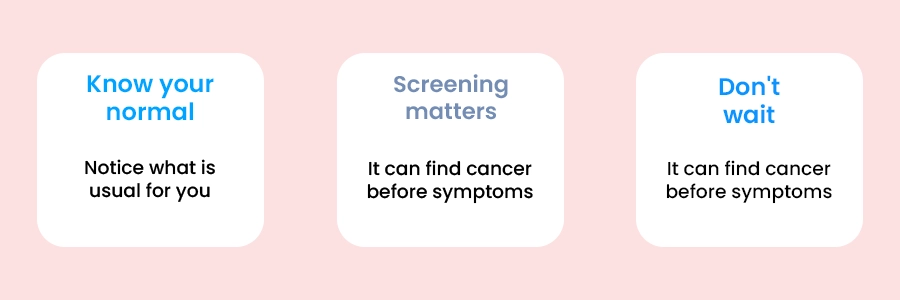
Most breast changes are not cancer. Any new breast change deserves a proper check. Awareness means knowing what is normal, for you attending screening when it is offered and acting promptly rather than waiting.
Breast cancer is one of the common cancers. When it is found early, the outcomes are usually better. Many changes in the breast are not serious. Things like cysts or benign lumps are not cancer. You cannot tell if a change is harmless just by looking at or touching it. That is why any new change should be checked by a doctor. It is important not to wait and see. Always get it checked.
Changes worth getting checked
- A new lump or thickening in the breast or armpit
- A change in the size or shape of a breast
- Dimpling, puckering, or redness of the skin
- A nipple that turns inward, or a new rash or scaling on the nipple
- Nipple discharge, particularly bloody discharge or discharge from one side only
- Persistent breast pain in one spot that does not settle
I have noticed that breast pain alone is rarely a sign of cancer, but if breast pain is persistent or feels unusual, breast pain should still be examined. Men can also develop breast cancer. The same advice applies to men.
How a breast problem is investigated
- Clinical examination
A doctor examines both breasts and the armpits and asks about your history and family history.
- Imaging
A mammogram, an ultrasound, or both, depending on age and findings. Sometimes an MRI is used.
- Biopsy
If something looks suspicious, a small sample is taken with a needle to confirm what it is. This is the only way to know for sure.
- Staging if cancer is found
Tests to see whether it has spread and receptor tests on the tumor that guide treatment.
Treatment in outline
Treatment is planned based on the type and stage of the cancer, the tumor receptors, and the patient’s own health and wishes. A team usually includes surgeons, medical oncologists, radiation oncologists and pathologists. The main elements are
| Treatment | What it does |
|---|---|
| Surgery | Removes the tumor, either the lump with surrounding tissue (breast-conserving) or the whole breast (mastectomy). Lymph nodes may be checked or removed. |
| Radiation therapy | Targets remaining cancer cells, often after breast-conserving surgery. |
| Chemotherapy | Drug treatment that works throughout the body, used for selected cancers. |
| Hormone therapy | Used when the cancer is fuelled by hormones, to block or lower their effect. |
| Targeted therapy | Medicines aimed at specific features of certain cancers. |
A note on this topic
A breast cancer diagnosis, or even the wait for results, is frightening. It is normal to feel overwhelmed. Bring someone with you to appointments, write down your questions, and ask about counselling and peer support. You do not have to make every decision in one visit.
Questions for your doctor
- What do you think this change could be, and which tests do I need?
- How soon will I get results, and who will explain them?
- If cancer is found, what type and stage is it?
- What are my treatment options, and why do you recommend one?
- How will treatment affect my daily life, and what support is available?
Frequently asked questions
Q: Does a lump always mean cancer?
I have seen cases, and I can tell you: No. Most breast lumps are not cancer. I always advise that every new breast lump be examined.
Q: Does a normal mammogram mean I am clear?
It is reassuring. No test is perfect. Report any change even after a normal screening.
Q: Does family history mean I will get breast cancer?
It can increase the risk. Most people, with breast cancer do not have a family history. If multiple relatives have had the disease talk to your doctor about counselling.
Q: Should I check my breasts every month?
Of sticking to a strict schedule, many guidelines focus on understanding what is normal for you and paying attention to any changes. It’s an idea to ask your doctor what they suggest for you.
Q: Can I get a second opinion on my results?
Yes. Our partner oncology specialists can review your reports through a no-obligation second opinion.
Conclusion
Awareness matters when awareness sparks action. First learn what feels normal for you. When a screening is offered, take it. If something new appears, go to a doctor’s office. If you get a diagnosis, it gives you the right to understand fully and to ask questions before any treatment starts.