
How a 35-Year-Old Patient from Central Asia Got a Successful Kidney Transplant in India — Real Story 2026
| Patient’s Name | Mr. Dovletjan Narbayev |
| Age | 25 Years |
| Gender | Male |
| Country of Origin | Turkmenistan |
| Hospital | BLK-Max Super Speciality Hospital, Delhi |
| Procedure | Kidney Transplant |
| Lead Surgeons | Dr. Sunil Prakash, Senior Nephrologist |
| Facilitated By | MediKaya Healthcare (International Patient Coordination) |
| “His kidneys were failing. The wait for a transplant in his home country stretched years into the future. His wife stepped forward—a perfect blood match. Seven days after surgery at BLK-Max Hospital in Delhi, he walked out with creatinine at 0.92—completely normal. This is that story.” |
CKD is not a patient killer. For millions of patients around Central Asia, the waiting time on government donor registries is more than just a wait—it’s a multi-year ordeal, a time during which the disease gets worse, patients rely on dialysis for their daily lives, and quality of life suffers.
Kidney transplant in India has become the most available, cost-effective, and technologically advanced treatment for patients from Kazakhstan, Uzbekistan, Russia, and other countries of the CIS region. The turning point for one 35-year-old patient from Central Asia was when he got into contact with MediKaya Healthcare and selected India.
This case study chronicles his entire ordeal from the first inquiry to getting successfully discharged from BLK-Max Super Speciality Hospital, Delhi, one of the best kidney transplant hospitals in India. It is brought to the attention of other patients and families so they can realize that world-class transplant care is available and accessible.
Understanding the Diagnosis: What Is Renal Engraftment?
The process of taking the kidney from a donor and successfully making it a part of the recipient’s body is called renal engraftment. This kind of live-related renal transplant (where the donor is a blood relative or legal spouse with a blood type compatible with the recipient) is performed by the individuals who are blood relatives or spouses of the recipient.
In his patient:
- Patient (recipient) blood group: A Positive
- Recipient (husband) blood group: A Positive
- ABO compatibility: It is confirmed that O positive is a universal donor blood type.
- Optimal (CDC/FCX): No rejection antibodies detected
One of the most significant pre-operative confirmations in kidney transplant surgery is a negative crossmatch. This means that the recipient’s body’s immune system will not immediately reject the new kidney, which is a huge benefit to the long-term success of the transplant.
Why India? The Medical Case for Kidney Transplant in India
1. Waiting Time: Years vs Weeks
| Country / Region | Average Wait for Deceased Donor | Live Donor Timeline |
| Kazakhstan | 3–7 years (government registry) | Limited centres, long evaluation |
| Uzbekistan | 4–6 years | Very limited availability |
| Russia (non-major city) | 2–5 years | Restricted to select hospitals |
| India (BLK-Max via MediKaya) | N/A — live donor preferred | 3–6 weeks total timeline |
2. Cost Comparison: India vs Other Options
| Country | Kidney Transplant Cost (USD) | Notes |
| India (BLK-Max / Delhi) | $12,000 – $18,000 | JCI accredited, live donor |
| Turkey (Istanbul) | $25,000 – $35,000 | Higher cost, similar outcomes |
| Germany | $60,000 – $100,000+ | Deceased donor only for foreigners |
| USA | $150,000 – $300,000+ | Not accessible for most CIS patients |
| Kazakhstan / Local Option | $35,000 – $55,000+ (if available) | Very limited availability |
3. BLK-Max Hospital: Why It Is India’s Top Choice for CIS Patients
- One of the few hospitals in India to have a dedicated transplant ICU, the Dedicated Kidney Transplant ICU (KTICU).
- Avoid this if you have kidney stones. Do not use if a kidney stone is present; more than 200 kidney transplants are performed every year.
- The gold international standard for hospital quality is JCI accredited.
- Department of International Patients, Director Russian-speaking coordinator
- Round-the-clock nephrology team and continuous monitoring of the ICU team.
- Full suppression control and post-suppression protocol.
The Patient Journey: Step by Step
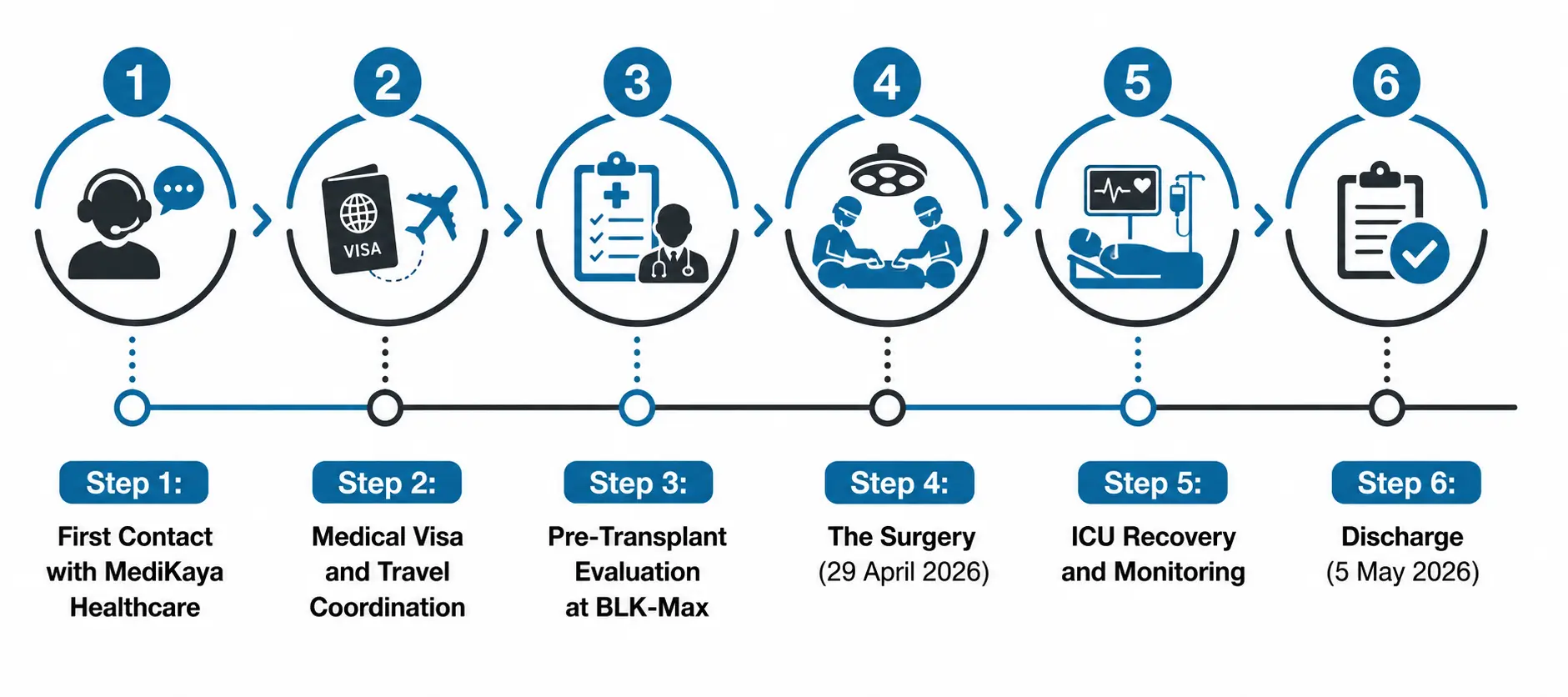
Step 1: First Contact with MediKaya Healthcare
The patient’s family has sent medical reports to MediKaya Healthcare using WhatsApp, which included creatinine levels, GFR results, and ultrasound reports. MediKaya’s medical team saw the individual within 24 hours and agreed that he was an ideal fit for a live-related kidney transplant. A preliminary cost estimate and a hospital recommendation (BLK-Max, Delhi) were provided on the spot.
Step 2: Medical Visa and Travel Coordination
MediKaya prepared the hospital invitation letter, needed for the Indian e-Medical visa application, within 48 hours of confirmation of the treatment plan. The patient and his wife (the donor) were issued an Indian medical visa. MediKaya arranged airport pick-up, a patient coordinator in the Russian language, and stayed with the patient at the hotel near BLK-Max in Karol Bagh.
Step 3: Pre-Transplant Evaluation at BLK-Max
In Delhi, both the patient and the donor were fully evaluated prior to the surgery:
- Full blood work, including HLA tissue typing and cross-matching.
- Pre-operative assessment of cardiac fitness for surgery
- Imaging tests of donor kidneys (ultrasound and CT scans)
- ABO compatibility (O+ to A+) and CDC/FCX crossmatch both passed
- The team discussion with Dr. Sunil Prakash (lead nephrologist) along with Dr. Ashwini Goel, Dr. Vishwas Gulati and Dr. Mehak Singla.
All necessary clearances were granted. Patient was found to be fit for surgery.
Step 4: The Surgery (29 April 2026)
A kidney transplant surgery was done on 29 April 2026. The procedure involved:
- Surgical transplantation of the donor kidney (from wife) into the recipient
- For induction, Anti-Thymocyte Globulin (ATG) is used in a dose protocol of 75/75/75 mg.
- A triple immunosuppressive regimen was initiated with tacrolimus, mycophenolate, and prednisolone.
Post-surgery, the patient was monitored in the Kidney Transplant ICU (KTICU-04) of BLK-Max, where they received one-on-one nursing care, constant monitoring of vitals, and immediate access to nephrology care 24/7.
Step 5: ICU Recovery and Monitoring
Mrs. Sinclair’s focus for post-surgery monitoring was:
- Creatinine will be monitored every day to evaluate kidney function.
- Monitoring of urine output one of the most important early signs of graft function
- Daily monitoring for rejection (clinical and laboratory) monitoring
- Therapeutic range calibration of tacrolimus drug level.
The kidney functioned right after the transplant a very good positive indicator. The creatinine level slowly dropped to the normal range.
Step 6: Discharge (5 May 2026)
The patient was discharged 5 May 2026, only 7 days after surgery. Discharge creatinine: 0.92 within a completely normal range (normal: 0.7–1.3 mg/dL for adult males). This outcome is a measure of a high early-functioning kidney transplant.
| Discharge Summary Highlights | |
|---|---|
| Diagnosis | ABO Compatible Live Related Renal Transplant — Successful |
| Donor | Wife (O Positive → A Positive) |
| Surgery Date | 29 April 2026 |
| Discharge Date | 5 May 2026 (7 days post-surgery) |
| Final Creatinine | 0.92 mg/dL — NORMAL RANGE |
| Immunosuppression Protocol | Tacrolimus / Mycophenolate / Prednisolone |
| Treating Team | Dr. Sunil Prakash | BLK-Max Hospital, Delhi |
Medical Explained: For Patients and Families
What Is a Creatinine Level of 0.92?
Creatinine is a waste product filtered by healthy kidneys. Normal level for adult males is 0.7–1.3 mg/dL. A creatinine of 0.92 at discharge indicates that the transplanted kidney was functioning well to remove waste products, which is a good sign of early graft function.
End-stage kidney disease patients have a creatinine level of 8-15 mg/dL or more at the time of transplant.
What Is Triple Immunosuppression?
Kidney transplantation in India or elsewhere requires some suppression of the immune system so that the transplanted kidney does not get attacked by the immune system. In this case the treatment was a three-drug therapy protocol of tacrolimus, mycophenolate, and prednisolone, which is the international ‘gold standard.’ This combination:
- Helps to prevent acute rejection in more than 95% of patients when managed appropriately
- Is administered as an oral daily drug (not shots)
- Needs regular checks by monthly blood tests
- The levels of the drug become steady after the 1st 3-6 months, and doses are slowly lowered over time.
What Is Anti-Thymocyte Globulin (ATG) Induction?
In the days following transplant surgery, anti-Thymocyte Globulin (ATG) is administered intravenously for potent early immune suppression in the most vulnerable time for rejection. The protocol adopted (75/75/75 mg, given for three days) is the standard followed by all the major transplant hospitals in India and also helps minimize the chances of early acute rejection.