
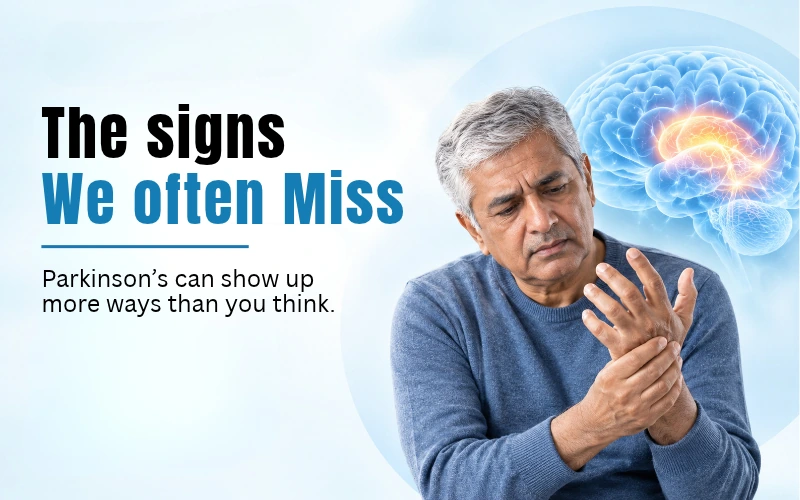
When people think of Parkinson’s, they often imagine a trembling hand. But the early signs of Parkinson’s disease can be much quieter. The handwriting may shrink. The voice may soften. The face may look less expressive. These changes can be easily blamed on age or mood, and families are often the first to notice them.
I have seen Parkinson’s disease slowly take over the system as the brain gradually loses cells that make dopamine, a chemical that helps coordinate movement. Because the changes build slowly, Parkinson’s disease patients often do not notice what has shifted. A spouse, a child or a colleague notices it first: “Dad’s handwriting looks different.” “She does not swing her arm when she walks.”
Parkinson’s Disease Symptoms: The Early Signs Families Often Miss
Doctors usually first describe the movement features of Parkinsons. In my experience some of the signs of Parkinsons can be easy to overlook.
| What you might notice | What it can look like day to day |
|---|---|
| Smaller, cramped handwriting | Writing that gets smaller as a sentence goes on, or is noticeably tighter than it used to be |
| Slowness of movement | Everyday tasks such as buttoning a shirt, brushing teeth or getting out of a chair take longer than before |
| A softer, flatter voice | Speaking more quietly, or sounding more monotone; others keep asking the person to repeat themselves |
| Reduced facial expression | A face that looks serious or “blank” even when the person feels fine; less blinking |
| Changes in walking and posture | Shorter steps, less arm swing on one side, a slightly stooped posture |
| Tremor or stiffness on one side | A tremor that appears when the hand is resting and eases with movement, or a limb that feels stiff; often starts on one side |
Signs Beyond Movement: Non-Motor Symptoms of Parkinson’s
I have seen that Parkinson’s can also cause changes that do not look like a movement problem, and some of these changes can appear years before the movement signs.
A loss of sense of smell that doesn’t go away and isn’t caused by a cold or allergy.
- Constipation that keeps happening and doesn’t improve.
- Changes in sleep patterns, like moving, shouting, or kicking during sleep, and acting out dreams.
- Mood changes, such as feeling low or anxious when this wasn’t usual before.
- Feeling tired all the time or losing motivation to do things.
How Parkinson’s Disease Is Diagnosed
- History, including from family
The doctor asks what has changed, when it began, and which side it affects. A relative’s observations are often as valuable as the patient’s own account, so bring someone who knows the person well.
- Neurological examination
A movement disorder specialist examines movement speed, muscle tone, tremor, walking, posture and balance. In most cases the diagnosis rests on this clinical assessment.
- Tests to rule out other causes
There is no single blood test that confirms Parkinson’s. Brain imaging and other tests may be used to exclude other conditions, and in uncertain cases specialised scans may be considered.
- Review over time
Because early Parkinson’s can resemble other conditions, the picture often becomes clearer with follow-up, and a response to treatment can also help guide the diagnosis.
Parkinson’s Disease Treatment: What It Can Do
There is currently no cure for Parkinson’s, but there is a lot that can be done to control symptoms and keep people active and independent for longer. Treatment is individual and is planned with a neurologist:
- Medication: medicines that replace or mimic dopamine are the mainstay for movement symptoms. Doses and combinations are adjusted over time, and should only ever be changed by the treating doctor.
- Exercise and physiotherapy: regular, structured exercise is widely recommended and supports movement and balance.
- Speech and swallowing therapy for voice and swallowing changes.
- Occupational therapy to adapt daily tasks and the home.
- Surgery in selected patients: deep brain stimulation, in which a device is implanted to modulate abnormal brain signals, may be considered for some people whose symptoms are no longer well controlled with medication. Suitability is assessed carefully by a specialist team.
A note on this topic
A Parkinson’s diagnosis can bring fear, grief and uncertainty for the person and for those around them. It is a long-term condition, but many people live active lives for many years with good care. Counselling and support groups, for patients and carers alike, can help, and it is entirely reasonable to ask for them.
When to see a doctor
- Handwriting has become noticeably smaller or more cramped.
- A tremor or stiffness appears on one side and isn’t going away.
- Everyday movements have slowed, or walking has become shuffling with less arm swing.
- Voice has become quieter or the face less expressive, and family have commented on it.
- Several of the other signs, such as smell loss, long-standing constipation and acting out dreams, are present together.
Frequently asked questions
Q: Is a hand tremor always Parkinson’s?
No. Many tremors have other causes, including essential tremor, anxiety, caffeine and certain medicines. A neurologist can tell them apart by examining when and how the tremor appears.
Q: Is Parkinson’s inherited?
Most cases are not clearly inherited, although genetics can play a role in some. Having a relative with Parkinson’s doesn’t mean you will develop it, and a neurologist can discuss individual questions.
Q: Does Parkinson’s affect thinking and memory?
It can in some people, particularly later in the course of the disease. Mood, sleep and thinking changes are part of the picture and are worth raising with the doctor, as they can often be helped.
Q: Can lifestyle changes help?
Regular exercise, good sleep and a balanced diet support overall health and well-being and are encouraged alongside medical treatment. They do not replace it, and no supplement has been shown to cure the condition.
Q: How much does Parkinson’s treatment cost in India?
The cost depends on the type of treatment, the hospital, and how advanced the condition is. Our Parkinson’s treatment package lists deep brain stimulation (the main surgical option) in India at roughly $14,000 to $25,000, and a neurologist can confirm a personalised estimate after reviewing your reports.
Q: Can I get a neurology opinion before deciding on treatment?
Yes. Our partner neurology specialists can review your reports and scans through a free, no-obligation second-opinion consultation, so you understand the diagnosis and the options before you decide anything.
Conclusion
Parkinson’s often announces itself in small, ordinary ways, and it is the people closest to someone who notice. If a cluster of these changes sounds familiar, don’t wait for a tremor to appear: an early assessment gives you a clearer picture and, if it is Parkinson’s, an earlier start on treatment, therapy and support.