
When people begin researching options abroad they type phrases such as medical tourism India, India medical travel and safe treatment India and understandably so. Choosing to travel for healthcare raises immediate questions about quality, continuity, legal protections and logistics. This article explains, in practical detail, how medical travel to India works, why many international patients consider it a safe option and how a specialist facilitator such as MediKaya Healthcare helps turn lower headline prices into genuine, secure value. Throughout we use evidence-based considerations, practical checklists and clear guidance so that prospective patients can judge safety for themselves and confidently plan their India medical travel journey.
Why India attracts international patients- context and facts
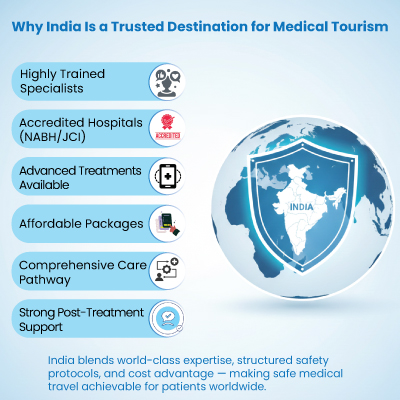
India has become a leading medical travel destination for several reasons-
- Clinical expertise and high procedural volumes- Many Indian centres perform large numbers of common and complex procedures, which often correlates with better outcomes for specific operations.
- Accredited hospitals and modern technology- Increasingly, private hospitals in India maintain international-standard infrastructure, advanced imaging, intensive care units and access to minimally invasive and robotic techniques.
- Cost advantage without automatic compromise- As discussed elsewhere, lower operating costs, local manufacturing of devices and high throughput often translate into substantial savings for international patients.
- Multilingual clinical communications- For many international patients, English as a working language reduces barriers to informed consent and follow-up.
- A mature facilitation ecosystem- Experienced medical facilitators (such as MediKaya Healthcare) provide pre-travel assessments, logistics, on-ground case management and post-discharge follow-up.
These factors do not guarantee safety automatically, but they create the conditions for safe, high-quality care when the right checks and partnerships are in place.
What “safe” means for international patients
Safety for medical travellers is multi-dimensional. Thinking beyond a single metric helps avoid false assumptions.
Clinical safety and outcomes
Clinical safety covers surgeon skill, multidisciplinary team competence, infection control, critical care capacity and adherence to clinical protocols. Outcome measures to ask about include mortality, complication rates, readmission rates and infection rates for the specific procedure.
Structural and institutional safety
This includes hospital accreditation (for example, national accreditations such as NABH and international accreditations such as JCI), the availability of modern imaging and intensive care units and established emergency procedures.
Logistical and informational safety
Safe medical travel depends on transparent, itemised pricing, documented consent, timely communication, reliable transport and interpreter services and clear plans for post-operative rehabilitation and follow-up.
Legal and ethical safety
Patients should understand the medico-legal environment, malpractice recourse and how medical records and privacy are handled across borders.
Common safety concerns and practical responses
Below are common fears international patients express and concrete ways to address them.
Concern- “How can I trust surgeon skill and hospital standards?”
Ask for the surgeon’s CV, subspecialty training and numbers of similar procedures performed in the past year. Request hospital outcome data for the operation and confirm accreditation status. MediKaya Healthcare pre-qualifies partner hospitals and can supply these documents as part of the pre-travel package.
Concern- “Will infection control and ICU care match my home country?”
Confirm whether the hospital has an accredited infection control programme and dedicated ICU beds for post-operative care. Seek details on nursing ratios, critical care protocols and availability of ventilators or blood bank services. MediKaya Healthcare’s on-ground case managers review these facilities during site assessments.
Concern- “What happens if there’s a complication after I return home?”
Plan continuity of care before travel. Obtain an itemised discharge summary, full imaging and test results in English and arrange telemedicine follow-ups. MediKaya Healthcare coordinates with the patient’s local clinician to ensure a smooth handover and, where appropriate, will assist in arranging repeat evaluation or transfer back to India if required.
Concern- “How do I avoid fraud, hidden costs or sub-standard hospitals?”
Insist on an itemised pro-forma invoice showing surgeon fees, theatre charges, implants, ICU and physiotherapy. Check whether the hospital is on the facilitator’s verified partner list. MediKaya Healthcare negotiates transparent packages, discloses implant brands and provides a single point of contact throughout the stay to prevent unforeseen charges.
Accreditation, certification and what to verify
Accreditation is a practical proxy for institutional quality, but it must be interpreted correctly.
- NABH (National Accreditation Board for Hospitals & Healthcare Providers) is India’s national benchmark for hospital quality and patient safety.
- JCI (Joint Commission International) is widely recognised by international patients and insurers as an indicator of global-standard clinical governance.
- ISO certifications address systems such as laboratory quality management but do not by themselves guarantee clinical excellence.
Ask whether the hospital holds NABH and/or JCI accreditation, when those accreditations were last renewed and whether the specific department (cardiac surgery, orthopaedics, oncology) is subject to departmental audits. MediKaya Healthcare only lists and recommends hospitals that meet rigorous accreditation and performance criteria.
The MediKaya Healthcare advantage how a reputable facilitator improves safety
Choosing a trusted facilitator significantly reduces risk. MediKaya Healthcare specialises in supporting international patients through every stage of India medical travel. Here’s how MediKaya Healthcare’s services map directly onto the safety needs described above.
Clinical matching and second opinions
MediKaya Healthcare organises an initial medical review and secures specialist second opinions to confirm diagnosis and appropriate treatment pathways. This helps prevent unnecessary travel and ensures the chosen hospital and consultant are well matched to the patient’s condition.
Transparent, itemised costing
MediKaya Healthcare insists on pro-forma invoices that itemise surgeon fees, theatre charges, implants, ICU days and physiotherapy. Clear costing avoids unpleasant surprises and helps patients obtain insurance pre-authorisations.
Pre-travel planning and legal documentation
MediKaya Healthcare assists with invitation letters, medical visa guidance, consent forms in English and explanations of local medico-legal protections, giving patients better clarity before departure.
On-ground case management and language support
From airport pickup to bedside coordination during hospital stay, MediKaya Healthcare assigns a dedicated case manager. Interpreters and liaison staff ensure that clinical instructions, consent and discharge paperwork are understood.
Logistics, accommodation and companion care
MediKaya Healthcare negotiates hospital-adjacent accommodation and arranges travel and airport transfers, reducing stressors that can otherwise increase the risk of post-op complications such as delayed mobilisation.
Post-operative follow-up and telemedicine
MediKaya Healthcare arranges teleconsultations, sends full discharge summaries and CT/MRI images electronically and coordinates with the patient’s local physician for rehabilitation, crucial steps in ensuring outcomes are maintained once the patient has returned home.
Contingency planning and insurance liaison
MediKaya Healthcare helps patients prepare contingency funds, explains policies relating to complications and liaises with international insurers for claims and documentation, reducing financial and legal uncertainty.
A realistic, step-by-step patient pathway with MediKaya Healthcare
Understanding the typical flow helps demystify the process.
- Initial contact and records submission- The patient shares medical records, images and history with MediKaya Healthcare for a no-obligation review.
- Specialist review and treatment options- MediKaya Healthcare secures opinions from the most appropriate consultants and outlines recommended procedures, alternatives and likely timelines.
- Pro-forma quotation and negotiation. MediKaya Healthcare obtains itemised quotes from accredited hospitals, negotiates where appropriate and presents package options (treatment, accommodation, airport transfers).
- Visa and travel planning. MediKaya Healthcare supplies documentation for medical visas and gives advice on travel insurance and pre-travel testing where required.
- Arrival and admission. Airport pickup, hotel check-in and hospital admission are coordinated by MediKaya Healthcare’s case manager.
- Surgery and inpatient care. MediKaya Healthcare liaises closely with the treating team, updates family members and ensures communication lines remain open.
- Discharge and immediate follow-up. Discharge summary, medicines, instructions and telemedicine appointments are provided before departure.
- Remote follow-up and rehabilitation. MediKaya Healthcare organises follow-up teleconsultations, shares records with local clinicians and helps arrange post-op rehabilitation at home.
This pathway reduces uncertainty at every stage and increases the probability of a safe, well-managed experience.
Practical safety checklist before you travel
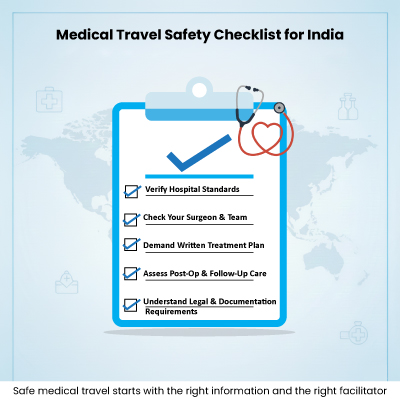
Use this checklist as a guide when evaluating options for India medical travel-
- Is the hospital NABH or JCI accredited?
- Can the hospital provide the named surgeon’s CV and outcome statistics for the specific procedure?
- Is a detailed, itemised pro-forma invoice available up front?
- What implant brand and serial numbers will be used (if applicable) and what is the warranty?
- What is the ICU capacity, nurse-to-patient ratio and infection control protocol?
- Are blood banks and other emergency services immediately available?
- Is there a case manager or patient liaison assigned for the duration of the stay?
- Is telemedicine follow-up available and will discharge documents be shared in full?
- How will complications be handled and who is responsible for additional costs?
- Does your insurance cover treatment abroad, and what documentation is required for pre-authorisation?
MediKaya Healthcare ensures partner hospitals answer these questions before travel is confirmed.
Specific clinical areas, how safety considerations change
Different specialties carry different risk profiles and require tailored checks.
Cardiac surgery
Focus on the cardiac surgeon’s annual procedural volume, perfusion technology, on-site cardiac ICU, infection control and postoperative rehabilitation services. MediKaya Healthcare partners with tertiary cardiac centres with proven track records.
Orthopaedics and joint replacement
Confirm implant brands (and provenance), surgeon experience with the specific prosthesis, intraoperative navigation or robotic assistance if used and a physiotherapy plan. MediKaya Healthcare secures implant details and rehabilitation packages.
Oncology
Look for multidisciplinary tumour boards, availability of molecular diagnostics, radiotherapy quality assurance and clinical trial participation where relevant. MediKaya Healthcare helps identify centres with robust oncology governance and follow-up pathways.
Transplantation and complex procedures
Transplant programmes require comprehensive evaluation of immunology labs, organ retrieval networks, ICU support and long-term follow-up. MediKaya Healthcare works with transplant centres that meet stringent protocols and documentation requirements.
Costs, insurance and financing safety through financial clarity
Financial surprises can undermine clinical outcomes by deterring necessary follow-up. Key steps-
- Get an itemised pro-forma invoice that lists everything: surgeon fees, theatre, implants, ICU, consumables and physiotherapy.
- Check insurance acceptance and pre-authorisation requirements well in advance. MediKaya Healthcare assists with insurer documentation and pre-auth letters.
- Plan for contingencies. A contingency fund (or insurance extension) is prudent for rare but possible complications requiring extended stay or reoperation.
- Consider bundled packages. Hospitals often provide package pricing that includes treatment, accommodation and transfers, MediKaya Healthcare negotiates these bundles to balance cost and safety.
Transparent financing reduces stress and improves adherence to post-op plans.
Legal, regulatory and ethical considerations
International patients should understand the medico-legal landscape-
- Medical records and privacy- Confirm how records will be shared and stored, and request copies of your records in English.
- Malpractice recourse- Investigate the hospital’s grievance mechanism and local legal avenues; these differ between jurisdictions and are rarely identical to patients’ home country protections.
- Informed consent- Ensure consent forms are in a language you understand, and that risks, alternatives and expected outcomes are documented.
- Cross-border follow-up- Clarify warranty terms for implants and who bears costs for corrective procedures should they be required later.
MediKaya Healthcare provides support in obtaining legally relevant documentation and clarifies procedural protections as part of the pre-travel process.
Realities and limitations, honest caveats
No healthcare system is flawless and medical travel is not suitable for every patient or condition. Consider these limits:
- Emergency care is not a travel plan- Acute emergencies require immediate local treatment rather than planned medical travel.
- Complex co-morbidities increase risk- Patients with multiple serious health problems may be safer receiving care closer to home.
- Long-term follow-up may be harder- Some procedures require prolonged rehabilitation or monitoring. Ensure continuity before selecting international care.
- Cultural and dietary differences can affect recovery- MediKaya healthcare addresses these with tailored nursing and dietary plans, but patients should factor them in.
Good facilitators will candidly recommend against travel when risks outweigh benefits.
Frequently asked questions
Are outcomes in India comparable to Western hospitals?
For accredited hospitals and experienced consultants outcomes for many procedures are comparable and, in some high-volume specialities, excellent due to focused expertise.
How can I verify that a MediKaya Healthcare recommended hospital is reputable?
Ask MediKaya Healthcare for accreditation certificates, surgeon CVs, departmental outcome data and patient pathway documentation. Reputable facilitators will provide these promptly.
Will my insurance cover treatment in India?
Many international insurers cover treatment in India with pre-authorisation; MediKaya Healthcare assists with the necessary documentation and insurer communication.
How does MediKaya Healthcare handle complications?
MediKaya Healthcare outlines contingency plans before travel, including likely costs, the treating hospital’s protocol and pathways for local or repatriation care if necessary.
Checklist- questions to ask your facilitator or hospital before committing
- Can you provide the hospital’s accreditation and the surgeon’s CV?
- Will I get a detailed pro-forma invoice?
- What exact implant brand/model will be used (if applicable)?
- What is the ICU capacity and nurse-to-patient ratio?
- How will discharge documentation and imaging be shared?
- What telemedicine follow-up is included?
- What are the contingency procedures for complications and associated costs?
MediKaya Healthcare proactively answers these questions for every patient and includes them in the travel package.
Conclusion- balancing value and safety in India medical travel
Medical tourism India and India medical travel are terms that reflect a growing, practical choice for patients seeking high-quality care at a lower landed cost. The question “Is medical travel to India really safe?” cannot be answered with a single yes or no; it depends on choices made before, during and after treatment. When patients select accredited hospitals, insist on transparent, itemised invoices, verify named surgeons and use a trusted facilitator such as MediKaya Healthcare, the probability of a safe, well-managed outcome rises substantially.
MediKaya Healthcare converts headline affordability into responsible care by matching patients with accredited centres, negotiating transparent packages, coordinating visas and logistics, providing on-ground case management and arranging rigorous post-operative follow-up. For many patients, this approach delivers safe treatment in India that is both affordable and dependable.
If you are considering medical travel, make decisions based on evidence- accreditation, outcome data, surgeon experience, a clear financial plan and a facilitator that places safety and transparency first. With the right preparation and partners, India medical travel can be a safe, cost-effective pathway to excellent healthcare.
Follow us on:
Address:
E-44/3, First Floor, Okhla Ind. Area Phase 2,
Okhla Industrial Estate, South Delhi,
New Delhi – 110020, India