
Among the medical services which are most relevant and which are less delivered to the patients from Turkmenistan, Uzbekistan, Kyrgyzstan and Tajikistan, the kidney transplant is one of the most important ones. The transplant programmes are either very small, or even nonexistent, and patients end up on long-term dialysis or they travel to Germany and/or Turkey but do not have the financial resources to cover the expenses. The solution, however, lies in India, as there is a living donor programme for kidney transplant in India that can provide a solution: surgery in 6-10 weeks, managed end-to-end by Russian-speaking specialists from the MediKaya Healthcare group at $12,000-$18,000.
This booklet is for patients and family members from countries impacted by CIS (Turkmenistan, Uzbekistan, Kyrgyzstan, Tajikistan and Kazakhstan) who are in the process of a kidney transplant. It includes what you need to do prior to arrival in India, what occurs on arrival, the cost of this and how you are catered for by MediKaya Healthcare throughout.
Why Patients from Turkmenistan and CIS Choose India for Kidney Transplant?
There are no complicated explanations why; just simple facts about access to healthcare in Central Asia:
Turkmenistan — No Local Programme
There is no kidney transplant programme in Turkmenistan. Until recently, patients with end-stage renal disease along with their eligibility for transplant, had three choices: to stay on dialysis for life, to go to Russia or Turkey for transplant for a very high cost or go to India. India is the most feasible place for families from Ashgabat, Mary, Turkmenistan and Turkmenabat as they have had more experience in getting visas from the Embassy of Turkmenistan in India, and have had existing connections.
Uzbekistan — 3–6 Year Government Waiting List
There is a program for kidney transplantation in the government hospitals in Uzbekistan and waiting list for cadaveric (deceased donor) kidneys is usually 3-6 years. It is not consistent, and living donor transplants are not available, and expensive in the private sector ($20,000 – $50,000). A high prevalence of hepatitis B infection exists in Central Asia, with over 5-7% of population being infected and HBV related nephropathy is a significant cause of kidney failure among the patients from Uzbekistan. MediKaya Healthcare has helped patients in Tashkent, Samarkand, Namangan and Fergana.
Check for the Top 5 Hospitals for Kidney Transplant in India.
Kyrgyzstan — Limited Capacity, Long Waits
Kazakhstan’s transplant system is relatively advanced and waiting list on public queues is from 2-5 years, while the cost of a transplant in a private hospital is $40,000-$60,000 for a living donor transplant. This is what can be achieved in India at $12,000-$18,000; which comes to $25,000-$40,000 is a viable option for Kazakhstani families.
Kazakhstan — Long Public Waits, High Private Costs
Compared to other Central Asian states, Kazakhstan has a relatively advanced transplant system, but waiting lists on public queues are 2-5 years, and the price of a transplant in a private hospital is $40,000–$60,000 for living donor transplant. This is similar to what is possible in India, at $12,000–$18,000, a saving of $25,000–$40,000—a viable alternative for Kazakhstani families.
Cost Comparison — Kidney Transplant for CIS Patients
All costs below reflect living donor kidney transplant including pre-operative workup, surgery, hospital stay, and discharge medications:
| Country / Hospital | JCI | NABH | ||
|---|---|---|---|---|
| Administered by | Cost (USD) | Waiting Time | Donor Type | Standard |
| India — BLK-Max Delhi (MediKaya partner) | $12,000–$16,000 | 6–10 weeks | Living donor | JCI Accredited |
| India — Medanta Gurugram | $14,000–$18,000 | 6–10 weeks | Living donor | JCI Accredited |
| Turkey — Istanbul | $25,000–$40,000 | 4–8 weeks | Living/Cadaveric | Some accreditation |
| Russia — Private hospital | $30,000–$60,000 | Variable | Limited | Variable |
| Germany | $60,000–$100,000 | 6+ months wait | Cadaveric priority | International |
| Kazakhstan — Private | $30,000–$60,000 | 2–5 years public | Variable | Variable |
| Uzbekistan — Limited availability | $20,000–$50,000 | 6–24 months | Limited | Variable |
| Turkmenistan | Not available | N/A | N/A | No programme |
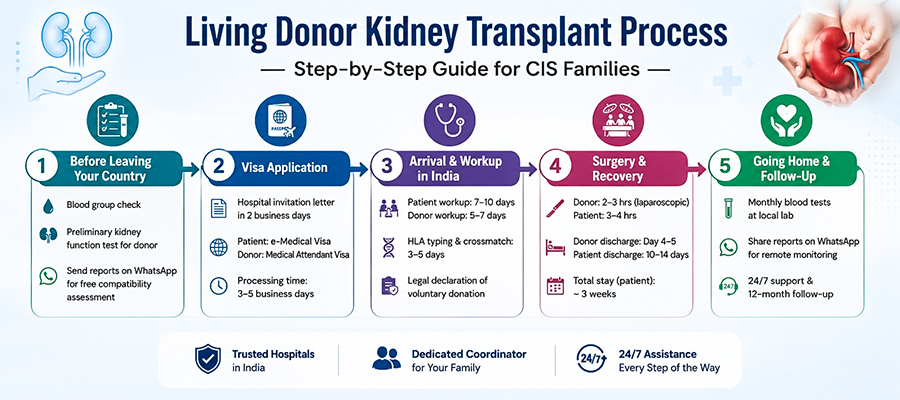
Living Donor Process — A Practical Guide for CIS Families
The majority of patients with CIS who come to India for a kidney transplant have a relative as the living donor. That process is actually as follows:
Phase 1: Before Leaving Your Country
- Find the potential donor (spouse, sibling, parent, adult child) who is in good general health, age 18-65
- Blood group check will be conducted at any local lab, both patient and donor will have their blood group typed
- A preliminary kidney function test has been done on the donor to test creatinine, urea, GFR estimated — at local lab.
- Send all results to MediKaya via WhatsApp for preliminary compatibility testing – free – within 48 hours.
- MediKaya Healthcare offers an assurance of initial compatibility and visa paperwork checklist
Phase 2: Visa Application
- MediKaya creates Hospital Invitation Letter from Partner Hospital — within 2 business days.
- Patient submits the e-Medical Visa application to the indianvisaonline.gov.in website with the invitation letter and passport and photographs.
- Patient applies for e-Medical Visa with invitation letter, passport, photographs at indianvisaonline.gov.in.
- Donor applies for Medical Attendant Visa at the same time.
- Processing time: 3-5 business days after application.
- No government referral letter is required — it is only a hospital invitation letter.
Phase 3: Arrival and Pre-Transplant Workup in India
- The MediKaya coordinator greets patient and donor at Indira Gandhi International Airport, in Delhi
- Arrangement of hotel near hospital for the family members who are not in hospital.
- Cardiac evaluation and infectious disease screening, blood tests, renal imaging: 7–10 days patient workup
- Donor workup: 5-7 days — CT renal angio, full kidney function, psychological evaluation, health assessment
- HLA tissue typing and final crossmatch: 3-5 days — confirms compatibility
- Legal declaration of voluntary donation — mandatory in India. MediKaya coordinates paperwork.
Phase 4: Surgery and Recovery
- Surgery day: patient and donor operations scheduled at same hospital
- Donor: laparoscopic nephrectomy (minimally invasive, 2–3 hours)
- Patient: kidney implantation (3–4 hours)
- Donor discharge: day 4–5 post-surgery
- Patient: ICU 2–3 days, then general ward 10–14 days, then discharge when kidney function stable
- Total stay (patient): approximately 3 weeks from surgery date
Phase 5: Going Home and Follow-Up
- MediKaya offers discharge pack: immunosuppression protocol, dietary guide, activity restrictions, emergency contacts
- Monthly blood tests conducted in local lab: creatinine, tacrolimus level, blood count
- Results delivered through MediKaya nephrologist’s WhatsApp for remote monitoring
- The 24/7 MediKaya coordinator is available to answer questions and provide guidance on medication.
- 12-month follow-up in MediKaya Healthcare service
What to Bring to India — CIS Patient Checklist?
Taking the time to prepare can help minimize delays and avoid repeat testing. MediKaya provides each patient family with an individualised checklist once assessed. The following are the common documents written:
- Lab Data: All kidney function tests over the past 6 months (including creatinine, urea, GFR and urine protein)
- Dialysis records: Access type, frequency, duration, adequacy reports (if on dialysis).
- Treatment: Echocardiogram (cardiac function assessment — preferably within 3 months)
- Imaging: Ultrasound (abdominal, renal, uterine, and pelvic), X-ray, MRI (abdominal, kidney, liver, and pelvis), and CT scan (abdominal and pelvis)
- Renal ultrasound or imaging (if available)
- Recipient: Blood group, creatinine, urine protein, blood pressure for 24 hour.
- Both: Valid passports (minimum 6 months validity beyond planned travel date)
- Both: 2 passport-size photographs for visa
Also Check- India Medical Visa Checklist
MediKaya Healthcare provides a Russian-language checklist to all CIS patients. Your coordinator will confirm exactly which tests are needed based on your specific situation.
Russian-Speaking Coordinator — What Support Is Available?
From the first WhatsApp message, Medikaya Healthcare’s CIS patient support is provided throughout the 12-month period following surgery. At every stage there is our Russian-speaking coordinator:
- The process of initial report review and assessment of eligibility — in Russian
- Prepare and provide information for visa applications
- Airport pick up in Delhi and accommodation arrangement shall be taken care of.
- Consultations, workup and ward visits provided with daily translation services
- Legal declaration of donation documents (with assistance in Russian)
- Explanation of discharge and medications in Russian.
- All blood test reviews via WhatsApp in Russian – after 12 months.
- In the event of an emergency call 24 hours, 7 days a week.
Get Free Medical Consultation with Russian Coordinator.
Frequently Asked Questions — CIS Patients and Kidney Transplant India
Q: Does India accept patients from Turkmenistan without a referral letter from the government?
A: Yes. A letter of referral from the government in Turkmenistan is not needed for medical visa for kidney transplant in India treatment. MediKaya’s partner hospital (BLK-Max or Medanta) invitation letter will be accepted as sufficient proof for the e-Medical Visa application. This has helped many patients in Turkmenistan be able to get their kidney transplant done in India.
Q: My potential donor is my 58-year-old mother. Is she too old to donate?
A: The accepted donor age range for living kidney donation is 18-65 years, which is within the age range of 58. Her main factors are general health, renal function (GFR should be >80 mL/min/1.73m²), blood pressure control, lack of diabetes, and cardiovascular history. The transplant team carefully looks at all these factors. Arrange for transfer of her blood test results, creatinine, blood pressure, to MediKaya for a free initial evaluation.
Q: We are from Uzbekistan and have three potential donors — husband, son, and brother. How do we know who is the best match?
A: There is great flexibilities from having several possible donors. The first screen (performed at any local laboratory) is for blood group compatibility. HLA compatibility (strongest match) is tested on arrival in India which takes 3-5 days. When considering compatible donors, age, kidney function, vascular anatomy on computed tomography (CT) scan, and psychological suitability will be taken into account. When travelling, MediKaya will help you to narrow down through preliminary screening of all three to maximise chances of finding at least one confirmed “compatible” donor upon your arrival.
Q: Can I continue my dialysis in India while waiting for the workup and transplant?
A: Yes. If you are currently on haemodialysis, MediKaya Healthcare arranges dialysis at the partner hospital during the period of work up for your transplant (usually 7-10 days). Your dialysis schedule is included in your inpatient work-up plan, so that you will not miss any treatment during your evaluation.
Q: After returning home, can I get my monthly blood tests done at a local clinic in Tashkent or Bishkek?
A: Yes. The monthly monitoring tests (creatinine, tacrolimus level, blood count) can be done at any standard laboratory. Just send a picture or PDF file to us via WhatsApp. Our nephrologist checks and responds within 24 hours and makes any recommendations for changes in medication dosage. No need to return to India for routine follow-up.
🇷🇺 КРАТКОЕ СОДЕРЖАНИЕ (Для читателей из России, Казахстана и СНГ)
Трансплантация почки в Индии для пациентов из Туркменистана и СНГ — стоимость и процесс 2026 Для пациентов из Туркменистана, где программа трансплантации почки практически отсутствует, Индия предлагает единственный реалистичный вариант помимо диализа. Стоимость трансплантации почки от живого донора в Индии составляет $12,000–$18,000 — значительно дешевле Германии ($60,000–$100,000) или Турции ($25,000–$40,000). Срок ожидания — 6–10 недель. Для пациентов из Узбекистана и Кыргызстана, где государственные очереди на трансплантацию занимают 3–6 лет, а частные клиники берут $20,000–$50,000 при нестабильном качестве, Индия — это более быстрый и доступный путь. MediKaya Healthcare организует весь процесс с русскоязычным сопровождением: от первого сообщения в WhatsApp до 12-месячного наблюдения после операции. Мы помогаем пациентам из Ашхабада, Ташкента, Самарканда, Бишкека и Душанбе.
Краткое резюме – Kidney Transplant (Russian Summary Box)
Трансплантация почки в Индии для пациентов из Туркменистана и СНГ — стоимость и процесс 2026 Для пациентов из Туркменистана, где программа трансплантации почки практически отсутствует, Индия предлагает единственный реалистичный вариант помимо диализа. Стоимость трансплантации почки от живого донора в Индии составляет $12,000–$18,000 — значительно дешевле Германии ($60,000–$100,000) или Турции ($25,000–$40,000). Срок ожидания — 6–10 недель. Для пациентов из Узбекистана и Кыргызстана, где государственные очереди на трансплантацию занимают 3–6 лет, а частные клиники берут $20,000–$50,000 при нестабильном качестве, Индия — это более быстрый и доступный путь. MediKaya Healthcare организует весь процесс с русскоязычным сопровождением: от первого сообщения в WhatsApp до 12-месячного наблюдения после операции. Мы помогаем пациентам из Ашхабада, Ташкента, Самарканда, Бишкека и Душанбе. Пишите: WhatsApp +91 9717998697 | Telegram: @MediKayaHealthcare