
Two numbers, one reading, and depending on which guideline your doctor follows, the same reading can carry a different label. Here’s what each number measures, where the major guidelines disagree, and what to do with a result higher than you expected.
The same reading can be “high” in one guideline and “elevated” in another.
That isn’t a contradiction; it reflects different choices about where to start treating. Knowing which yardstick your doctor uses is part of understanding your own number.
A blood pressure reading is one of the most common numbers in medicine and one of the least explained. Most people know 120/80 as “the healthy one,” but far fewer know what the two numbers actually measure, why a single reading proves very little on its own, or why a friend treated in another country might have been given a different label for a similar result.
This guide is a plain-language reference: what the numbers mean, how the main guidelines differ, how to take an accurate reading, and when a high result stops being “monitor it” and becomes “act today.”
What the two numbers actually measure
The top number (systolic) is the pressure in your arteries when your heart contracts and pushes blood out. The bottom number (diastolic) is the pressure between beats, while the heart relaxes and refills. A reading of 120/80 is said to be “120 over 80” and is measured in millimeters of mercury (mmHg).
Both numbers matter. In most classification systems a reading is placed in the higher category if either number falls into it so 118/92 is not “normal because the top number is fine.”
The categories most people are familiar with
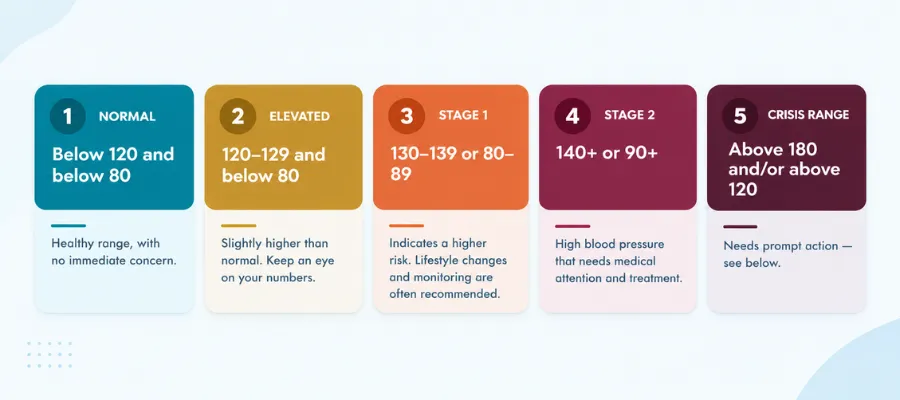
The 2025 US guideline (ACC/AHA) kept the same category names used since 2017. This is the scale you’ll see printed on many home monitors and health apps:
Why guidelines disagree and why it matters to you
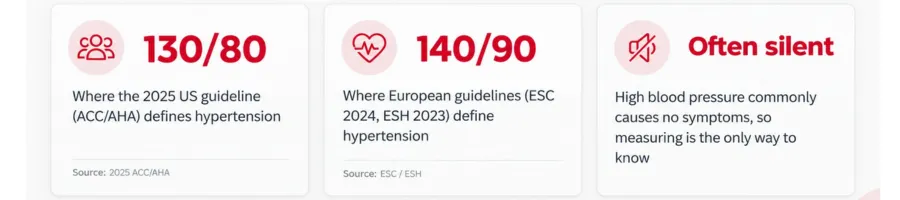
The difference isn’t about what the numbers are; it’s about when to start calling something hypertension and treating it. Lowering the threshold catches more people earlier but means more people carry a diagnosis; a higher threshold reserves the label for clearer-cut cases. Both approaches agree on the most important point: treatment is recommended for readings of 140/90 and above and for the 130–139/80–89 zone when overall cardiovascular risk is high.
| Guideline | Hypertension Defined From | How It Treats the 130–139 / 80–89 Zone |
|---|---|---|
| ACC/AHA 2025 (United States) | 130/80 | Labelled “Stage 1 hypertension.” Lifestyle first; medication depends on risk factors (existing heart disease, kidney disease, diabetes, or a high calculated risk score), or if readings stay high after several months of lifestyle change. |
| ESC 2024 (Europe) | 140/90 | The 120–139 / 70–89 range is labelled “elevated blood pressure.” Lifestyle advice for everyone; medication considered when overall cardiovascular risk is high. |
| ESH 2023 (Europe) | 140/90 | 130–139 / 85–89 is called “high-normal.” Treatment targets are tailored by age, with less strict targets for older adults. |
Note: Diastolic cut-offs differ slightly between guidelines, so treat this as a summary, not a conversion chart. Your own doctor’s assessment of your total risk matters more than any single label.
One high reading is not a diagnosis
Blood pressure naturally moves through the day with activity, stress, caffeine, pain, a full bladder, and even the act of being in a clinic. This is why diagnosis rests on repeated readings taken correctly, ideally on more than one day, and increasingly on readings taken outside the clinic (at home or with a 24-hour monitor) as well. Some people read high only in the clinic; others read normal in the clinic but high at home, and only repeated measurements reveal what is happening.
How to take an accurate reading
Small mistakes can shift a reading by enough to change its category. These habits are the difference between a number you can trust and one that just adds worry.
- Avoid caffeine, smoking, and exercise for at least 30 minutes beforehand, and empty your bladder first.
- Sit quietly for about five minutes, back supported, feet flat on the floor, legs uncrossed.
- Rest your bare upper arm on a table so the cuff sits at heart level; don’t talk during the measurement.
- Use a correctly sized cuff. A cuff that’s too small can read falsely high.
- Take two readings a minute apart and write both down, with the date and time.
What to do with a higher-than-expected reading
- Don’t act on one number: A single reading is a prompt to look closer, not a diagnosis.
- Rest and remeasure: Sit quietly for five minutes and repeat the reading correctly. Many “high” readings settle.
- Build a small log: Record readings over several days, at consistent times, so a pattern can be seen rather than guessed at.
- Book a review and bring the log: Your doctor can combine your readings with your age, family history, kidney function, blood sugar, and cholesterol to judge your overall risk and set a target.
- Know the emergency threshold: Readings above 180/120 need prompt attention; see the warning below.
What lowers blood pressure and where medication fits
For many people, lifestyle changes make a measurable difference: reducing salt, being physically active, moving toward a healthier weight, limiting alcohol and not smoking. How much they help varies from person to person, and lifestyle alone isn’t always enough — particularly when readings are in the higher ranges or overall cardiovascular risk is high. That is not a failure; it’s simply how the condition behaves for some people, and modern medications are effective and well studied.
When a specialist opinion is worth seeking, including abroad
Most high blood pressure is best managed steadily and close to home, with a doctor who sees you regularly. Travelling for it isn’t usually necessary, and we’d rather say that plainly. A cardiology opinion becomes more valuable in specific situations:
- Readings stay above target despite several medications
- High blood pressure appears at a young age or rises suddenly
- There are signs it’s affecting the heart or kidneys
- You’ve been told a procedure or treatment is needed and want confirmation before committing.
In those cases, a second opinion with your existing reports in hand can clarify your options without any obligation to travel or proceed.
Frequently asked questions
Q: Is the top number or the bottom number more important?
Both count, and a reading is generally classified by whichever number falls in the higher category. Doctors often pay particular attention to the top (systolic) number in older adults, but a raised bottom number is not something to ignore.
Q: Can my blood pressure be high without any symptoms?
Yes this is exactly why it’s called a “silent” risk factor. Many people feel entirely well while their readings are consistently raised, which is why measuring, not waiting for symptoms, is the only reliable way to know.
Q: Why is my reading higher at the clinic than at home?
Some people’s blood pressure rises in a medical setting, often called the “white-coat effect.” The opposite also happens, where readings look fine in clinic but run high at home. This is why repeated readings outside the clinic add valuable information where they’re available.
Q: Do I need to buy a home monitor?
Where you can access a validated device, it’s useful. Where you can’t, repeated readings at a clinic or pharmacy on different days, written down and brought to your doctor, are still worthwhile. If you buy a monitor, an upper-arm cuff is generally preferred over wrist devices.
Q: Which guideline should I follow, 130/80 or 140/90?
You don’t need to pick. Follow the plan your own doctor sets, based on your total cardiovascular risk. The guidelines agree on the fundamentals: measure properly, act on persistently high readings, and treat readings of 140/90 and above.
Q: Can I get a second opinion on my blood pressure treatment?
Yes, our partner cardiologists offer a free, no-obligation second opinion, which can be useful if your readings aren’t coming under control or you’ve been advised to start a major treatment.
Conclusion
Blood pressure numbers are simple to take and surprisingly easy to misread. The real skill is knowing what one reading can and can’t tell you: measure carefully, look for patterns rather than single results, understand which yardstick your doctor is using, and treat the emergency range as genuinely urgent. Do that, and the two numbers on the screen become a useful conversation with your doctor rather than a source of worry.