
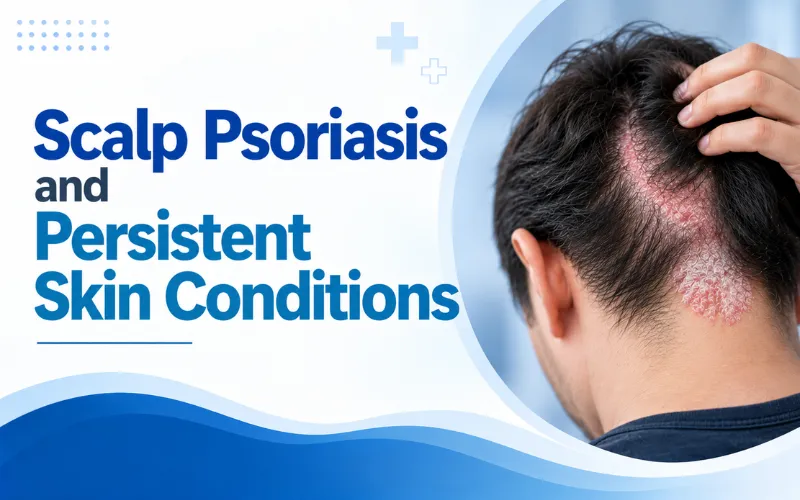
Persistent scalp flaking gets dismissed as stubborn dandruff for years, sometimes decades, before anyone considers it might be something else. This guide is for anyone who has tried every shampoo on the shelf without lasting relief — it’s time to look at scalp psoriasis treatment as a genuine, medically manageable condition rather than a cosmetic nuisance to keep masking. Understanding the real difference between dandruff and psoriasis, and what proper dermatological treatment actually involves, changes years of frustrated trial and error into a clear, effective plan.
How Scalp Psoriasis Differs From Dandruff
Dandruff typically causes fine, white-to-yellow flakes with mild itching and no thickened skin underneath, generally linked to a yeast called Malassezia and an oily scalp. Scalp psoriasis, by contrast, produces thicker, silvery-white scaly patches on red, well-defined areas of skin, often extending past the hairline onto the forehead, neck, or behind the ears — and it tends to be more persistently itchy or even sore to the touch.
The distinction matters because dandruff responds to over-the-counter anti-fungal shampoo containing ingredients like ketoconazole or zinc pyrithione, while psoriasis is an autoimmune condition driven by an overactive immune response that anti-dandruff treatment alone will not resolve, no matter how consistently it’s used.
A simple but telling clue: dandruff flakes tend to be smaller and more diffuse across the scalp, while psoriasis plaques are usually thicker, more clearly bordered, and can sometimes bleed slightly if scratched or picked at, due to the rapid, disorganized skin cell turnover characteristic of the condition.
Why Home Remedies Eventually Stop Working
Coconut oil, aloe vera, and medicated shampoos can genuinely ease mild symptoms, which is exactly why the condition often goes undiagnosed for years — temporary relief masks an underlying autoimmune process that continues regardless of which oil or shampoo is used that week. Over time, patches tend to thicken, spread, or become resistant to whatever combination previously worked, leaving patients cycling through an escalating series of home remedies with diminishing returns.
That escalation pattern — needing more product for less relief, or needing to combine multiple remedies just to maintain the same level of comfort — is one of the clearest signals it’s time for a dermatologist rather than a different shampoo. It reflects the underlying immune process continuing to progress beneath surface-level symptom management.
What Real Treatment Looks Like
Dermatological treatment typically starts with medicated topical steroids or vitamin D analogues applied directly to affected areas, moving to phototherapy (controlled UV light treatment) or systemic/biologic treatments for more extensive or resistant cases that don’t respond adequately to topical approaches alone. Diagnosis is usually clinical, based on the characteristic appearance and pattern, sometimes confirmed with a skin biopsy in ambiguous cases where the presentation isn’t entirely typical.
Treatment plans are adjusted based on severity and response over several weeks — a dermatologist will typically reassess after an initial trial period rather than committing to one treatment indefinitely regardless of how the skin is actually responding.
MediKaya connects international patients with dermatology specialists for a full scalp and skin evaluation, including biologic therapy options not always accessible locally, particularly valuable for patients whose psoriasis extends beyond the scalp or has proven resistant to standard topical treatment.
Understanding Biologic Therapy for More Severe Cases
For moderate-to-severe psoriasis that hasn’t responded adequately to topical treatment or phototherapy, biologic medications — which target specific components of the overactive immune response responsible for psoriasis — have transformed outcomes for many patients over the past decade or so. These are typically given by injection at intervals ranging from weekly to every few months, depending on the specific medication.
Biologics require careful screening beforehand, including tests for latent infections like tuberculosis, since they work by modulating immune function — this screening process is a standard, important part of safely starting biologic treatment rather than an unnecessary hurdle, and MediKaya’s dermatology partners manage this full evaluation as part of the treatment planning process.
The Psychological Weight of a Visible Skin Condition
Scalp psoriasis, particularly when it extends to visible areas like the hairline or behind the ears, carries a genuine psychological burden that’s easy to underestimate from the outside — self-consciousness, social withdrawal, and frustration with a condition that resists simple fixes are common and valid experiences, not an overreaction to ‘just a skin problem.’
Addressing this openly with a dermatologist, rather than only discussing the physical symptoms, often leads to a more complete and satisfying treatment plan — many patients find that effective treatment brings relief that extends well beyond the visible skin itself, into confidence and daily comfort that had quietly eroded over years of managing the condition alone.
What to Expect From an International Dermatology Consultation
A thorough scalp psoriasis evaluation typically includes a detailed history of when symptoms started, previous treatments tried and their effectiveness, family history of psoriasis or other autoimmune conditions, and a physical examination of the affected areas alongside any other joints or skin areas that might show related symptoms like psoriatic arthritis.
MediKaya arranges this evaluation, along with any recommended biopsy or blood testing, within a coordinated visit to its dermatology partner hospitals, providing a clear written treatment plan that can be continued and monitored by a physician back home once initial treatment is established.
Lifestyle Factors That Support Better Control
While lifestyle changes cannot replace medical treatment for psoriasis, certain habits meaningfully support better long-term control alongside prescribed therapy — maintaining a healthy weight (since obesity is associated with more severe psoriasis and reduced treatment response), limiting alcohol, and managing stress through whatever methods genuinely work for the individual, whether exercise, sleep hygiene, or other approaches.
Gentle scalp care — avoiding harsh scratching, using lukewarm rather than hot water, and choosing fragrance-free moisturizing products for the surrounding skin — also reduces the physical irritation that can trigger new plaques to form at sites of skin injury, a phenomenon known as the Koebner response.
Setting Realistic Long-Term Expectations
Psoriasis is generally a chronic condition managed rather than definitively cured, meaning treatment goals typically focus on achieving clear or near-clear skin and maintaining that control over time, rather than expecting a single treatment to eliminate the condition permanently. Many patients cycle through periods of better and worse control, sometimes linked to stress, illness, or seasonal changes, and adjusting treatment accordingly is a normal part of long-term management rather than a sign of treatment failure.
MediKaya’s dermatology partners provide this kind of long-term perspective from the first consultation, helping patients understand realistic expectations alongside the specific treatment plan, so ongoing management feels like an informed partnership rather than a series of disappointing surprises.
Frequently Asked Questions
Q. Is scalp psoriasis contagious?
No. Psoriasis is an autoimmune condition, not an infection, and cannot be spread through contact with another person.
Q. Can diet affect scalp psoriasis?
Some patients report flare correlation with alcohol, smoking, or high-stress periods, though diet’s direct role varies by individual. It is best managed alongside, not instead of, medical treatment.
Q. How long does it take to see improvement with proper treatment?
Topical treatments often show improvement within 2-4 weeks; more resistant cases using phototherapy or biologics may take longer but typically show meaningful results within a few months.
Q. Does scalp psoriasis cause permanent hair loss?
Psoriasis itself doesn’t usually destroy hair follicles, but aggressive scratching or picking at plaques can cause temporary hair loss, which typically regrows once the underlying inflammation is controlled.
Q. What screening is needed before starting biologic therapy?
Screening typically includes tests for latent infections like tuberculosis and hepatitis, since biologics work by modulating immune function — this is a standard safety step before starting treatment.
Q. Is scalp psoriasis linked to psoriatic arthritis?
Yes — psoriasis, including scalp involvement, is associated with an increased risk of psoriatic arthritis, which is why dermatologists often ask about joint pain or stiffness alongside skin symptoms.
КРАТКО НА РУССКОМ
Псориаз кожи головы часто путают с перхотью, но это разные состояния: перхоть вызвана грибком и хорошо поддаётся косметическим шампуням, тогда как псориаз — аутоиммунное заболевание с толстыми серебристо-белыми бляшками на покрасневшей коже, требующее медицинского лечения. Домашние средства дают лишь временное облегчение, не устраняя аутоиммунный процесс, который со временем прогрессирует. Лечение включает местные стероиды, витамин D, фототерапию, а при более тяжёлых формах — биологическую терапию, требующую предварительного скрининга на скрытые инфекции. Заболевание также связано с повышенным риском псориатического артрита. MediKaya Healthcare организует консультации дерматологов в Индии для пациентов из СНГ, включая современные биологические препараты и полное обследование.
Tried everything without lasting relief? Get a free dermatology consultation to find out what’s really going on.