
Replacing a missing tooth usually comes down to two realistic options: an implant or a bridge. Both work, both look natural, and both have loyal advocates among dentists — but they age very differently over the years, and the dental implants vs bridges cost comparison matters more when you factor in that difference than when you only look at the upfront price tag alone. This guide walks through exactly how each option works, how long each realistically lasts, and what the true cost comparison looks like over a couple of decades.
How Each Option Actually Works
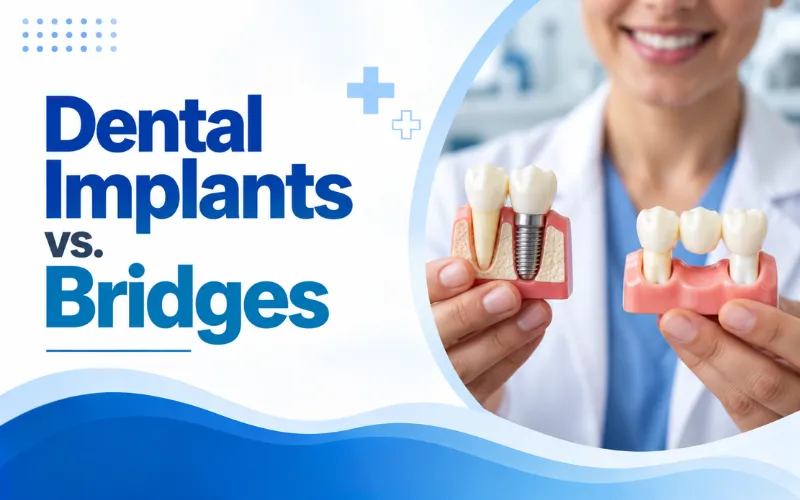
A dental bridge replaces a missing tooth by anchoring an artificial tooth to the two adjacent natural teeth, which are shaved down to support crowns on either side that hold the replacement tooth (pontic) in place between them. A dental implant, by contrast, places a titanium post directly into the jawbone, topped with a crown — it doesn’t rely on neighboring teeth at all, functioning instead like an artificial tooth root.
This structural difference is the root of nearly every durability and cost difference between the two, and understanding it makes the rest of the comparison much more intuitive rather than feeling like an arbitrary choice between two similar-sounding options.
The Longevity Difference
Dental implants, with good oral hygiene, commonly last 15-25 years or longer — often functioning as a lifetime solution for many patients, since the titanium post fuses directly with the jawbone through a process called osseointegration, creating a remarkably stable, long-term foundation. Bridges typically last 10-15 years before needing replacement, partly because the supporting teeth remain vulnerable to decay under the crowns, and partly because of the added structural stress placed on those anchor teeth over time.
Implants also preserve jawbone density by stimulating it like a natural tooth root through normal biting and chewing forces, while a missing tooth root under a bridge allows gradual bone loss underneath — a factor most patients don’t consider until a dentist explains it, but one that can subtly change facial structure and bite over many years if left unaddressed.
Weighing the Real Cost Over Time
Bridges usually cost less upfront, which makes them attractive initially — but factoring in one or two likely replacements over 20-30 years, the total lifetime cost frequently approaches or exceeds a single implant placed once and maintained with good hygiene. Implants cost more initially and require a healing period of a few months for the bone to integrate before the crown is placed, but rarely need replacement once successfully integrated.
For patients without adjacent healthy teeth needing crowns anyway, implants are usually the more conservative and cost-effective long-term choice — the calculation shifts somewhat if the adjacent teeth already require crowns for unrelated reasons, since a bridge could then address two needs with one procedure.
The Bone Preservation Factor Most Patients Overlook
Jawbone naturally remodels in response to the stimulation it receives from tooth roots during normal biting and chewing — when a tooth is lost and not replaced with an implant, the bone in that area gradually resorbs (shrinks) over time, a process that continues silently for years without symptoms. This bone loss can eventually affect the fit of a bridge, the appearance of the gum line, and even facial structure in cases of multiple missing teeth left unaddressed.
Implants are currently the only tooth-replacement option that meaningfully preserves this bone stimulation, which is a significant long-term consideration beyond simply replacing the visible missing tooth — particularly relevant for younger patients facing a multi-decade timeline ahead of them.
What the Implant Process Actually Involves Step by Step
The process begins with a consultation including imaging (often a 3D CT scan) to assess bone density and plan precise implant placement, followed by the surgical placement of the titanium post under local anesthesia. A healing period of roughly 3-6 months follows, allowing osseointegration to complete, before a custom-made crown is attached to the now-integrated implant.
For patients with insufficient bone density, a bone grafting procedure may be recommended beforehand to build up the area — an additional step that extends the timeline but is a well-established, routine part of implant dentistry for patients who need it, rather than a sign the implant approach isn’t suitable.
Making the Right Choice for Your Situation
A thorough dental evaluation — including imaging to assess bone density and the condition of adjacent teeth — is the only reliable way to determine which option genuinely fits a specific case, rather than a generic recommendation applied to every missing tooth. Patients with several missing teeth in a row, healthy adjacent teeth they’d prefer not to alter, or specific bone density considerations will each reasonably lean toward different solutions.
MediKaya’s partner dental centers provide this full evaluation, including 3D imaging where relevant, and a transparent breakdown of both options’ costs so patients can make an informed decision rather than defaulting to whichever option is presented first.
Caring for Implants and Bridges Long-Term
Both options require diligent oral hygiene to last their expected lifespan — implants need regular brushing, flossing (using specific implant-safe floss or interdental brushes around the post), and professional cleanings, since gum disease around an implant (peri-implantitis) can threaten its longevity much like gum disease threatens natural teeth. Bridges require careful cleaning underneath the pontic using floss threaders or specialized tools, since food debris trapped in this area is a common cause of decay in the supporting teeth.
Regular dental check-ups, typically every six months, allow early detection of any developing issues with either option, catching small problems before they become significant enough to threaten the restoration’s longevity.
What International Patients Should Plan For
For implant treatment specifically, the multi-month healing period between placement and final crown means international patients typically need at least two separate visits — one for placement and initial healing check, and a second, later visit for the final crown once osseointegration is confirmed through imaging. Some cases with excellent bone quality may qualify for immediate-loading protocols that shorten this timeline, though this depends on individual anatomy.
MediKaya coordinates this multi-stage process clearly from the outset, so patients understand the full timeline and number of visits required before committing to treatment, rather than discovering the need for a second trip partway through.
Frequently Asked Questions
Q. Is dental implant surgery painful?
The procedure is performed under local anesthesia and most patients report mild discomfort for a few days afterward, manageable with standard pain relief — not significantly more than a tooth extraction.
Q. How long does the full implant process take?
From placement to final crown, the process typically takes 3-6 months to allow proper bone integration (osseointegration), though some cases qualify for faster same-day or same-week protocols.
Q. Are bridges a better option for anyone specifically?
Bridges can be preferable when adjacent teeth already need crowns for other reasons, when bone density is insufficient for an implant without additional grafting, or when a faster, lower-cost solution is the priority.
Q. What does dental implant treatment in India typically cost compared with Western countries?
Dental implants in India are typically priced at a fraction of equivalent treatment in the US, UK, or Western Europe, using comparable implant brands and technology, through internationally accredited dental centers.
Q. What happens if there isn’t enough bone for an implant?
A bone grafting procedure can build up the area beforehand, extending the overall timeline but remaining a routine, well-established part of implant dentistry for patients who need it.
Q. Do implants really preserve jawbone better than bridges?
Yes — implants stimulate the jawbone similarly to a natural tooth root through biting forces, while a bridge does not, which means the bone underneath a bridge can gradually shrink over time.
КРАТКО НА РУССКОМ
Импланты обычно служат 15-25 лет и дольше благодаря сращению титанового штифта с костью челюсти (остеоинтеграции), тогда как мостовидные протезы служат 10-15 лет и требуют обточки соседних зубов, которые несут дополнительную нагрузку. Импланты также сохраняют плотность костной ткани, тогда как под мостом кость постепенно уменьшается — незаметно, но со временем влияя на прикус и форму лица. С учётом долгосрочной перспективы и возможной повторной установки моста имплант часто оказывается более выгодным решением. MediKaya Healthcare организует стоматологическое лечение в аккредитованных клиниках Индии для пациентов из СНГ по прозрачной стоимости, включая 3D-диагностику костной ткани.
Weighing implants vs. a bridge for your case? Get a free dental consultation and cost comparison.