

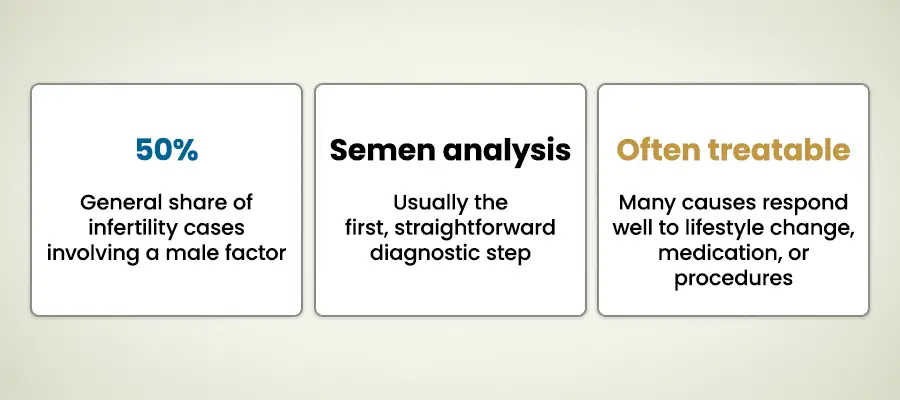
It’s common to put the female partner in the spotlight when talking or thinking about fertility, whether it’s in media or in the real world, including in early medical workups. However, men factor into about 50% of cases of infertility and are sometimes easier to diagnose.
When a couple is struggling to conceive, the first set of questions, from friends, relatives, and sometimes the first doctor, are directed at the woman. It needs to be said clearly, male factors are responsible for approximately 50% of the cases of infertility, either on their own or in conjunction with female factors. Starting an evaluation with only one of the partners is not only incomplete, it is also likely to take longer to identify the answer, which could have been easily determined at the beginning.
What male infertility actually means
When a man has biological factors that reduce the likelihood of conception, including low sperm count, sperm that don’t move normally, or abnormal sperm shape, this is referred to as male infertility. Some men are infertile because they don’t produce enough sperm or because their sperm doesn’t work normally. Fertility has nothing to do with a man’s general health, virility, or manliness. Male infertility is a medical condition, and the only way to know if you have it is to see a doctor. Frequently, male fertility problems cannot be diagnosed until a later age, when it is no longer useful to address the problem.
Common causes
| Category | Examples |
|---|---|
| Sperm production issues | Low sperm count, reduced motility, or abnormal shape, sometimes with no single identifiable cause, sometimes linked to hormonal or genetic factors |
| Structural or blockage issues | Blockages in the tubes that carry sperm, sometimes from infection, prior surgery, or a congenital condition |
| Hormonal factors | Hormone imbalances affecting the signals that drive sperm production |
| Lifestyle and environmental factors | Smoking, excessive alcohol, certain medications, prolonged heat exposure, and some occupational or environmental exposures |
What a diagnostic evaluation actually involves
1. Medical history and physical exam
A doctor reviews general health, prior surgeries or infections, medication use, and lifestyle factors, alongside a physical examination.
2. Semen analysis
A laboratory test measuring sperm count, motility, and morphology — usually the first and most informative test, sometimes repeated since results can vary between samples.
3. Hormone testing
Blood tests check hormone levels that regulate sperm production, helping identify hormonal causes if semen analysis results are abnormal.
4. Further testing if needed
Depending on initial findings, genetic testing, imaging, or other specialized tests may be recommended to pinpoint a specific cause.
Treatment options, broadly
- Lifestyle Changes: Address smoking, alcohol consumption, and other modifiable risk factors, where applicable
- Medication: For hormonal imbalance or infection-related fertility problems
- Surgery: For structural issues (obstruction) in the reproductive organs, where appropriate
- Assisted Reproductive Techniques: IUI, IVF, and ICSI, where a single sperm is injected into an egg, especially in the setting of extremely low or poorly moving sperm
The correct approach for men with infertility will largely depend on the result of the investigation. There is no single “male infertility treatment,” like there is not a single cause.
A note on this topic
A diagnosis of male infertility can carry a certain emotional weight tied up with unhelpful ideas about masculinity. Sometimes, a sense of self-worth is tied to being a provider. This reaction is understandable, but unfounded. A medical evaluation is needed to determine the next steps. If feeling better about the process would help, ask the clinic about counseling support before and/or after the medical evaluation. There are often support people to help provide emotional support as well as help with the logistics of the medical process.
What to expect at a first urology or fertility consultation
- A semen sample is typically required. Clinics will instruct on collection, including the need for a short period of abstinence.
- As results can vary from sample to sample, it is common to get more than one abnormal test before a conclusion is drawn.
- Being honest about lifestyle factors (i.e., alcohol use, smoking, and medication use) can help your doctor interpret results better.
- Ask your doctor what the results mean and what the next steps are likely to be. It’s reasonable to want this explained to you.
Frequently asked questions
Q: Does a low sperm count always mean infertility?
A: Many men who have low sperm counts are able to conceive naturally or with the help of treatments like ICSI, where very low sperm counts are considered.
Q: Should both partners be evaluated at the same time?
A: It is normally recommended to evaluate both partners at the same time to avoid delays in the process and to better understand the infertility problem at the initial evaluation rather than eliminating one partner and considering the other later on.
Q: Can I improve my fertility with lifestyle changes?
A: Yes, for some reasons like smoking, heavy alcohol use, and frequent exposure to high temperatures (like hot tubs) lifestyle changes are all that is needed to improve infertility in some individuals.
Q: Is male infertility always permanent?
A: Infertility can be due to reversible or irreversible causes. Some causes of male infertility are treatable, and pregnancy can be achieved after treatment.
Q: Can I get a consultation?
A: Yes, a consultation can be arranged. Our partners are able to provide no-cost consultations to discuss potential next steps.
Conclusion
Male infertility is common, and oftentimes, treatment is straightforward. These are three things that are rarely discussed when this topic arises casually. It is actually faster and more effective to start a fertility workup on both partners, as opposed to defaulting to the female partner, to get the real answers.