
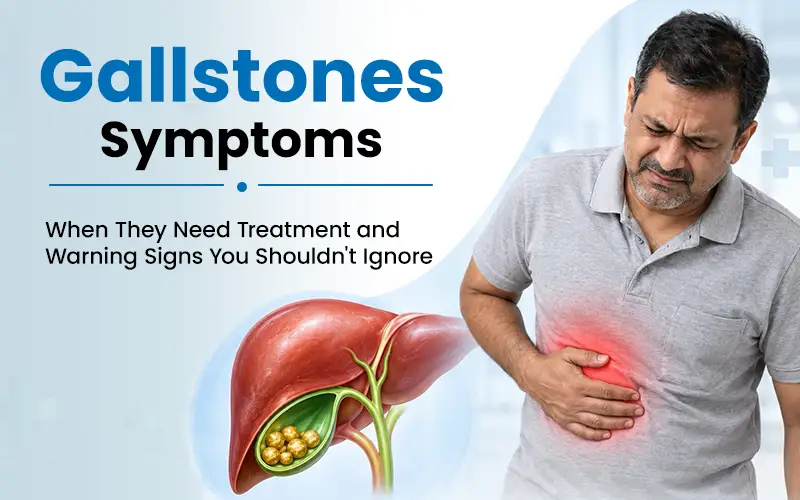
Most gallstones cause no symptoms and need no treatment at all. Pain that keeps coming back after eating is a different situation. Here is how to tell the difference and the specific gallstone symptoms and warning signs that mean it is time for care instead of another round of “wait and see.”
Gallstones are spots that usually form from cholesterol in the gallbladder. The gallbladder is an organ under the liver that stores bile, and this bile helps break down fat. A large number of people who have gallstones don’t even realize it. They find out by accident when they get imaging tests for something. Some people do have gallstones that cause pain over and over again. A few people end up with serious problems that need immediate medical attention.
Why gallstones form
Gallstones typically form when bile contains too much cholesterol or bilirubin relative to the substances that keep it dissolved, or when the gallbladder doesn’t empty completely or often enough. Several factors are associated with higher risk, including being female, being over 40, pregnancy, rapid weight loss, certain medications (including some hormone therapies), a family history of gallstones, and certain underlying medical conditions. These are population-level associations, not a diagnosis having one or more risk factors doesn’t mean gallstones are inevitable.
From “No Symptoms” to “Complication”: The Real Spectrum of Gallstone Disease
| Stage | What’s happening | Typical approach |
|---|---|---|
| Asymptomatic (silent) gallstones | Stones present, but causing no pain or complications — often found incidentally | Generally monitored rather than treated, in most patients |
| Biliary colic | Episodes of pain, usually after fatty meals, as a stone temporarily blocks bile flow | Surgery is commonly recommended once symptomatic episodes occur, to prevent recurrence and complications |
| Acute cholecystitis | Gallbladder inflammation, often from a persistently blocked stone, causing more severe, sustained pain — sometimes with fever | Typically needs prompt medical evaluation and often surgery during the same admission |
| Complications (blocked bile duct, pancreatitis, infection) | A stone migrates and blocks the bile duct or triggers pancreatic inflammation — more serious complications | Requires urgent treatment, sometimes including additional procedures beyond gallbladder removal alone |
What the diagnostic and treatment pathway looks like
- Evaluation of symptoms
A doctor reviews your pain pattern timing relative to meals, location, duration alongside a physical exam.
- Imaging
An abdominal ultrasound is typically the first and most informative test, confirming gallstones and assessing the gallbladder’s condition.
- Blood tests if indicated
If complications are suspected, blood tests can check for signs of infection, inflammation, or bile duct blockage.
- Treatment decision
Based on findings, the plan ranges from monitoring (for silent stones) to scheduled surgery (for recurring symptomatic episodes) to urgent treatment (for complications).
Warning signs that need urgent attention
- Severe abdominal pain that doesn’t ease after a few hours.
- Fever or chills alongside abdominal pain.
- Yellowing of the skin or eyes (jaundice).
- Persistent nausea or vomiting alongside abdominal pain.
- Dark urine or pale stools, which can indicate a blocked bile duct.
These are not “wait and see” symptoms
Unlike occasional mild discomfort after a heavy meal, the combination of fever, jaundice, or severe unrelenting pain can indicate a genuine complication — infection, a blocked bile duct, or pancreatitis — that needs prompt evaluation rather than a scheduled appointment next week.
Frequently asked questions
Q: Can gallstones be treated without surgery?
For some patients, medication that dissolves certain types of stones is an option, but this takes a long time and does not work for all types of stones or all patients. Surgery to remove the gallbladder is still the standard way to treat gallstones that keep coming back and cause symptoms, because it deals with the reason the stones keep appearing. A gastroenterologist can advise which approach suits your case.
Q: Can I live normally without a gallbladder?
Yes most people adjust well after gallbladder removal. Digestion usually keeps going because bile flows straight from the liver. Some people do feel a change in digestion especially when eating very fatty food and this can happen mainly during the first few weeks, after surgery.
Q: Is gallbladder removal a major surgery?
Most gallbladder removals today are done laparoscopically, which is an invasive way. This means the stay in the hospital is short. The recovery time is also shorter than with open-surgery methods. However, the exact way the surgery is done depends on each patients situation. It also depends on any complications that might happen.
Q: Will I develop gallstones again after treatment?
Once the gallbladder is removed, new gallstones can’t form in that spot because that’s where they usually develop. That’s why taking out the gallbladder is seen as a solution for people who keep getting symptomatic gallstones, not just a short-term fix.
Q: Can I get a consultation to discuss my symptoms?
Yes. Our partner gastroenterology specialists will gladly offer a no-obligation consultation to discuss your specific symptoms and guide you through the next steps.
Conclusion
Gallstones can be in different situations. From something that doesn’t cause any problems at all to something that causes pain again and again to sometimes a serious health problem. Finding out which situation you are in starts with watching the pattern of symptoms you have and knowing the exact signs that mean it’s time to stop ignoring them and go see a doctor.