
A true fair comparison, since if you do not see that we heard the other alternatives first, then you cannot believe our conclusion.
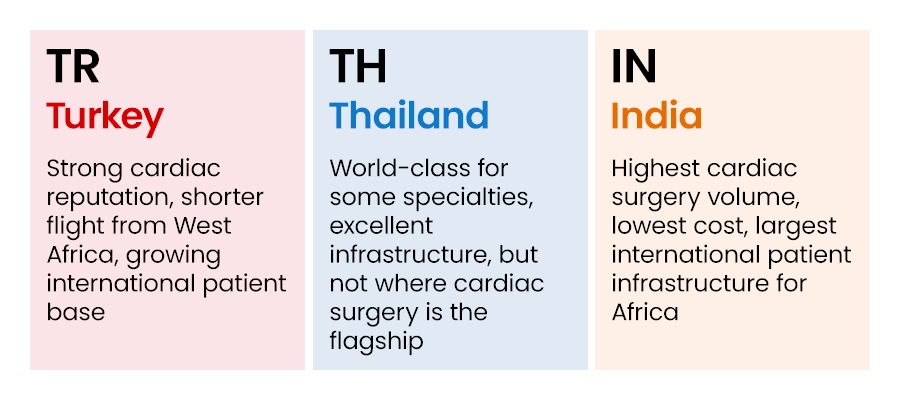
Three countries consistently come up in searches for heart surgery abroad: India, Turkey, and Thailand. All three have established robust medical tourism industries, all three have internationally accredited hospitals and all three have real success stories from international patients.
So, for an Africa-specific patient, who might be traveling from Nigeria, Kenya, Ghana, Uganda or any other African country — which would make the most sense for cardiac surgery?
In this comparison, we’re going to give Turkey and Thailand a fair hearing, since otherwise, it’s not worth reading. If India is declared a winner in the first paragraph, then don’t believe the conclusion.
How We Are Making This Comparison?
We will be measuring all three nations in relation to the same six indicators — otherwise it’s three competing marketing pitches:
- Accreditation quality and availability – number of cardiac hospitals accredited by the JCI and the quality of the accreditation.
- The number of cardiac surgical operations performed by the top hospitals each year.
- The full, transparent cost overview, including often-overlooked elements. The full, transparent overview of the cost, including the elements that are often overseen when comparing costs.
- Flight time and access from Africa, which is a very real practical consideration (and one not accounted for in most comparisons)
- Language and communication — both in the hospital and in the coordination process In terms of infrastructure, are you a novelty or do you have existing infrastructure in place in this country for African patients?
Flight Times from Africa — Why This Matters More Than You Think?
This is something that is virtually never pointed out when comparing countries from a Western point of view, but is actually important to African patients. A longer flight isn’t just a nuisance — if you are a cardiac patient who is travelling to and from a cardiac surgery during the process of recovery, or to and from a cardiac surgery centre after the procedure, flight duration is not just a practical consideration; it’s a medical one too.
| From | To Istanbul, Turkey | To Bangkok, Thailand | To Delhi/Mumbai, India |
|---|---|---|---|
| Lagos, Nigeria | ~6.5 hrs direct | ~12 hrs (1 stop) | ~9.5 hrs (1 stop) |
| Nairobi, Kenya | ~8 hrs (1 stop) | ~10 hrs (1 stop) | ~5 hrs direct |
| Accra, Ghana | ~7 hrs direct | ~13 hrs (1 stop) | ~10 hrs (1 stop) |
| Kampala, Uganda | ~8 hrs (1 stop) | ~11 hrs (1 stop) | ~4.5 hrs direct |
| Dar es Salaam, Tanzania | ~9 hrs (1 stop) | ~10 hrs (1 stop) | ~5 hrs direct |
| On-site inspection | Yes | Yes | Quality Council of India (India) |
| Lusaka, Zambia | ~10 hrs (1 stop) | ~13 hrs (2 stops) | ~7 hrs (1 stop) |
My honest confession: there’s a real flight-time advantage for the West African populace (Nigeria, Ghana, Liberia, Côte d’Ivoire) for Turkey. In the East African countries (Kenya, Uganda, Tanzania, Ethiopia) India’s flight time is shorter or similar. This must be considered a real factor and should be a serious one and not be ignored.
Turkey — The Real Case For It
In the last 20 years, Turkey has made high investments in health tourism. Several hospitals in Istanbul are JCI accredited and have a real capability of cardiac surgery. There is governmental support for medical tourism promotion and a well-developed infrastructure for medical tourism coordinators of European patients. Some of the infrastructure has now been replicated for African patients, especially for West Africans.
- Weaker winds in the Gulf of Guinea (Lagos, Accra, Abuja) region. Less wind in the Gulf of Guinea (Lagos, Accra, Abuja) areas 6-7 hours flight times to India instead of 9-10 hours.
- Multiple cardiac capable, and JCI accredited hospitals (Acibadem, Medical Park groups)
- European standards for quality — hospitals that attract patients from Germany, UK and the Gulf.
- For some African countries there is no visa requirement.
- Improving medical staff’s English language skills.
- Cost is significantly higher than India – usually 30-50% for similar cardiac procedures.
- Not as many cardiac-specialist hospitals as the best in India, with JCI accreditation.
- It is more difficult to understand medical English than in India because of the language barrier.
- In Africa, infrastructure for patient coordination is also thinner than in India.
- The number of cardiac surgeries performed in Turkish hospitals is generally less than the biggest hospitals in India.
The true answer about Turkey: it’s a legitimate choice, not a bad choice. The shorter flight may be a big advantage for a West African patient, in particular, perhaps an older patient or one with a high pre-surgical risk, and can be more than the cost is worth. One area in which Turkey is consistently outdone is in terms of price for similar quality, and in the coordination infrastructure in Africa.
Thailand — The Real Case For It
Thailand is not an exception as it has an honest reputation as a medical tourism destination, but not for cardiac surgery. Thailand is a leader in cosmetic surgery, dental care, orthopaedics and gender-affirming surgery. By any standards, Bumrungrad International Hospital is one of the best hospitals in Asia, located in Bangkok. Indeed, the fact that Thailand is a good place to visit for medical tourism doesn’t necessarily make it the best place to go for heart surgery.
- Bumrungrad Hospital is accredited by JCI and is highly recognised by the international community.
- Exceptional patient experience — hospitality infrastructure is world-class
- English is commonly used by the medical and service personnel.
- Excellent dental, cosmetics, orthopaedic skills.
Real Limitations
- The volume of cardiac surgery carried out at Thai hospitals is much less than that of the best cardiac centres in India.
- Flight from anywhere in Africa, will always involve an at least one stop and usually 11-13 hours flight time in total.
- For cardiac surgery, the costs are more expensive in India.
- Very limited patient coordination infrastructure specific to Africa
- The visa application to obtain a medical visa for African nationals may be complicated and variable.
The medical tourism business Thailand is known for is different from the one that I’m talking about here. The volume and cost disadvantages are important for heart surgery, in particular.
A particular mention should be paid to the surgical volume point. In cardiac surgery – where volume (one of the best predictors of outcome) makes a difference – the disparity between the top centres in India (several thousands cardiac procedures per year) and top cardiac hospital in Thailand is significant. Bumrungrad does not do cardiac surgery at the scale that achieves the outcome consistency benefits that the finest centres in India have developed.
India — The Real Case For It
Heart surgery in India isn’t just about scale, specialisation or cost, it’s about all three in India. None of the other countries in this comparison have all three of these things. But India has its own shortcomings and they must be recognised in a just assessment.
- Most cardiac surgery volume worldwide (excluding the USA) — ensures outcome uniformity due to real-world experience
- Lowest cost for equivalent quality – 30-50% lower than Turkey, lower than Thailand for cardiac
- In this comparison, most of the cardiac-specialist hospitals that are accredited by the JCI in any country.
- Best infrastructure to coordinate services on the African continent — providers such as MediKaya have managed thousands of African cardiac patients
- English as a professional language: not an accommodation, but the standard in medical system.
- East Africa is great for getting short flights with; Nairobi to Delhi is a direct 5 hour flight.
- This is because flights from Nigeria/Nigeria and Ghana/Ghana are longer than flights from Turkey, although both countries are in West Africa (9-10 hours compared to 6-7 hours from Turkey)
- Planning for the medical visa process is essential — but not difficult — it’s not something you can accomplish on a whim.
- The quality of hospitals varies widely in India – the highest level is excellent, but without guidance it is likely that the middle tier will be selected.
- Being away from home can be lonely for family members who are accompanying.
The Full Side-by-Side Comparison
| Criterion | 🇹🇷 Turkey | 🇹🇭 Thailand | 🇮🇳 India |
|---|---|---|---|
| JCI-accredited cardiac hospitals | Several Acibadem & Medical Park groups |
Limited Bumrungrad leads |
Most of any country Apollo, Medanta, Fortis Escorts, Max |
| Cardiac surgical volume (top hospitals) | Moderate Hundreds/yr at best centres |
Lower Not a volume cardiac centre |
Highest Thousands/yr at top centres |
| Cost (heart bypass, 3-vessel) | $7,000–$9,000 | $8,000–$12,000 | $4,500–$6,000 |
| Flight from West Africa (Lagos) | ~6.5 hrs direct | ~12 hrs, 1+ stops | ~9.5 hrs, 1 stop |
| Medical English quality | Good at top hospitals | Excellent | Excellent — standard language |
| Africa-specific coordinator ecosystem | Developing | Very limited | Deepest of three |
| Medical visa process (African patients) | Varies by nationality | Complex/inconsistent | Clear process, 3–7 days |
| Post-discharge record transfer (English) | Usually available | Excellent | Excellent — standard practice |
Real Cost Comparison — Including What Most Tables Leave Out?
Most comparisons of cost include only the price of the surgery package. When looking at African patients travelling internationally for treatment, there are a couple of other important factors:
- International flights are usually cheaper and more direct flights to Istanbul, from West Africa. The flights from East Africa to Delhi are both shorter and more affordable.
- Accommodation for companion – If family member is there, additional cost of accommodation for 3-4 weeks (regardless of country)
- Length of stay – cardiac surgery: all three countries advise that patients stay for 3–4 weeks after surgery before flying home. Therefore LOH costs are comparable in all three, with local accommodation values taken into account.
- Coordinator fees – This is a settled practice in India, and the coordinator fee is typically included in the package for African patients. In Turkey and Thailand, similar coordination for African patients can include an extra markup for coordination.
Adding all these up, India will come out on top in terms of cost. Lower surgery costs in India could be partly offset with higher flight costs in comparison to surgery packages, which would bring down the total-cost difference compared to a West African patient where flights are much cheaper.
What this means practically: For the patients of West Africa (Nigeria, Ghana, Liberia, Côte d’Ivoire) make a practical calculation of the total travel expenses for the whole trip to Turkey and India, not only the cost. Surgery package in India is 30 to 50 percent cheaper and return ticket from Lagos to Istanbul is $400-$600 as compared with $700-$1000 from Lagos to Delhi. There is still an advantage to surgery in most cases, but not so great as the surgery-only comparison would indicate, because the savings with the surgery do not necessarily offset the difference in flight.
The Africa Factor — What This Comparison Misses if You Are Not African?
The majority of the country-comparison articles available on the medical tourism website are written for patients from Europe, America or the Gulf regions. There are a number of unique factors that affect the comparison in African patients that are not covered by those articles:
Coordinator experience with African patients specifically
Indian medical tourism has developed authentic infrastructure for Africa, not for charity, but because Indian hospitals saw African patients as an important and expanding market. Those who have managed hundreds of cardiac patients from Nigeria, Kenya and Ghana have the experience and knowledge of how to handle the questions these families ask, the requirements for documentation with African embassies for insurance claims, the language dynamics that help earn trust from patients who have been burned by promises in the past and the realities of wire transfers from African bank accounts to Indian hospitals. This is not the case in Turkey or Thailand’s medical tourism industry. Yet.
Also Read: Heart Surgery in India: The Complete Guide for African Patients
The diaspora community factor
India has a large population of African students and business people in cities such as Delhi, Hyderabad and Bangalore. It’s not irrelevant when a patient is away from home for 3-4 weeks — having a community in which to receive informal care, understanding the local context, and simple human familiarity is an invaluable comfort to patients and families facing a daunting medical experience in an unfamiliar place.
Documentation and insurance compatibility
Indian hospitals have a vast experience in generating medical documentation in the format which can be accepted by insurance companies, embassies and health systems in Africa. This is an institutionalized skill that can’t be improvised — one that is important in practice when a patient comes home and requires records to be processed.
The Verdict — With the Honest Caveats
When it comes to cost, accredited cardiac hospital availability, surgical volume, infrastructure for supporting coordination for patients from Africa, and English-language medical capabilities, for most of the patients who travel to India for cardiac surgery, the country is a top choice.
Turkey is a valid option particularly for patients from West Africa where a quicker flight time really matters medically or practically and the patient or family can afford the 30-50% more expensive surgery. It is not a second best solution; it is another trade-off that is appropriate for certain patients.
The medical tourism reputation of Thailand is not quite accurate, but only as it applies to cardiac surgery — it’s because of a different set of procedures. If it’s a heart bypass or valve replacement, the lower cardiac volume, higher cost than Africa and longer flights from Africa makes it difficult to recommend it over either of the other two.
The first step before selecting a country is to obtain a written cost estimate and treatment plan from a hospital in that country, not just the coordinator’s word or a vague hospital treatment plan, but a written hospital treatment plan for your specific diagnosis. That document goes into more detail than any country comparison can.
Frequently Asked Questions
1. Is heart surgery in India safe for patients from Africa?
Yes. Many hospitals offering heart surgery in India are internationally accredited and perform thousands of cardiac procedures each year. Choosing an experienced hospital with a proven track record is the key to better outcomes.
2. Why do many African patients choose heart surgery in India instead of Turkey or Thailand?
Many patients prefer heart surgery in India because it combines advanced cardiac expertise, high surgical volumes, affordable treatment costs, and dedicated support services for international patients.
3. How much can I save on heart surgery in India?
Depending on the procedure, heart surgery in India can cost 30–50% less than similar treatments in Turkey or Thailand, while still offering internationally recognized standards of care.
4. How long should I stay in India after heart surgery?
Most patients are advised to stay in India for 3–4 weeks after surgery for follow-up appointments, recovery, and medical clearance before returning home.
5. What should I check before choosing a hospital for heart surgery in India?
Look for international accreditation, the hospital’s cardiac surgery experience, surgeon expertise, transparent treatment costs, and availability of support services such as visa assistance, interpreters, and patient coordinators.