
The first question every family asks — answered directly, with the data, the caveats, and the things most medical tourism sites won’t tell you.
When someone receives a cardiac diagnosis — bypass surgery, valve replacement, or a serious blockage — one of the first questions is whether safe, high-quality treatment is available at a lower cost. For many international patients, that search leads to Heart Surgery in India.
India is a name that comes up quickly. And almost as quickly, the doubt follows: but is it actually safe?
This article gives you the complete, honest answer to that question — not the version that glosses over legitimate concerns, and not the version that manufactures fear to keep you from exploring your options. The real answer, with the data that supports it.
The Direct Answer First
✓ The Evidence-Based Answer
Heart surgery is done in India to international standards, which are independently audited and verifiable in JCI accredited cardiac hospitals in India. The results of surgical procedures at the best cardiac centers in India are akin to that of the same procedures at similar cardiac centers in the West. Accreditation isn’t self-reported, but comes from the same organization that accredits American hospitals. The key factor is accreditation. Not every hospital in India has it and the distinction will make a huge difference.
What is important to say in that answer is what India is a nation of 1.4 billion people with thousands of hospitals some of which are world class and some of which are very unsafe. The question, “Is India safe for heart surgery?” is akin to asking, “Is the UK safe for heart surgery?” – it really depends on the hospital you’re referring to. The accreditation status of the particular hospital is the most crucial factor to take into account while answering the question.
The remainder of this article describes how to do just that—and what that data reveals of accredited cardiac hospitals, in particular.
What JCI Accreditation Actually Means — In Practice?
Our main guide introduced JCI briefly. We get a bit deeper here because knowing whether the accreditation is checking the security of a site or whether it’s just a marketing label makes all the difference.
The Joint Commission International is the international wing of The Joint Commission, which has been accrediting hospitals in the United States since 1951. JCI specifically inspects hospitals around the world to a set of standards that are in large part the same standards that US hospitals must meet in order to receive Medicare and Medicaid reimbursements the standards that are legally required of US hospitals.
The 1,000+ Standards: What Do They Actually Cover?
JCI’s International Patient Safety Goals, which make up the foundation of the audit, encompass six areas related to the most common causes of preventable harm in hospitals around the world.
01. Patient Identification- Strict measures to be sure that the correct patient receives the correct procedure, including wrong-patient surgical errors, among the most severe types of failures in a hospital system.
What the audit is NOT: JCI accreditation is NOT a paper review. Surveyors go to the hospital to see clinical practice in action, conduct interviews with those involved in clinical practice and review medical records, and test protocol knowledge in person. A hospital cannot show a “clean” policy document and be accredited if clinical practice isn’t either. Accreditation is also subject to renewal requirements — hospitals must submit new applications for accreditation and go through on-going re-survey. No hospital can achieve accreditation and maintain it forever.
JCI vs. NABH—What’s the Difference and Does It Matter?
Both accreditations appear frequently in descriptions of Indian hospitals. Here is what the distinction means practically:
| Feature | JCI | NABH |
|---|---|---|
| Administered by | Joint Commission International (USA) | Quality Council of India (India) |
| Standard basis | Equivalent to US Medicare hospital standards | ₹Equivalent to international standards, with Indian regulatory context |
| Recognised internationally by | ISQua, WHO, governments worldwide | ISQua, WHO, governments worldwide |
| Typical audit frequency | Every 3 years | Every 3 years |
| Cost of accreditation | Higher (partly why fewer hospitals hold it) | More accessible for Indian hospitals |
| On-site inspection | Yes | Yes |
| International patient focus | Explicit — International Patient Safety Goals | Implicit |
The honest answer is that both are credible accreditations. JCI is the higher international profile, and JCI accreditation is specifically designed with international patients in mind. For patients traveling from Africa, we would treat both as meaningful signals with JCI carrying slightly more weight purely because of its explicit international patient orientation. Either is vastly better than no accreditation at all.
Addressing the Real Fears Directly
The majority of the genuine concern over India for heart surgery is not regarding the theoretical matter of accreditation. It’s about very specific fears — that something will go wrong in a country they haven’t been to for a procedure that is critical. These are responses that need to be taken directly and not optimistically dismissed.
Surgical Volume and Why It Predicts Outcomes?
The relationship between surgical volume and outcomes is one of the most consistent findings in surgical quality research, replicated across procedure types, countries, and decades of data. The underlying mechanism is well understood: frequent repetition of a complex procedure builds technical skill in the surgical team, optimises the supporting processes around that procedure, and allows hospitals to accumulate the institutional knowledge to recognise and manage complications quickly.
Surgeons and hospitals that perform a high volume of a specific procedure consistently show better outcomes than those who perform it infrequently. This is true in the UK, the USA, and India equally.
India’s top cardiac hospitals operate at volumes that would be considered high by any global standard — driven by a combination of a large domestic population with high cardiovascular disease burden and a steady inflow of international patients. Medanta Heart Institute, Fortis Escorts Heart Institute, and Apollo New Delhi each perform several thousand cardiac procedures annually. This is not incidental — it is structurally a safety advantage.
For comparison: most regional UK hospitals perform 200–400 cardiac surgeries per year. Leading UK centres such as the Royal Brompton or Freeman Hospital perform 600–900. India’s top centres operate at volumes above these numbers — with the benefits that volume brings to outcome consistency.
What the Data Shows on Specific Outcomes?
Precise, independently published outcome statistics for specific hospitals are not always publicly available in India in the same standardised format as US or UK hospital report cards — this is a genuine limitation of the data landscape, and worth acknowledging honestly rather than glossing over.
What is available: Indian cardiac surgery outcomes are regularly published in peer-reviewed journals, showing mortality rates for bypass surgery (CABG) that are comparable to Western benchmarks. For elective, non-emergency CABG in good-health patients — the majority of international patient cases — in-hospital mortality at leading Indian centres is consistently below 1–2%, which aligns with published Western benchmarks for the same patient population and procedure type.
Important context: Mortality statistics for cardiac surgery are highly patient-dependent. A 65-year-old diabetic patient with reduced cardiac function has a materially different risk profile than a 45-year-old with isolated coronary artery disease. Any comparison of raw mortality rates without adjusting for patient risk is misleading — this applies to comparing hospitals in the same country, not just internationally. When evaluating specific outcome data, always ask whether the figures are risk-adjusted.
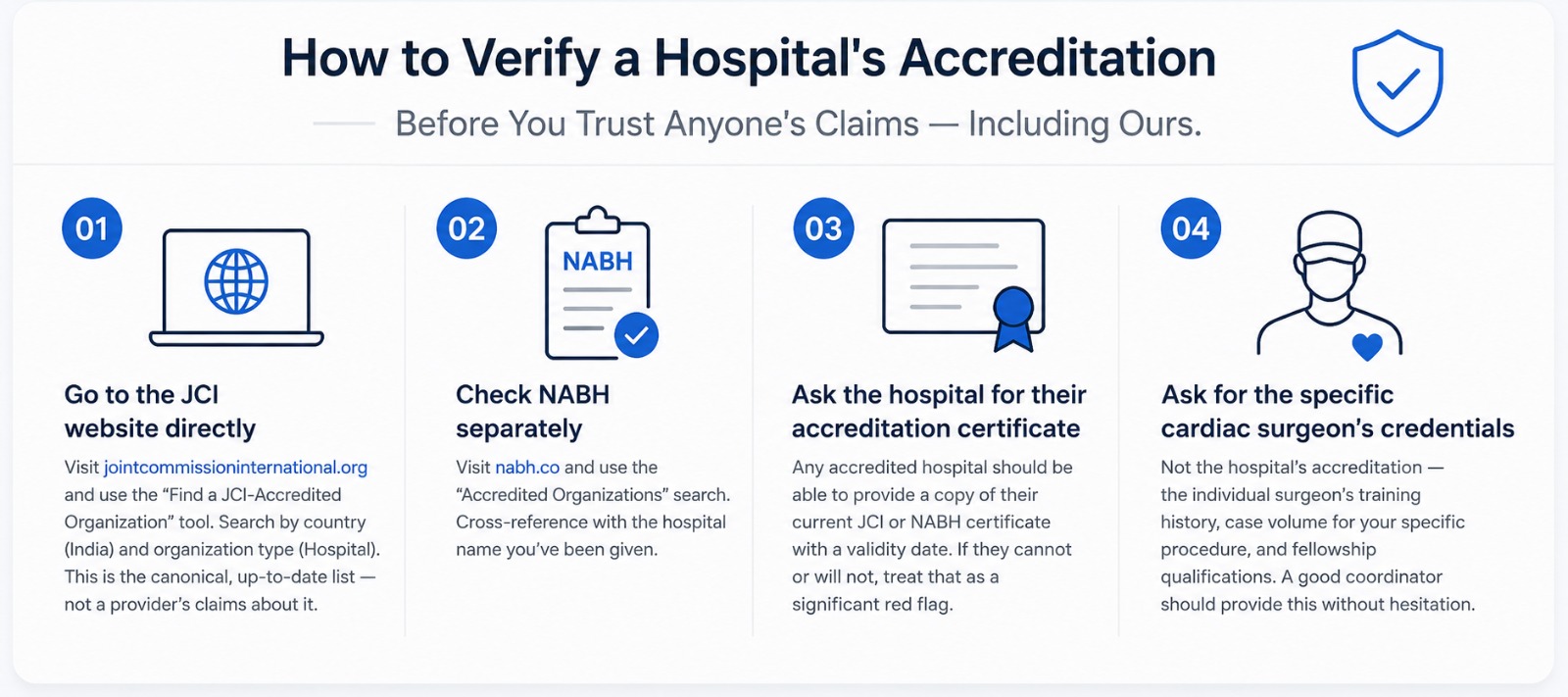
How to Verify a Hospital’s Accreditation — Before You Trust Anyone’s Claims?
Also Read: Best Hospitals in India for Cardiac Surgery
Red Flags — When to Walk Away
The cases where medical travel genuinely goes wrong almost always involve one or more of the following warning signs. Use these as a checklist against any provider or hospital you are considering:
- No verifiable accreditation. If a hospital or clinic is not on the JCI or NABH list, treat that as disqualifying for cardiac surgery — regardless of how professional the website looks or how reassuring the coordinator sounds.
- Refusing to provide itemised costs in writing. A legitimate provider issues a written, itemised treatment estimate before any payment. Verbal assurances about cost are not acceptable for a procedure of this magnitude.
- Pressure to book quickly. Any provider who creates artificial urgency around your booking decision — countdown timers on offers, pressure to pay a deposit before you’ve had time to verify the hospital — is not operating in your interest.
- No dedicated international patient coordinator. Hospitals that genuinely serve international patients have structured departments for this. “We can arrange everything” from a travel agency with no hospital relationship is not the same thing.
- Inability to provide the surgeon’s CV or case volume. If a coordinator cannot tell you how many procedures your specific surgeon has performed this year, something is wrong.
- No protocol for post-discharge care handoff. A reputable hospital sends you home with complete records in English and a clear plan for remote follow-up. If the conversation ends at discharge, the hospital is not designed for international patients.
Frequently Asked Questions
Is heart surgery in India really as safe as in the UK or USA?
Yes when performed at JCI or NABH-accredited hospitals with experienced cardiac teams, outcomes are comparable to international standards.
How can I verify if a hospital is genuinely accredited?
You can check the hospital’s accreditation status directly on the official JCI or NABH websites before making any decision.
Will I have access to Russian-speaking coordinators during my treatment?
Yes. Many leading hospitals and medical facilitators provide Russian-speaking coordinators to assist with consultations, hospital communication, appointments, and travel arrangements.
What happens if I face complications after surgery?
Accredited cardiac hospitals provide 24/7 ICU support and emergency care, along with post-discharge follow-up plans.
Should I choose a hospital based only on the lowest price?
No. Accreditation, surgeon experience, and hospital outcomes are far more important than cost alone.
Conclusion
The question “is heart surgery in India safe?” does not have a single yes-or-no answer—just as that question has no single answer about the UK, the USA, or any other country with a mix of hospital quality levels.
The right question is: is heart surgery at this specific JCI-accredited hospital, performed by this specific cardiac surgeon with this case volume, safe for my specific diagnosis? And to that question, the evidence independent accreditation data, peer-reviewed outcome publications, and the experience of thousands of international patients gives a consistent answer.
At JCI or NABH-accredited cardiac hospitals with dedicated international patient departments and high surgical volume, heart surgery in India is performed to internationally verified safety standards. The accreditation is independently audited, not self-reported. The fears around language, emergency care, anesthesia quality, and post-surgical follow-up all have specific, verifiable answers at hospitals that are genuinely designed to serve international patients. The risk of choosing on price alone without verifying accreditation is real which is why accreditation verification should always come before any other consideration.