
When your physician or loved one tells you or them, that you need heart surgery, you most likely have two fears: the heart surgery diagnosis and the cost of heart surgery treatment. This guide provides the fact, the real hospital, and the real process — so you can come to your own conclusion, one way or another — whether or not you ever speak with us at all.
📌Note: This is NOT a sales letter. The costs listed are approximate averages and do not represent a quote — ask for a written, detailed estimate of your diagnosis. This guide provides information only and should not be used as a substitute for consultation with medical practitioners.
Why India, and Why Now?
It’s not that the patients in India need cardiac surgery more than any other country in the world except the USA; it’s just that India has been making deliberate efforts over the past 20 years to develop a medical tourism system specifically for foreign patients. In hospitals such as Medanta, Apollo and Fortis Escorts, there are sections for the patients who speak neither Hindi and do not possess Indian Passport, who have never even stepped in the country.
For African patients specifically, India offers a combination that’s difficult to find anywhere else:
✓ JCI and NABH accreditation — the same international standard used by leading UK and US hospitals
✓ Internationally trained surgeons — many trained at institutions like Royal Brompton, London
✓ A fraction of the cost — typically 80–90% less than equivalent surgery in the US or UK
✓ No long waiting lists — most procedures scheduled within 1–3 weeks of diagnosis
None of this is an argument against India, or even the right choice for all. It indicates that it should not be overlooked, but taken seriously before a family enters into a treatment programme they are not able to afford.
Is Heart Surgery in India Actually Safe?
This is, understandably, the first and foremost question a patient and family will ask, and it must be answered, not marketed!
The short answer: at JCI-accredited hospitals, yes. India’s top cardiac centers operate at the same international safety standard as leading hospitals in Europe and North America. But accreditation matters enormously here, and not every hospital in India carries it.
What JCI Accreditation Actually Means?
Joint Commission International (JCI) is the accreditation body for hospitals in the United States. A JCI-accredited hospital is independently audited against over 1,000 specific quality and safety standards, including infection control, surgical site verification, medication error management and much more. It isn’t a marketing badge, it’s a third party clinical audit that’s repeated, rigorous.
In India, NABH (National Accreditation Board for Hospitals) is the local standard that is equivalent to JCI and is also implemented by the same hospitals.
📌When MediKaya refers a patient, we only work with JCI or NABH-accredited cardiac centers. This is non-negotiable — and it’s the single most important filter we’d encourage anyone to apply when researching any provider, not just us.
Success Rates and Surgical Volume
The outcomes of cardiac surgery vary significantly with surgical volume; the surgeon’s and hospital’s performance of a large number of a certain procedure is associated with measurably superior outcomes. It’s not just in India, but all over the world.
The biggest cardiac hospitals in India are involved in extremely high number of bypass surgeries, valve replacements, angioplasties and so on, catering to a huge domestic patient base and a continuous influx of patients from across the globe. This book is a major factor in the fact that outcomes in top cardiac centres in India are similar to what is observed in the top cardiac centres in the west for the same procedure.
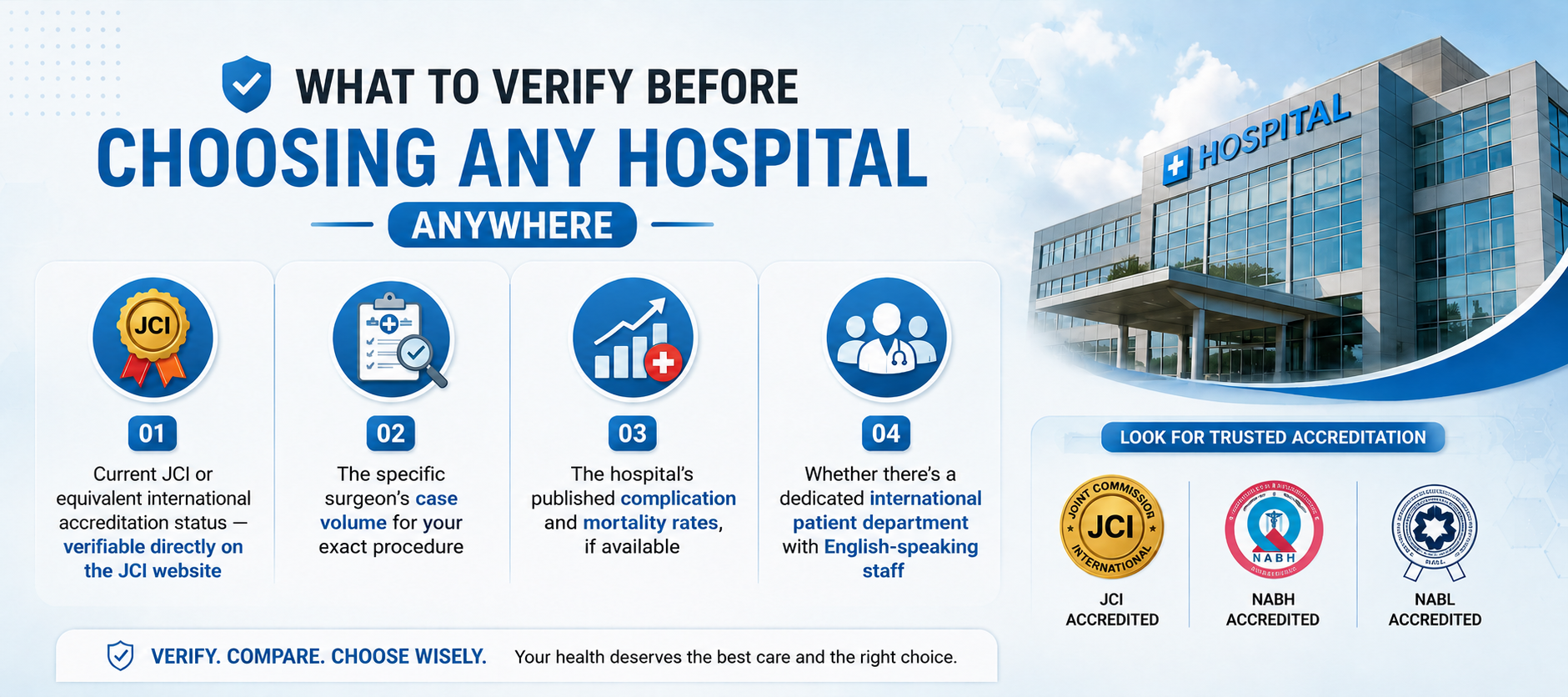
A credible provider will have no hesitation sharing this information.
How Much Does Heart Surgery Cost in India?
This is the number that changes everything for most families, so let’s be precise about it.
| Procedure | USA (avg.) | UK (avg.) | India (MediKaya network) | Savings |
|---|---|---|---|---|
| CABG — Bypass (1 vessel) | $35,000 | £25,000 | $4,000 | ~89% |
| CABG — Bypass (3 vessel) | $50,000 | £38,000 | $5,200 | ~90% |
| Angioplasty (1 stent) | $28,000 | £20,000 | $3,500 | ~88% |
| Heart Valve Replacement | $65,000 | £48,000 | $6,500 | ~90% |
| ASD / VSD Closure Surgery | $40,000 | £30,000 | $4,500 | ~89% |
| Diagnostic Angiography | $5,000 | £3,800 | $450 | ~91% |
Figures are illustrative averages based on commonly reported ranges — not a quote. Always request a written, itemized estimate based on your specific diagnosis before making any decision.
What’s Typically Included in an India Cardiac Surgery Package?
A well designed package — one that is coordinated by MediKaya Healthcare — should contain:
- The surgery itself, including the surgeon’s fee and anaesthesia
- ICU stay for post-operative monitoring
- Hospital ward stay during recovery
- Medications administered during the hospital stay
- Cardiac rehabilitation / physiotherapy sessions
- Follow-up consultations before discharge
It typically does not include international airfare, accommodation beyond the hospital stay, or a travel companion’s costs — though many coordinators, including MediKaya Healthcare, assist in arranging these separately.
Why Is It So Much Cheaper, Really?
That’s a good question and the truthful answer has nothing to do with cutting corners on safety:
- Reduced operating expenses – real estate, manpower, Hospital expenses etc. are just cheaper in India.
- No equivalent malpractice insurance burden — US healthcare costs in particular are heavily inflated by malpractice premiums that don’t exist at the same scale in India
- Government-subsidized medical education reduces the long-term cost structure of running a hospital
- High patient volume lets hospitals spread fixed costs across far more procedures per year
None of these factors reduce surgical quality. They reduce the cost structure surrounding the surgery — which is precisely why JCI accreditation matters so much as an independent quality check.
The Best Cardiac Hospitals in India for International Patients
This is detailed in our accompanying article — 7 JCI Accredited Cardiac Hospitals in India Ranked for International Patients — but, as a quick summary, the hospitals in the MediKaya Healthcare network include:
Medanta Heart Institute, Gurgaon
One of India’s highest-volume cardiac centers, JCI-accredited, performing thousands of cardiac surgeries annually with a dedicated international patient wing.
Apollo Hospitals, New Delhi
A pioneer of cardiac surgery in India, JCI and NABH accredited, with decades of experience treating international patients specifically.
Fortis Escorts Heart Institute, New Delhi
A hospital specializing exclusively in cardiac care, with over 50,000 cardiac surgeries performed historically and JCI accreditation.
Max Super Speciality Hospital, Delhi
Known for advanced robotic-assisted cardiac procedures, NABH and ISO certified.
Each of these hospitals maintains an international patient department specifically structured to support patients arriving from Africa, the Middle East, and elsewhere — including translation support, visa documentation assistance, and dedicated patient coordinators.
Also Read- Who Are India’s Most Trusted Heart Surgeons? Discover with MediKaya Healthcare
What Recovery Actually Looks Like, Week by Week
Knowing the realistic timeline matters enormously for planning — both for the patient and for any family member accompanying them. This is covered in full in Heart Surgery Recovery in India: What Actually Happens, Week by Week, but here is the high-level shape of it:
| Days 1–3 | ICU monitoring immediately following surgery |
| Days 4–7 | Transfer to a hospital ward, beginning light mobility and breathing exercises |
| Week 2 | Typical hospital discharge for straightforward cases, beginning outpatient physiotherapy |
| Weeks 3–4 | Continued recovery, usually still in India for follow-up monitoring before clearance to fly home |
| Months 2–3 | Continued recovery at home, with possible remote follow-up consultation with the Indian surgical team |
Total recommended time in India for most cardiac surgery patients is 3 to 4 weeks, accounting for pre-surgical assessment, the procedure itself, and sufficient recovery monitoring before international travel is medically advisable.
The Medical Visa Process — Step by Step
The complete document checklist is detailed in Indian Medical Visa for Heart Surgery: The Complete Document Checklist, but the overall stages of the process are as follows:
- Get a confirmed treatment plan from the receiving hospital, including a formal hospital invitation/recommendation letter — required for the visa application and cannot be skipped.
- Submit the medical visa application through India’s official visa channels, including the hospital letter, passport, photographs, and supporting financial documentation.
- Processing typically takes 3–7 working days for most African applicants, though this can vary by country and season.
- A companion visa can usually be arranged for one accompanying family member under the same medical visa category.
This entire process is one of the most common points of confusion and anxiety for first-time patients — and one of the clearest ways a coordinator (whether MediKaya or another provider) earns their value, by managing this paperwork correctly the first time.
What to Pack and Expect on Arrival?
Covered in complete detail in What to Pack and Expect on Arrival in Delhi for Heart Surgery, but in brief: most patients arrive into Delhi, are met at the airport by a coordinator, and are transported directly to accommodation near the treatment hospital. Pre-surgical tests typically begin within 24–48 hours of arrival, with the surgery itself scheduled shortly after, once the cardiac team confirms the patient is medically ready.
Frequently Asked Questions
Is it really safe to travel to India for heart surgery?
At JCI-accredited hospitals, yes — these hospitals meet the same international safety standards as leading hospitals in the UK and USA. The accreditation is independently audited and is the single most important factor to verify with any provider.
Will there be a language barrier?
At hospitals with dedicated international patient departments, no. Doctors and coordinating staff at these centers work in English as a standard part of their role treating international patients.
Can a family member come with me?
Yes. Most patients are advised to bring for Heart Surgery in India, at least one companion, and a companion visa can typically be arranged alongside the patient’s medical visa.
What happens if there’s a complication?
JCI-accredited hospitals maintain 24/7 ICU capacity and emergency protocols equivalent to Western hospital standards. This is part of what the accreditation specifically audits.
How do I get started?
Begin by having your existing diagnosis and any test results reviewed by a cardiac specialist — either through a provider like MediKaya, which offers this as a free second opinion, or independently. From there, a confirmed treatment plan and cost estimate can be issued before any travel commitment is made.
📌This guide is intended for general informational purposes and does not replace direct medical consultation. Costs referenced are illustrative averages and not a quotation. MediKaya Healthcare can be reached via WhatsApp for a free, no-obligation review of your specific diagnosis and an itemized treatment cost estimate.