
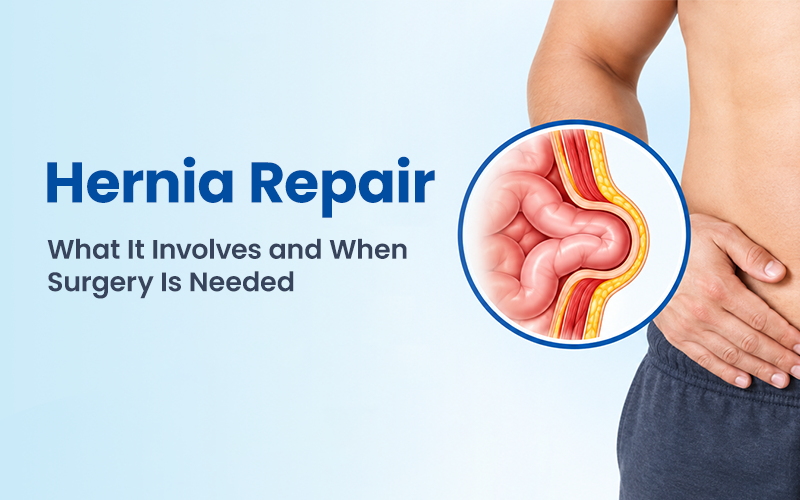
A hernia can be ignored easily because it may feel no pain for a time. A hernia will not disappear by itself, and a few hernias can turn into emergencies. Here is what you should know about the kinds of hernias, the warning signs of a hernia, and how a hernia can be repaired.
A hernia happens when part of an organ like the bowel or fatty tissue pushes through a spot in the muscle wall. This weak spot usually can’t hold the organ properly, so it bulges out. It’s a problem that can happen anywhere in the body, but most often, in the belly or groin area. You might notice a bulge, usually when you cough, strain, or lift something, and this bulge might go away when you lie down. Hernias don’t get better by themselves because the muscle wall doesn’t close on its own.
Common Types of Hernia and Their Symptoms
| Type | Where it appears | Notes |
|---|---|---|
| Inguinal | Groin | The most common type, more often seen in men |
| Umbilical | Around the belly button | Seen in adults and children; can be linked with pregnancy or weight gain |
| Incisional | Through a previous surgical scar | Can develop after abdominal surgery |
| Femoral | Upper thigh, near the groin | Less common, and more likely to need prompt treatment |
| Hiatal | Where the stomach meets the chest | Different from the others, and often managed for acid reflux first |

Does Every Hernia Require Surgery?
It does not always need to be done away. A small hernia that shows no symptoms may be watched over in some people after a talk about the risks of waiting. Surgery is usually advised if the hernia causes pain or discomfort, keeps getting bigger, interferes with life, or has a higher chance of problems. Because the decision depends on the type of your health, and, on your surgeon’s assessment, the decision is worth getting an explanation of the reasons.
Hernia Repair: What Does the Procedure Involve?
- Open repair: the surgeon works through one incision over the hernia and strengthens the weak area.
- Keyhole (laparoscopic) or robotic repair: several small incisions and a camera are used. Not every hernia or patient suits each approach.
- Mesh or stitches: a mesh is commonly used to reinforce the weak spot, though some smaller hernias are repaired with stitches alone. Ask your surgeon which is planned and why.
- Consultation and examination
The surgeon examines you and may order an ultrasound or scan, and reviews other conditions and medicines.
- Preparation
You are advised about fasting, medicines and stopping smoking, which helps healing.
- Surgery
Often performed under general or regional anesthesia, frequently as a day case for straightforward hernias, though this varies.
- Recovery
Some soreness and swelling are common. You will be told when to resume walking, driving, work, and lifting. Heavy lifting is usually restricted for a period set by your surgeon.
- Follow-up
Checks for healing and complications, such as infection or a lump returning.
Recurrence and complications
No operation is risk-free. A hernia can return, and complications can include infection, pain and problems related to the mesh. Ask your surgeon about the risks specific to your hernia and how they reduce them.
Questions to Ask Your Hernia Surgeon
Bring these to your consultation.
- What type of hernia do I have, and is it at risk of complications?
- Do I need surgery now, or can it be monitored safely?
- Which technique do you recommend, and why?
- Will a mesh be used, and what are the risks and benefits?
- When can I return to work, driving and exercise?
Frequently Asked Questions About Hernias
Q: Can a hernia go away on its own?
No. The weak spot in the muscle wall does not heal itself, though a small hernia may be monitored if it is not causing problems.
Q: Is hernia surgery major surgery?
Many repairs are routine and done as day cases, but it is still an operation under anaesthesia with real risks. Your surgeon will explain what applies to you.
Q: What causes a hernia?
A weakness in the muscle wall combined with pressure from straining, heavy lifting, coughing, pregnancy, obesity or previous surgery. Some people are born with a weak spot.
Q: Can I wear a belt or truss instead?
Some people use supports temporarily, but they do not repair the hernia. Ask your surgeon before relying on one.
Q: Can I get an opinion on my scan?
Yes. Our partner specialists can review your reports through a free, no-obligation second opinion.
Conclusion
A hernia is one of those problems that is easy to ignore until it is not. Get a lump checked, understand your options and the warning signs, and do not wait if the signs of an emergency appear.