
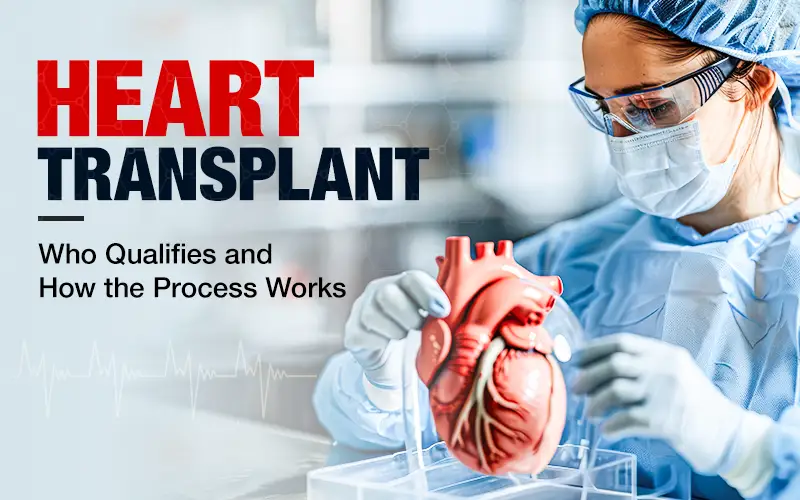
A heart transplant is not something you can just schedule. It is a journey: a detailed evaluation, a decision made by a team of experts, a wait for the right heart to become available, and a lifelong commitment after the surgery. Here is who might be eligible, what each step of the heart transplant process includes, and what international patients need to know before they start.
Heart failure means the heart is not able to pump blood enough to meet the body’s needs. It can be controlled for years using medicines, medical devices, and changes in lifestyle. Many people with heart failure never need a heart transplant. For a group the condition moves into advanced or end-stage heart failure, where symptoms such as breathlessness and exhaustion keep going even with the best treatment we have. For those patients, a heart transplant may be considered.
Who Is Eligible for a Heart Transplant?
Common underlying causes of heart failure include a weakened heart muscle, which is known as cardiomyopathy. Another cause is damage from heart attacks or coronary artery disease. Some cases also stem from heart conditions or problems, with the heart valves. . The diagnosis, by itself doesn’t make the decision. The transplant team asks three questions: is the transplant really needed will the patient probably get better and is the patient able to handle the things that come with it?
| The team assesses | Why it matters |
|---|---|
| Severity of heart failure and other options | Transplant is generally considered when medicines, devices and other treatments are no longer enough |
| Other organs (kidneys, lungs, liver) | The body must be able to cope with major surgery and long-term medication |
| Infection and cancer screening | Anti-rejection medicines suppress the immune system, so active infection or cancer must be addressed first |
| Blood group, tissue typing and antibodies | Used to match the patient with a compatible donor heart |
| Pressures in the lung circulation | Very high, fixed pressures can make a new heart struggle, which can change the plan |
| Support, understanding and ability to follow treatment | Success depends on taking medicines reliably and attending lifelong follow-up |
How the process works
- Referral and detailed evaluation
Tests of the heart, other organs and the immune match, plus assessments by the cardiology, surgical, nursing, social and psychological teams. This can take days to weeks.
- Team decision and listing
A multidisciplinary team decides whether you are a suitable candidate. If so, you are placed on the transplant waiting list under the rules that apply to the centre and the region.
- Waiting for a donor heart
Hearts come from deceased donors after brain-stem death. A heart cannot be donated by a living donor. Waiting time is unpredictable and depends on factors such as blood group, body size, urgency and donor availability. Medicines, close monitoring and sometimes a heart-support device are used while waiting.
- The call, and surgery
A donor heart can remain usable for only a limited time outside the body, so the call can come with very little notice, and the patient needs to be able to reach the hospital quickly. This is why many patients stay near the transplant centre while waiting.
- Intensive care and hospital recovery
After the operation, recovery starts in intensive care, then moves to a ward as the new heart settles and anti-rejection medicines are adjusted.
- Rehabilitation and lifelong follow-up
Frequent early check-ups, tests to look for rejection, a graded exercise programme, and regular reviews for life. This part continues long after leaving hospital.
What international patients should understand
Access to a deceased-donor heart is governed by national and regional allocation rules that are meant to be fair and transparent. These rules may differ for foreign nationals compared with citizens, so availability for international patients is not certain and must be confirmed with the transplant centre under the current rules. In addition, long-term follow-up must be arranged. After going home, you will need a local cardiologist or transplant group who can handle medications and check-ups while working together with the treating centre.
Life after a heart transplant
- Anti‑rejection medicines, for life are essential. These anti‑rejection medicines keep the system from attacking the new heart. You must take these anti‑rejection medicines exactly as prescribed. Do not stop taking these anti‑rejection medicines unless the transplant team says it is safe.
- Monitoring for rejection involves tests and check‑
- Infection risk: when the bodys ability to fight illness is intentionally reduced any signs of infection must be dealt with quickly. The medical team will go over steps to take to stay safe.
- Heart-healthy living involves eating a diet doing regular supervised exercise and not smoking.
- Many people go back to living lives but results are different, for everyone. The team can tell you what to expect in your situation.
A note on this topic
Facing the possibility of a transplant is emotionally heavy, for patients and families alike: uncertainty about the wait, the surgery and what comes after is normal. Transplant centres usually have counsellors and social workers for this reason. Asking for that support is part of good care, not a sign of weakness.
Questions to ask a transplant centre
- Do you accept international patients for heart transplant, and under what rules? Please confirm in writing.
- What does the evaluation involve, how long does it take, and what do I need to bring?
- If I am listed, how long might I need to stay near the centre, and what support is available while waiting?
- How does the centre handle follow-up after I return home, and what must my home doctors provide?
- What are the full costs and what happens if complications or rejection occur? Get this in writing.
Frequently asked questions
Q: Can a family member donate a heart to me?
No. Unlike a kidney or a part of a liver a heart cannot be donated by a living person. Hearts that are donated come from people who have died.
Q: Is an artificial heart or heart pump an alternative?
I have seen how mechanical support devices can help patients while they wait for a transplant, and sometimes a device can be used for treatment. Deciding if a device is right for a patient is up to a specialist.
Q: How long will I wait?
There is no general answer. The general answer changes depending on the blood group, body size, urgency, donor availability, and the rules of the system you are listed in. I have seen how the answer shifts when any of these factors change.
Q: What if I’m told I’m not a candidate?
Reasons matter a lot. Some issues can be treated. Criteria change from one center to another. Getting a second opinion can help clarify whether the decision is “not suitable” or “not yet” or if other treatments should come first.
Q: Can I get an opinion on my heart reports before deciding anything?
Yes. Our partner cardiology specialists will review your reports through a no-obligation second-opinion consultation. This will help you understand where you stand and what the options are.
Conclusion
A heart transplant is one of the most difficult treatments in medicine, and the strongest candidates are those who understand the path ahead before they start. If you or someone you love has heart failure, the smart first step is not to look for a date: it is to understand the diagnosis and the choices clearly, and to ask every centre the tough questions listed above.