
Every year, thousands of international patients from Turkmenistan and Uzbekistan, where transplant programmes are unknown or awaiting years for a transplant, as well as Zambia and Zimbabwe, where CKD is a heavy burden on health systems with little infrastructure for transplants, have opted for kidney transplant in India as their first choice. India carries out more than 10,000 kidney transplants every year, the highest number in Asia, and the country has a living donor programme which eliminates the years-long waiting lists for cadaveric transplants typically experienced in most of the world.
This detailed article explains everything an overseas patient needs to know about kidney transplant in India in 2026 – from knowing who needs it, a short glimpse into the living donor process, the cost of kidney transplantation in India, the hospitals offering kidney transplantation and how we process everything for our overseas patients with kidney transplantation at MediKaya Healthcare and what it’s like after the transplant.
Who Needs a Kidney Transplant? Understanding Chronic Kidney Disease?
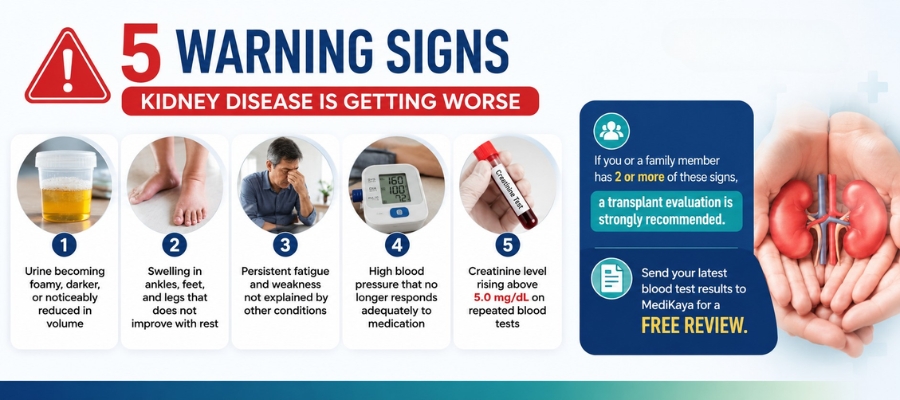
Chronic kidney disease (CKD) is an ongoing condition in which the kidneys slowly fail to work as they should. The stages of CKD are determined by the level of glomerular filtration rate (GFR) and there are five stages. Transplantation of a kidney is medically indicated at Stage 5 (also known as end-stage renal disease – ESRD or kidney failure) when the GFR level is below 15 mL/min/1.73m2.
It is at this point that the kidneys are no longer able to maintain life without medical help. There are two choices: dialysis, which treats the symptoms of kidney failure, and a kidney transplant, which is replacing the kidney with a functioning donor kidney and returns kidney function to near normal.
The 5 Stages of Chronic Kidney Disease
- Stage 1 — GFR above 90: Kidney damage with normal function. No symptoms. Monitor regularly.
- Stage 2 — GFR 60–89: Mild reduction in kidney function. No major symptoms.
- Stage 3 — GFR 30–59: Moderate reduction. Fatigue, fluid retention, mild anaemia may appear.
- Stage 4 — GFR 15–29: Severe reduction. Start transplant evaluation at this stage.
- Stage 5 — GFR below 15: Kidney failure. Dialysis or transplant required. URGENT.
Why Dialysis Is Not the Long-Term Answer?
Kidney failure can be lifesaving if treated with dialysis, which can be done at a dialysis centre (haemodialysis) or at home (peritoneal dialysis) three times a week. But, it is not a cure. Dialysis is able to control the symptoms of kidney failure, but it cannot perform all of the normal kidney functions.
Over time, most people and families of patients undergoing dialysis are aware of the serious risks and limitations of long-term dialysis:
- Cardiovascular disease: The risk for cardiovascular disease in dialysis patients is 10-20 times that of the general population.
- Anaemia: the kidneys make erythropoietin, which helps make red blood cells, dialysis cannot do this.
- Bone disease: disturbance of phosphate and calcium metabolism leads to a decrease in bone density in the long term.
- Quality of life: Dialysis (3 x per week for 4-5 hours) restricts daily activity, travel and work. Infections: dialysis access points (fistulas and catheters) are a regular risk of infection
Several studies have shown that kidney transplant offers a much longer life span than dialysis and that patients who have a successful transplant experience a markedly improved quality of life. The aim is to transplant as early as possible (when medically possible.
Kidney Transplant in India: Why International Patients Choose India?
India has the following characteristics that make it a suitable destination for foreign kidney transplant patients:
- Availability of Living Donor Transplant — No Years-Long Wait
While most Western countries have mostly deceased donor (cadaveric) waiting lists and patients stand for 5 to 10 years, India’s kidney transplantation programme is mainly of living donors, who are mostly close blood relatives. This is the fundamental reason why waiting time for kidney transplant in India is 6–10 weeks rather than years. One kidney is donated and surgery is scheduled for both the patient and the donor.
- Cost — Fraction of Western Countries
Kidney transplant in India costs $12,000–$18,000 depending on the hospital, compared to $60,000–$100,000 in Germany, $300,000+ in the USA, and $30,000–$50,000 in Turkey. This is the same JCI International standard of care and treatment that is 70-90% cheaper.
- Volume and Experience — 10,000+ Transplants Per Year
India surpassed 10,000 kidney transplants in 2024 — a national record and the highest volume in Asia. High-volume centres have lower complication rates and better outcomes than low-volume programmes. India’s leading transplant hospitals have decades of experience with complex cases including re-transplantation, sensitised patients, and haploidentical matching.
- Russian-Speaking and English-Speaking Coordinators
MediKaya Healthcare provides Russian-speaking coordinators for CIS patients and English-speaking coordinators for African patients. Each stage, from the report to visa application through to discharge, is dealt with by a dedicated coordinator who speaks the patient’s language.
Kidney Transplant Cost in India 2026 — Full Comparison
The cost of kidney transplant in India includes pre-operative workup for both patient and donor, compatibility testing, the surgical procedures for patient and donor, ICU stay, hospital stay during recovery, immunosuppressive medications for the first month, and the discharge summary. The following table reflects 2026 pricing at MediKaya Healthcare’s partner hospitals:
| Country / Hospital | Cost (USD) | Waiting Time | Donor Type | Standard |
|---|---|---|---|---|
| India — BLK-Max Super Speciality, Delhi | $12,000–$16,000 | 6–10 weeks | Living donor | JCI Accredited |
| India — Medanta Medicity, Gurugram | $14,000–$18,000 | 6–10 weeks | Living donor | JCI Accredited |
| India — Max Super Speciality, Saket Delhi | $13,000–$16,000 | 6–10 weeks | Living donor | JCI/NABH Accredited |
| Turkey — Istanbul | $25,000–$40,000 | 4–8 weeks | Living/Deceased | Some accreditation |
| Germany — Berlin/Munich | $60,000–$100,000 | Variable (6 months+) | Deceased priority | International standard |
| UAE / Saudi Arabia | $40,000–$70,000 | Variable | Deceased/Living | International |
| Uzbekistan — Private (limited availability) | $20,000–$50,000 | 6–24 months | Limited | Variable quality |
| Kazakhstan — Private | $30,000–$60,000 | 6–18 months | Limited | Variable quality |
| Turkmenistan | Not routinely available | N/A | N/A | No established programme |
Important note: The India cost stated above includes the full in-hospital package for both patient and donor. It does not include flights, accommodation outside the hospital, or medications required after the first month. MediKaya provides an itemised pre-departure cost estimate for every patient family before they commit.
Living Donor Kidney Transplant — The Complete Process
The kidney transplant programme in India is largely based on the principle of living donors, which is a member of the patient’s family who gives one of his/her two kidneys to the patient voluntarily. In this manner, the patient will not have to wait for a cadaver kidney and will receive a younger, healthier, pre-screened donor kidney with better long term outcomes.
Who Can Be a Living Kidney Donor?
- Biological relative: Spouse, parent, sibling, adult child, grandparent, aunt/uncle or cousin
- Able to use the internet and email, able to speak and write English, age 18-65 years, good general health two normal kidneys on imaging (CT renal angiography). No serious illnesses: no uncontrolled diabetes, hypertension or kidney disease BMI in general is under 35 No live infections or cancer. Donor willingness: independently evaluated by psychology
Blood Group and HLA Compatibility — What Patients Need to Know
To ensure proper compatibility, MediKaya provides donor families a preliminary blood group matching at any local lab before visiting India. Full HLA tissue typing and final cross matching is done upon arrival in India. Preliminary tests which takes 2-3 days to confirm, are used for the workup schedule and hospital admission dates by MediKaya.
- Compatible blood groups: O donor can donate to any patient (universal donor). Donor contributes to A or AB. B donor gives to B or AB. AB blood type can only receive from AB blood type.
- Desensitisation protocols for selected cases are available at Medanta and BLK-Max allowing for ABO incompatibility transplants.
Is Kidney Donation Safe for the Donor?
This is the number one question families ask — and the answer has always been and will always be reassuring. Living kidney donors have a perfectly normal life with one kidney. Over time, the remaining kidney becomes more functional to compensate for the loss of the other kidney, and over time the function can increase to about 70–75% total function. In fact, long-term follow-up of kidney donors — including the landmark Minnesota cohort study of donors that has followed donors for more than 40 years — has demonstrated that properly selected living kidney donors have life expectancy comparable to donors who are matched to receive a deceased donor kidney.
- Donor surgery is done laparoscopically (keyhole) and is a minimally invasive procedure, taking 2–3 hours.
- A donor will spend 3 to 5 days in the hospital.
- Return to normal activity: 4-6 weeks
- No special diet restrictions, other than kidney health advice (increased fluid intake, low protein).
- Recommended: yearly creatinine test at local lab. MediKaya offers life long support.
Top Hospitals for Kidney Transplant in India — MediKaya Aligned Hospitals
BLK-Max Super Speciality Hospital, New Delhi
BLK-Max is the main kidney transplant partner hospital of MediKaya Healthcare. The nephrology and transplant unit has carried out more than 500 kidney transplants and has one of the best outcomes database in India. The international patient wing is designed specifically for foreign patients and features a Russian language patient coordinator and family support for accompanying family members.
- 500+ kidney transplants performed
- Graft survival rate after 5 years: 92%
- Available living donor laparoscopic nephrectomy (donor surgery is minimally invasive)
- 24-hour transplant nephrology team on call
- JCI Accredited – international standard
- Russian-speaking coordinator: available
- All patients with medically complicated nephrology-related issues: nephrologist review within 48 hours of report submission.
Medanta Medicity, Gurugram
Medanta’s nephrology and transplant centre is one of the largest and the most experienced in India. The hospital conducts more than 200 kidney transplants each year and has vast experience in complex transplants such as ABO incompatible transplants, highly sensitised patients and paediatric kidney transplants.
- 200+ kidney transplants annually
- Capable of full haploidentical or ABO-incompatible transplantations
- A dedicated International Patient Centre with multilingual co-ordinators.
- Assisted donor nephrectomy using a robot available
- JCI Accredited
Max Super Speciality Hospital, Saket, New Delhi
Max Saket’s transplant programme encompasses both adult and paediatric kidney transplants, equipped with a skilled nephrology team. It is situated 15 minutes from Indira Gandhi International Airport which makes it an ideal option for patients who come by air from the countries of the CIS or from Africa.
- A full transplant programme for adults and paediatric patients
- Very convenient as 15 minutes to international airport for long-haul international patients.
- International patient coordinator is offered.
- JCI and NABH Accredited
Read More: Top 5 Kidney Transplant Hospitals In India
Step-by-Step Process: Kidney Transplant in India via MediKaya Healthcare
MediKaya Healthcare oversees your kidney transplant process right from the initial contact till 12 months after the transplant. This is what will happen:
- Please send patient & donor reports to MediKaya through WhatsApp (+91 9205491370). Patient creatinine and GFR, dialysis history, blood group are required. Donor: recent blood tests, blood group. There is a no charge assessment.
- MediKaya Healthcare’s transplant nephrologist does a thorough evaluation of both the patient and the donor within 48 hours and gives them a written recommendation and cost estimate.
- Initial blood group match approved. MediKaya Healthcare offers an initial HLA testing protocol: some testing can be done by a local laboratory prior to travel to India.
- Medical visa application started. MediKaya drafts the hospital invitation letter & supporting documentation. e-Medical Visa for patient + Medical Attendant Visa for donor and 1 accompanying family member – applied at the same time. Usually takes 3–5 business days for processing.
- Admission confirmed at BLK-Max, Medanta or Max Saket depending on patient’s clinical profile and availability.
- Arrive in Delhi. MediKaya also helps arrange for family members who are staying out of hospital and have to pick up from the airport and arranged their accommodation near to the hospital.
- Pre-transplant workup — patient: 7-10 days. Cardiac evaluation, chest xray, infectious disease screening, blood panel, urine culture, ultrasound kidneys. This workup is to verify surgical fitness.
- Pre-donation workup — donor: 5 – 7 days. CT renal angiography, complete kidney function test, 24 hour urine protein, psychological assessment (required by Indian law), general health assessment.
- HLA tissue typing and final crossmatch: 3 – 5 days. Negative = clear for transplant, confirmed by Crossmatch.
- Declaration of voluntary donation submitted to hospital ethics committee (mandatory as per the Indian transplant law in all the cases of living donors). This paperwork is coordinated by MediKaya.
- Surgery day: surgical procedures conducted by the same surgical team for patient and donor. The sequential and/or parallel operating theatres are for donor laparotomy and patient kidney implantation. Surgery estimated to last 4-6 hours.
- Post-operative: patient is transferred to the transplant ICU for 2-3 days. Awarded to the general ward, with the donor as the nominator.
- Daily monitoring of kidney function: creatinine & urine output. Target: Progressive decline towards normal range over 7-14 days.
- DThe discharge from the hospital occurs on day 4–5 after surgery. Donor can go home or be placed with patient’s family.
- Patient discharge: typically 3 weeks post-surgery when kidney function is stable and immunosuppression is optimised.
- Discharge planning: MediKaya offers full discharge pack: immunosuppression protocol, dietary guide, activity restrictions, monthly blood test schedule and signs of rejection to look out for.
- Creatinine and tacrolimus levels measured monthly at local laboratory at 12-month follow-up. Communication with the MediKaya Healthcare nephrologist by WhatsApp. Adjustments of doses from a distance.
Kidney Transplant for CIS Patients — What Makes India Different
The situation of kidney transplantation in the countries of origin (Turkmenistan, Uzbekistan, Kyrgyzstan, Kazakhstan and Tajikistan) is not so good: in some it is limited while in others it is not available. It helps to understand the context here which is why many patients with kidney transplant in India are the ones who come from CIS.
Turkmenistan
There is no active kidney transplantation programme in Turkeymenistan. Patients in ESRD and require a transplant do not have any surgical option in their local area. People have only one option – to either spend a huge amount of money in a third country for transplant surgery (Turkey / Germany) or to stay on dialysis for the rest of their lives. India offers the most convenient and economical route for the treatment of Turkmenistan patients and MediKaya has helped people from Ashgabat, Mary and Turkmenbashi make the entire journey.
Uzbekistan and Kyrgyzstan
There is limited kidney transplant capacity at state hospitals, with Uzbekistan and Kyrgyzstan each having a waiting list of 3–6 years. Private alternatives are available but not widely available and have poor quality as compared to local income. In addition, both countries have higher prevalence of hepatitis B infection (5-7% in Uzbekistan; 8%+ in Kyrgyzstan) which can lead to kidney disease as a complication of hepatitis B infection (nephropathy) thereby adding to the local burden of transplanters.
Kazakhstan
The transplant programme is not as well developed in other Central Asian states as in Kazakhstan, and waiting times in the public system are 2-5 years, whereas in a private system, the prices for a living donor transplant can be as high as $40,000 to $60,000. The offer of similar or better results in India with the timeline of 6-10 weeks at $12,000-$18,000 is an attractive alternative that more and more Kazakhstani families are opting for.
Kidney Transplant for Africa Patients — Zambia, Zimbabwe, and East Africa
In sub-Saharan Africa, chronic kidney disease and end-stage renal disease are a major and under-resourced disease burden. More than 2 million people in sub-Saharan Africa die each year of kidney failure, most of them never having received dialysis, or a transplant.
When transplant is a viable option and the family donor is willing, the most practical option remains for patients from Zambia, Zimbabwe, Uganda, Kenya, and Tanzania – India:
- Direct flights from Nairobi (4-5 hours), Lusaka via hub (c. 10 hours), Harare via hub.
- Patients from East and Southern Africa have no language barrier as they are assisted by English-speaking coordinators.
- English speaking coordinators without any language barrier for East and Southern Africa patients.
- The medical visa procedure for Africans is easy via e-Medical Visa for Indians.
- Cost $12,000–$18,000 — significantly lower than South Africa’s private transplant costs of $50,000–$80,000
MediKaya Healthcare has helped kidney transplant patients in Zambia, Uganda and Zimbabwe.
Life After Kidney Transplant — What to Expect
A successful kidney transplant is truly life-changing. Others who have been on dialysis months or years report a change from surviving to living. Knowing what life after transplant is like can help families plan for the long-term.
Immunosuppressive Medications — Lifelong Requirement
Kidney transplant patients must take immunosuppressive drugs for the rest of their lives to avoid rejection in which the immune system tries to attack the new kidney as though it were foreign to the body. All MediKaya partner hospitals use Tacrolimus (calcineurin inhibitor), Mycophenolate Mofetil (antimetabolite) and Prednisolone (corticosteroid) as a standard triple combination treatment. The dosage is adjusted, so as to decrease the risk of rejection and stabilize kidney function, over the first 6 to 12 months.
At discharge, MediKaya offers patients a comprehensive medication guide with the name of the medicines (generic and brand), dosage, tapering schedule, monitoring needs and information on how to obtain these medicines in the patient’s own country. Tacrolimus and Mycophenolate are produced and sold as generics in India by manufacturers and is available at a cost-effective price at the time of discharge from hospitals or from local pharmacies.
Monthly Monitoring — What Tests Are Needed
- Month 1–3: Weekly blood tests — creatinine, tacrolimus level, blood count, liver function
- Month 3–12: Every 2 weeks — creatinine, tacrolimus, blood count
- Year 1+: Monthly creatinine. Quarterly tacrolimus. Annual comprehensive nephrology review
All these tests can be done at any local laboratory. The results are communicated to MediKaya Healthcare’s nephrologist on WhatsApp, who guides on the adjustment of doses and any intervention that may be necessary. Routine monitoring is not required for return trip to India.
Long-Term Graft Survival — What the Data Shows
- 1-year graft survival (BLK-Max partner data): 96–98%
- 5-year graft survival: 88–92% (comparable to international standards)
- 10-year graft survival: 75–80%
These numbers reflect the performance of living donor transplants, the best of which consistently beat the performance of deceased donor transplants over the long-term. Beyond the surgery itself, the single most important determinant of good long term survival of the graft is regular medication compliance and monitoring. The programme at MediKaya Healthcare aims to provide just such consistency from their countries of origin to encourage international patients to follow this path one year on.
Also Read: How can you keep your kidney strong before and after medical treatment?
Medical Visa for Kidney Transplant — What MediKaya Healthcare Arranges?
The e-Medical Visa program is a medical travel-oriented initiative introduced by India.The e-Medical Visa program is one specially crafted for medical travel. MediKaya Healthcare takes care of all paperwork and application assistance for kidney transplant patients and donors.
- Hospital invitation letter: prepared by BLK-Max/Medanta/Max on MediKaya Healthcare’s request — ready in 2 business days
- e-Medical Visa (patient): applied online at indianvisaonline.gov.in — MediKaya Healthcare provides all supporting documents. Processing: 3–5 business days
- Medical Attendant Visa (donor): applied simultaneously with patient visa — same timeline
- Second Medical Attendant Visa (family member): up to 2 attendants permitted with e-Medical Visa
- Visa validity: 60 days, extendable if medical stay requires. 3 entries permitted.
- No government referral letter required — hospital invitation from partner hospital is sufficient
Frequently Asked Questions — Kidney Transplant India
Q: My creatinine is 8.5 mg/dL and I am on dialysis three times a week. Am I eligible for transplant?
A: Yes. Dialysis does not prevent you from being considered for a transplant. Eligibility depends on your overall health, heart condition, and fitness for surgery. Share your latest reports for a free 48-hour review by MediKaya Healthcare’s nephrologist.
Q: My wife wants to be my kidney donor. She is 48 years old and has slightly elevated blood pressure. Can she still donate?
A: Possibly. Mild, well-controlled blood pressure usually does not rule out donation. Her kidney function and overall health will need to be evaluated by the transplant team.
Q: How long will I need to stay in India for the kidney transplant?
A: Most patients stay in India for 3–4 weeks, including pre-transplant tests, surgery, and recovery. Donors generally stay for around 2 weeks.
Q: What happens if my body rejects the kidney?
A: Most early rejection episodes can be treated successfully with medications if detected early. Regular follow-up and monitoring are essential for long-term transplant success.
Q: Are the immunosuppressive medications available in my country (Turkmenistan/Uzbekistan/Zambia)?
A: Yes, most transplant medicines such as Tacrolimus and Mycophenolate are available in many countries. MediKaya also provides one month of medication and guidance for future supply.
Q: My creatinine is normal now but my doctor says I may need a transplant in 2–3 years. Should I start planning now?
A: Yes. Early planning helps identify donors, complete compatibility testing, and avoid delays when the transplant becomes necessary.
India performs over 10,000 kidney transplants every year, with treatment costs starting from $12,000–$18,000 — significantly lower than many international destinations.
For patients from Zambia, Zimbabwe, and across East Africa, India offers short waiting times, internationally accredited hospitals, and experienced transplant teams, helping patients move from dialysis to transplantation within weeks rather than years.
MediKaya Healthcare supports the entire journey — from free medical report review within 48 hours to visa assistance, airport pickup, and post-transplant follow-up care.
✅ 5-year transplant success rates of 88–92% in our partner hospitals.