
Quick answer:
Heart valve disease treatment in India includes monitoring, medication, valve repair, and surgical and catheter-based procedures like TAVI. The treatment option is decided based on the valve affected, the extent of the problem, and the general health of the patient. International patients can first seek an expert opinion on their echo report to plan their visit.
Key takeaways
- Heart valve disease means a valve is narrowed (stenosis) or leaking (regurgitation).
- An echocardiogram is the main test that confirms the diagnosis and severity.
- Mild disease is monitored; severe disease usually needs repair, replacement, or TAVI at the right time.
- The cost depends on the procedure, valve type, hospital, and length of stay.
- A free second opinion on your reports can be arranged before you travel.
What is heart valve disease?
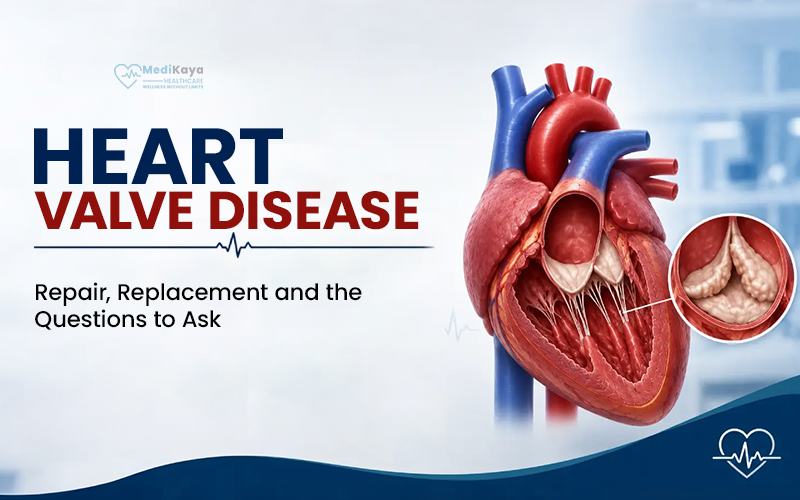
The heart has four valves: aortic, mitral, tricuspid, and pulmonary. Each works like a one-way door that keeps blood flowing in one direction.
Valve disease occurs when a valve does not open fully (stenosis) or does not close properly (regurgitation or leak). It may be present from birth or develop from age-related wear, past rheumatic fever, infection, or other heart disease.
The most commonly treated problems are aortic stenosis (a narrowed aortic valve) and mitral regurgitation (a leaking mitral valve). Which valve is involved changes the treatment plan, so the first step is always to identify it.
Heart valve disease symptoms
Common heart valve disease symptoms are breathlessness, tiredness, chest pain, dizziness or fainting, swollen ankles and palpitations. Some people have no symptoms for years, and a doctor finds a murmur by chance.
- Breathlessness, especially with activity or when lying flat
- Tiredness and reduced ability to exercise
- Chest pain or pressure
- Dizziness or fainting
- Swollen ankles
- Palpitations
Symptoms can build up slowly, so many people put them down to age or low fitness. Women in particular may notice different or milder signs; our guide on heart disease symptoms in women that are easy to miss explains more.
Seek emergency care if you have chest pain, fainting, sudden severe breathlessness, or fever with a known valve problem or prosthetic valve.
Echocardiogram for heart valve disease
An echocardiogram for heart valve disease is the main test. This ultrasound shows the valve structure, how severe the narrowing or leak is, and how well the heart is pumping.
An echo report usually describes the valve opening area, blood-flow pressure across the valve, the size of the heart chambers, and the pumping strength (ejection fraction). These are the numbers a specialist uses to grade the disease as mild, moderate, or severe.
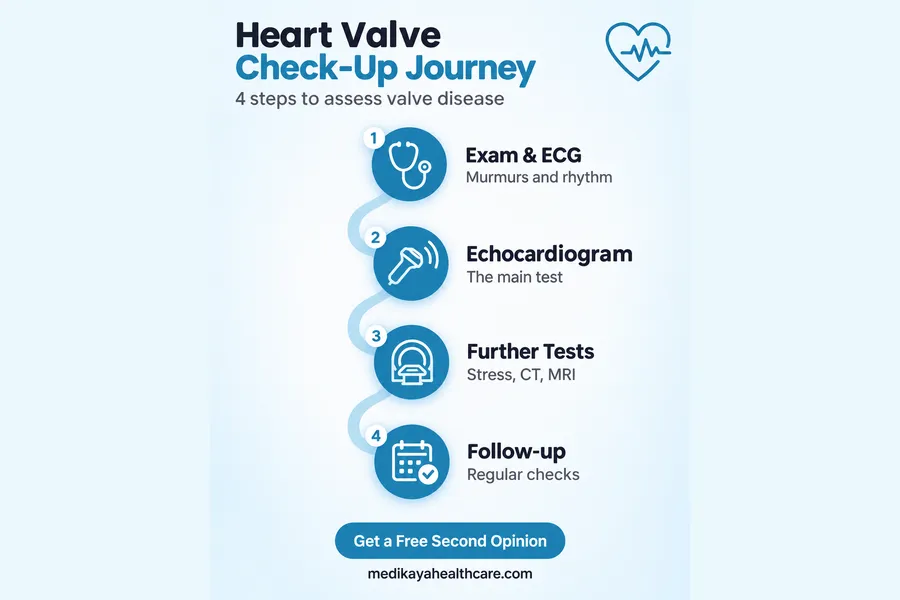
Diagnosis usually follows these steps:
- Examination and ECG: the doctor listens for murmurs and checks the heart rhythm.
- Echocardiogram: this confirms which valve is affected and how severe the problem is.
- Further tests: stress tests, CT, MRI, or angiography help plan treatment and check the coronary arteries.
- Follow-up: mild disease is monitored with regular checks.
Heart valve second opinion India
A heart valve second opinion India means a cardiology specialist reviews your echo report and test results. They confirm the diagnosis and say whether you need treatment now or monitoring.
MediKaya Healthcare’s partner cardiology specialists offer a free, no-obligation review of your echo report. International patients can upload their reports online and get an opinion before deciding on travel or surgery.
How the process works
- Upload your echo report, ECG, and any CT or angiography results.
- A cardiology specialist reviews them and confirms the diagnosis.
- You receive a written opinion on whether to monitor or treat, and which procedure suits you.
- If treatment is advised, MediKaya shortlists suitable hospitals and prepares a cost estimate for you.
Heart valve disease treatment options in India
| Option | What it involves |
| Medicines | They cannot fix a valve but can control symptoms, blood pressure, heart rhythm, or fluid. |
| Valve repair | The surgeon reshapes your own valve. This is often preferred for the mitral valve when possible. |
| Surgical replacement | The valve is replaced with a mechanical valve (usually needs lifelong blood thinners) or a tissue valve (may wear out sooner but often avoids long-term blood thinners). |
| Catheter-based procedures | A valve is replaced or repaired through a catheter, without open-heart surgery, in selected patients. |
Choosing the valve type: mechanical and tissue valves differ in durability, blood-thinner needs, and suitability for pregnancy and age. Ask your surgeon which suits your age, lifestyle, and plans.
When is treatment needed?
Doctors usually recommend a procedure when the disease is severe, when symptoms appear, or when the heart starts to enlarge or weaken even without clear symptoms. Timing matters, because waiting too long can reduce the heart’s pumping strength. For a detailed look at the surgery itself, read our guide to valve replacement surgery in India.
TAVI treatment in India
TAVI treatment in India (also called TAVR) is a catheter-based way to replace a narrowed aortic valve without open-heart surgery. It suits selected patients, depending on the valve and overall health. A heart team decides who is suitable.
TAVI versus surgical aortic valve replacement
| Point | TAVI | Surgical replacement |
| Approach | Catheter, usually through the groin | Open-heart surgery |
| Recovery | Often shorter hospital stay | Longer recovery; the breastbone needs weeks to heal. |
| Suits | Selected patients, often older or higher surgical risk | A wide range of patients, including younger people |
| Decided by | Heart team after CT and echo review | Heart team and surgeon |
Aortic valve replacement cost in India
The aortic valve replacement cost in India depends on the procedure (surgical or TAVI), the valve type, the hospital and room category, the length of stay, and any complications.
Factors that change the final estimate:
- Surgical replacement versus TAVI
- Mechanical valve versus tissue valve
- Hospital, city, and room category
- Pre-treatment tests and length of stay
- Follow-up care and medicines
| Procedure | Indicative range |
| Mechanical valve replacement (surgical) | about $3,500 – $7,000 |
| TAVI (transcatheter aortic valve implantation) | about $20,000 – $35,000 |
TAVI costs more mainly because the catheter valve device itself is expensive. These are estimates only; your final cost depends on your reports and the hospital chosen.
For a personalized estimate, share your reports with MediKaya Healthcare. We will match them with suitable hospitals and specialists. You can also read how to choose among the best hospitals in India for heart surgery.
Aortic valve replacement second opinion
An aortic valve replacement second opinion helps you confirm whether surgery is needed now, which procedure is suitable (surgery or TAVI), and which valve type fits you.
Share your echo report, CT or angiography results, and current medicines for review. You can also meet our cardiology specialists to understand who will review your case.
Recovery after heart valve treatment
Recovery depends on the procedure. After open-heart valve surgery, patients usually spend a day or more in intensive care and several days in the hospital. The breastbone typically takes around 6 to 8 weeks to heal, and full energy may take a few months to return. After TAVI, the hospital stay is often shorter, and many people get back to routine activities sooner.
Overseas patients are usually advised to stay in India for follow-up checks before flying home. Your surgeon will tell you when it is safe to travel. Lifelong follow-up with a cardiologist is needed after any valve procedure, and an echo is repeated at regular intervals.
Why international patients choose India for valve treatment
- Experienced cardiac surgery and interventional cardiology teams at leading hospitals
- Access to repair, surgical replacement, and TAVI in the same centers
- Treatment costs that are usually lower than in many Western countries
- Support with reports, hospital shortlisting, cost estimates, and travel planning through MediKaya Healthcare
Questions to ask your cardiologist
- Which valve is affected, and how severe is the problem?
- Do I need treatment now, or can it be monitored?
- Is repair possible, and what are the alternatives?
- Which valve type do you recommend, and why?
- What follow-up and medicines will I need afterwards?
Heart valve disease FAQs
Q. What is the best treatment for heart valve disease?
It depends on the valve and severity. Mild disease is monitored. Severe narrowing or leaks usually need repair, replacement, or a catheter-based procedure at the right time.
Q. Can a leaking heart valve be left alone?
Mild leaks are often just monitored. Severe leaks or narrowing usually need treatment.
Q. Will I need blood thinners after valve replacement?
Mechanical valves usually need them for life. Tissue valves may not. Your cardiologist will advise.
Q. Is TAVI treatment in India right for me?
It suits some patients, depending on the valve and overall health. The heart team decides.
Q. Can international patients get an echo report reviewed before travelling?
Yes. MediKaya’s partner cardiology specialists review reports through a free, no-obligation second opinion.
Q. Should I take antibiotics before dental work?
Some people with certain valve conditions or prosthetic valves are advised to. Ask your cardiologist and dentist.
Q. How much does aortic valve replacement cost in India?
The cost depends on whether you have surgery or TAVI, the valve type, the hospital, and the length of stay. TAVI usually costs more than surgical replacement because of the valve device. Share your reports with MediKaya Healthcare for a personalized estimate.
Q. What is the difference between TAVI and open-heart valve surgery?
TAVI replaces the aortic valve through a catheter without opening the chest, while surgery replaces it through an open-heart operation. TAVI suits selected patients, and the heart team decides which is safer for you.
Q. How long does recovery take after valve replacement?
Open heart surgery takes around 6-8 weeks for the breastbone to heal and up to 3 months to gain full energy. Recovery from TAVI is faster. Your surgeon will let you know when you can resume normal activities and travel.
Q. How long does a replacement heart valve last?
Mechanical valves last for the patient’s lifetime and require blood thinners. Tissue valves last longer than a decade and may require replacement. This is dependent on the patient’s age.
Q. Can heart valve disease be treated without open-heart surgery?
TAVI is a procedure used in selected patients to replace a valve without open heart surgery. Mild symptoms of heart valve disease can also be treated with medications.
Q. Which tests do I need before travelling to India for valve treatment?
Bring your recent Echo, ECG, angiograms and CT reports, if available, and a list of your medications. You may also bring reports from your previous tests if you have them.
Conclusion
Valve disease requires specific timing and an explanation you can understand. When considering heart valve disease treatment in India, first understand the severity and the rationale and plan for monitoring.
MediKaya Healthcare provides a free second opinion. You can upload your echo report and then compare your options. Once you have all the information you can make an informed decision regarding travel.