

The cornea is the clear window at the front of the eye. When it becomes scarred, swollen or misshapen, vision can fade. A cornea transplant in India replaces the damaged tissue with healthy donor tissue, and it is among the most commonly performed tissue transplants. Many international patients now choose corneal transplant surgery in India for experienced eye surgeons, established eye banking, and a far lower cost than in the US or UK.
The cornea is the transparent dome at the front of the eye. It focuses light and protects the eye. When it is damaged by disease, injury, infection, or inherited conditions, it can become cloudy or distorted, blurring vision. If glasses, lenses, and medicines cannot restore sight, a corneal transplant (keratoplasty) may be considered.
Who Needs a Cornea Transplant?
A cornea transplant is advised when the cornea is so scarred, swollen or misshapen that glasses, contact lenses and medicines can no longer give useful vision.
What conditions require corneal transplantation?
- Keratoconus, where the cornea thins and bulges outward
- Scarring from infection or injury
- Swelling and clouding, including Fuchs’ dystrophy
- Failure of a previous transplant
- Certain inherited corneal conditions
Types of Corneal Transplant Surgery in India
There are three main types: full-thickness (penetrating), deep anterior lamellar (DALK), and endothelial (DSAEK, DMEK). Your surgeon chooses based on which layer of the cornea is diseased.
| Type | What is replaced? |
| Full-thickness (penetrating) | All layers of the cornea |
| Deep anterior lamellar (DALK) | The front and middle layers, leaving the patient’s own innermost layer, in suitable conditions such as keratoconus |
| Endothelial (DSAEK, DMEK) | Only the thin inner layer, for conditions that cause the cornea to swell |
DALK vs DMEK vs DSAEK: What Is the Difference?
DALK replaces the front and middle layers of the cornea, while DSAEK and DMEK replace only the inner endothelial layer. DMEK uses a thinner graft than DSAEK, which generally means faster healing and better vision.
| DALK | DSAEK | DMEK | |
| Layer replaced | Front and middle layers (stroma) | Inner layer plus a thin portion of supporting tissue | Inner layer only (Descemet membrane and endothelium) |
| Commonly used for | Keratoconus, scars that do not reach the inner layer | Fuchs’ dystrophy, swelling after earlier surgery | Fuchs’ dystrophy and other inner-layer swelling |
| Patient’s own inner layer kept? | Yes | No | No |
| Graft thickness | Full front and middle layers | Thicker graft | Thinnest graft |
| Visual recovery | Gradual, can take many months | Faster than full-thickness | Often the fastest, with sharper vision |
Not every patient is suitable for every technique. Your eye surgeon decides after scans of your cornea, so ask which one fits your eye and why.
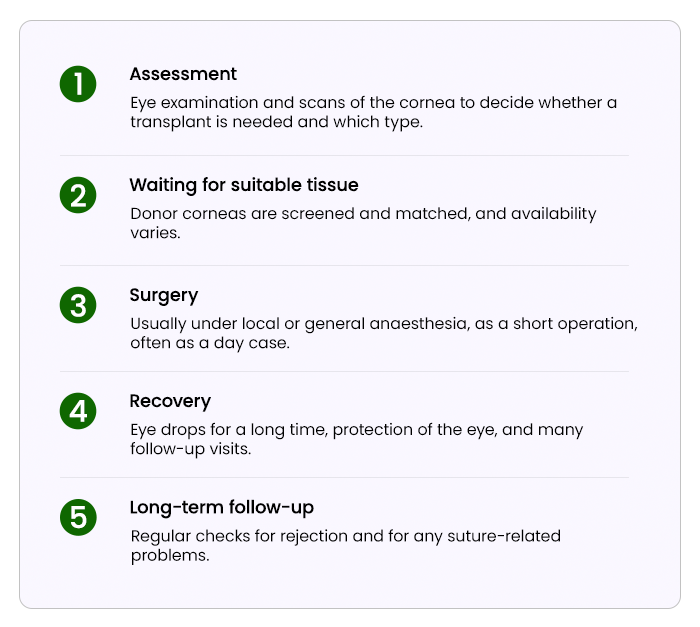
The Cornea Transplant Process
Assessment
Eye examination and scans of the cornea to decide whether a transplant is needed and which type.
Waiting for suitable tissue
Donor corneas are screened and matched, and availability varies.
Surgery
Usually under local or general anesthesia, as a short operation, often as a day case.
Recovery
Eye drops for a long time, protection of the eye, and many follow-up visits.
Long-term follow-up
Regular checks for rejection and for any suture-related problems.
How Long Does Recovery from a Cornea Transplant Take?
The first few weeks involve healing and regular eye drops, but full visual recovery can take several months to a year or more, depending on the type of transplant.
- First days: The eye is protected with a shield or patch, and some discomfort is normal.
- First weeks to months: Steroid and antibiotic drops are used on a strict schedule. Vision is often blurry and changes from week to week.
- Months to a year: Endothelial transplants (DSAEK, DMEK) usually recover faster. Full-thickness and DALK surgery may need more time, and stitches are removed gradually.
- Long term: Check-ups continue for years, because rejection can happen later.
Can vision return to normal after a cornea transplant?
Vision improves in most patients, and many see a big difference, but “normal” depends on your eye condition and on other eye problems such as glaucoma or retinal disease. Glasses or contact lenses are often still needed because the shape of the cornea changes. Final vision takes time, so ask your surgeon what realistic vision means for your eye.
Rejection can occur, and it can be treated if caught early.
Contact your eye doctor urgently if the eye becomes red, painful, or sensitive to light, or if vision suddenly worsens or blurs after a transplant. These can be signs of rejection, which needs prompt treatment, often with steroid drops.
What happens if a cornea transplant is rejected?
Rejection means the body’s immune system reacts against the donor tissue. If it is treated quickly with steroid drops, most rejection episodes can be controlled and the graft can often be saved. If treatment is delayed, the graft may fail and a repeat transplant may be needed.
Can a transplanted cornea be rejected years later?
Yes. Rejection can happen months or even many years after surgery, which is why regular follow-up and quick action on warning signs matter for life.
How Successful Is a Cornea Transplant?
Corneal transplants have high success rates worldwide, though the figure depends on the condition being treated and the technique used.
Medical references report that about 90% of full-thickness transplants are still clear at 5 years for conditions such as keratoconus, and around 97% of DALK grafts for keratoconus survive at 10 years. Endothelial transplants such as DSAEK show about 85% at 5 years in reference data. These figures come from international studies, not from a single hospital or country, and individual results depend on your eye condition, age, surgeon experience, and aftercare.
Which country is best for cornea transplant?
The best choice depends on the quality of the eye bank and surgeon, waiting time, and cost. India is a popular destination for international patients because of its experienced corneal surgeons, accredited eye hospitals, and treatment costs well below those in Western countries.
Cornea Transplant Cost in India
The cost of a cornea transplant in India depends mainly on the type of surgery, the hospital, and the city. Published estimates vary widely, from under USD 1,500 on some price-comparison sites to about USD 3,000 to 4,500 for all-inclusive international packages.
What affects the cornea transplant cost in India:
- Type of transplant: DALK, DSAEK, DMEK, full-thickness or artificial cornea
- Hospital and surgeon: accreditation, facilities, and surgeon experience
- City: Metro hospitals usually cost more
- Donor tissue: eye bank processing and quality checks
- Package inclusions: tests, medicines, hospital stay, follow-up visits, and coordinator support
- Complications: a longer stay or extra treatment can increase the final bill
Always ask for a written estimate that lists exactly what is included. You can also compare other treatment packages on our site. For a personalized quote based on your reports, use MediKaya’s medical tourism cost calculator or request a free cost estimate.
Which hospital is best for corneal transplant in India?
There is no single “best” hospital for everyone. Look for an accredited hospital with a dedicated cornea service, an eye bank, surgeons who regularly perform the specific type of transplant you need, and a clear follow-up plan for international patients. You can browse our partner ophthalmology specialists and partner hospitals. Many of our partners are JCI and NABH certified hospitals, and eye centers such as Centre for Sight Eye Hospital, Delhi are part of our network. Compare their experience before you decide.
Donation
Corneal donation is possible after death and gives others the chance of sight. Donation rules and eye banking arrangements differ between countries. If you wish to be a donor, tell your family and register according to local arrangements.
Questions for Your Eye Surgeon
Bring these to your consultation.
- What is wrong with my cornea, and are glasses, lenses, or other treatments suitable?
- Which type of transplant do you recommend, and why?
- What vision can I realistically expect, and when?
- What are the risks, including rejection?
- How long will I need drops and follow-up, and where will it take place?
- What is included in the quoted cost, and what is not?
Frequently Asked Questions About Cornea Transplant in India
Q: Is a cornea transplant painful?
Surgery is done under anesthesia. Some discomfort afterwards is common and treated with drops or medicines.
Q: Will I need glasses afterwards?
Often yes, or contact lenses, because the shape of the cornea changes. Final vision takes time.
Q: Can a transplanted cornea fail?
Yes. Rejection or other problems can occur, sometimes years later. Regular checks matter.
Q: Do the donor and recipient need to match?
Corneas are generally matched less strictly than other organs, but screening and quality checks are essential.
Q: How serious is a cornea transplant?
It is a major eye operation but a well-established one, and it is among the most commonly performed tissue transplants. The main risks are rejection, infection, raised eye pressure, and graft failure, which is why follow-up for years is part of the treatment.
Q: Does a cornea transplant require a donor?
Yes. The new cornea comes from a deceased donor through an eye bank, and it is tested for quality and safety before use. In rare cases where a donor cornea is not suitable, surgeons may discuss an artificial cornea (keratoprosthesis). Ask your hospital about their eye bank arrangements and the expected waiting time.
Q: How much does a cornea transplant cost in India?
The cost depends on the type of transplant, the hospital, the city and what the package includes. Ask for a written estimate listing every inclusion, or get a free cost estimate from MediKaya Healthcare.
Q: Can I get an opinion first?
Yes. Our partner ophthalmology specialists can review your reports through a free, no-obligation second opinion.
Conclusion
A cornea transplant in India can restore sight for many people, but it is a long relationship with your eye surgeon. Understand which type is being advised, what recovery requires, and the signs of rejection that need immediate attention. If you are an international patient considering treatment, send us your reports for a free second opinion and our team will guide you on specialists, estimated cost and travel planning. You can also read our medical visa guidelines for India and see how our treatment process works, or request a call back.