

The stages associated with many cancers are designed to measure how far the disease has progressed. Here’s a look at how the TNM staging system works and some considerations when treating patients with the same stage number associated with different cancers.
A stage is a description, not a prediction
It tells your care team how much of the body is involved right now. This is the single most useful fact for treating cancer.
One of the more common statements in oncology is “You have stage 2.” One of the less common statements is an explanation of what that means. Of course, an oncologist or cancer doctor will not give an explanation during the actual appointment. However, the more prepared patients are, the easier it is to be comfortable with everything else that follows.
A stage of cancer is not a percentage or a prognosis. It is not a time limit. It is a description of how much of the body a cancer involves. It is created in a way to give doctors a consistent way to communicate about treatment.
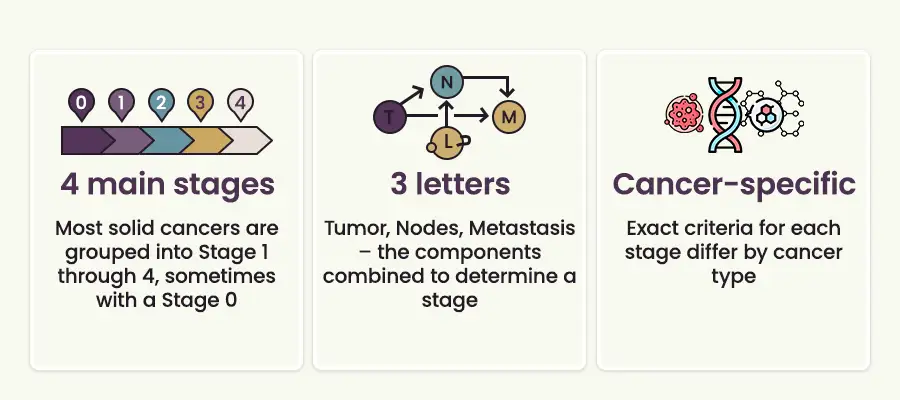
The TNM system: what’s actually being measured
Most solid tumors use the TNM framework for staging. The TNM framework is an internationally standardized cancer staging framework (formed by the American Joint Committee on Cancer and the Union for International Cancer Control, among others) that gets updated as new evidence is discovered. It considers three factors:
T: Tumor: The size of the primary tumor and, for some cancers, the amount of nearby tissue invasion, are typically scored T1 (smaller/less invasive) to T4 (larger/more invasive).
N: Nodes: The presence of cancer in local lymph nodes. Scored N0 (no spread) through N3 (spread to more nodes).
M: Metastasis: Whether cancer has spread to distant parts of the body. M0 means no distant spread found; M1 means it has spread.
These scores are combined (e.g. T2 N1 M0) and then a single overall group stage is assigned (a single number) which is the score most people will hear.
What Stage 1 through 4 broadly describes
| Guideline | Hypertension Defined From |
|---|---|
| Stage 0 | Abnormal cells are present but not yet behaving as invasive cancer (sometimes called “in situ”). Not used for every cancer type. |
| Stage 1 | A relatively small, localized tumor, generally without lymph node involvement. |
| Stage 2 | A larger tumor and/or limited spread to nearby lymph nodes, still localized to the region. |
| Stage 3 | More extensive local or regional spread often a larger tumor and/or more lymph nodes involved but not yet spread to distant organs. |
| Stage 4 | Cancer has spread to distant parts of the body (metastasized), such as the liver, lungs, or bones. |
Note: This is a general framework, not a lookup table. The exact T, N, and M values that define each stage number differ by cancer type. Stage 2 breast cancer and stage 2 lung cancer are not measured the same way.
How a stage is actually determined
-
- Imaging
Scans (CT, MRI, PET, ultrasound, or others depending on the cancer type) assess tumor size and look for spread to nearby structures or distant organs. The kind of detailed diagnostic workup offered at specialized centers such as Apollo Athenaa Women’s Cancer Centre. - Biopsy and pathology
Tissue samples confirm the cancer type and grade, and biopsy of nearby lymph nodes (sometimes during surgery) checks for microscopic spread that imaging alone can miss. Oncologists reviewing international cases typically ask for these pathology and PET-CT reports as the starting point for any review. - Additional testing where relevant
Blood tests, molecular or genetic testing of the tumor, and further scans may be added depending on the specific cancer to complete the picture. - Combining into a stage
The T, N, and M findings are combined according to that cancer type’s specific staging rules to arrive at the overall stage, which then informs the treatment plan. - Sometimes restaged
If surgery reveals more (or less) than imaging suggested, the stage can be revised. This is a normal part of refining the treatment plan, not a sign something was done wrong earlier.
- Imaging
What staging is used for
- Treatment is planned according to the stage of disease. An early stage could be treated with surgery only. A later stage might require surgery along with chemotherapy, radiation, and other systemic treatment care that is typically coordinated by a medical and radiation oncology team working across specialties.
- Outcomes are assessed based on large patient groups to study the effects of various treatment modalities. Researchers use stages to enable comparison of treatment effects across studies and facilities.
- Framing the discussion: The stage, along with the type of cancer, grade of the cancer, patients’ overall health, and biology of the cancer, is discussed. However, the stage doesn’t command the discussion on its own. This helps explain the treatment plan to the patient.
Questions worth asking after a staging result
- What specific T, N and M findings led to this stage?
- How does this stage specifically shape the treatment options being recommended?
- Is any further testing needed to confirm or refine the stage before treatment begins?
- Are there other factors tumor grade, genetic markers, overall health that matter as much as the stage number itself?
- Would a second opinion on the staging or treatment plan be reasonable at this point?
Frequently asked questions
Q: Does a higher stage always mean a worse outlook?
There are several factors other than stage that affect outlook, such as the type of cancer, the biology of the tumor, how the cancer responds to treatment, and the overall health of the individual. This means that it is not a single number prediction.
Q: Can a stage change after treatment starts?
The original stage at diagnosis is usually recorded as the reference point, but doctors keep track of the response to treatment. The assessment of response to treatment is distinct from that of the original stage.
Q: Is staging the same as grading?
No — staging describes size and the spread of the cancer. Grading describes how abnormal the cancer cells look compared to normal cells. This helps to determine how aggressively the cancer may behave. Both help provide the whole picture, however they are describing different things.
Q: Why did my stage change between the initial estimate and after surgery?
Imaging before surgery gives an estimate. Surgery and pathology give the complete picture, since the tissues can be directly examined. It is usual and expected to refine the stage at this point. This should not be a cause for concern to assume there was a mistake made earlier.
Q: Can I get a second opinion on my staging or treatment plan?
Yes, our partner oncology experts offer free, no-obligation second opinions, often reviewed as part of a multidisciplinary tumor board discussion. This can be very helpful in confirming a staging and treatment plan before major decisions.
Conclusion
A stage number is one of the most information-dense parts of a cancer diagnosis. Often, figuring out what stage your cancer is at requires a system of measurements and rules to guide the next steps. Stage numbers aren’t a verdict and can’t be compared across different types of cancers. This can make it difficult to understand a number that is often the first step in feeling less lost when dealing with a new and difficult-to-understand cancer diagnosis.